Mawsim al-Nabi Musa
موسم النبي موسى
The week-long season of pilgrimage from Jerusalem to the shrine near Jericho — prayers, drums, banners and dancing — that became, under the Mandate, a Palestinian political gathering.
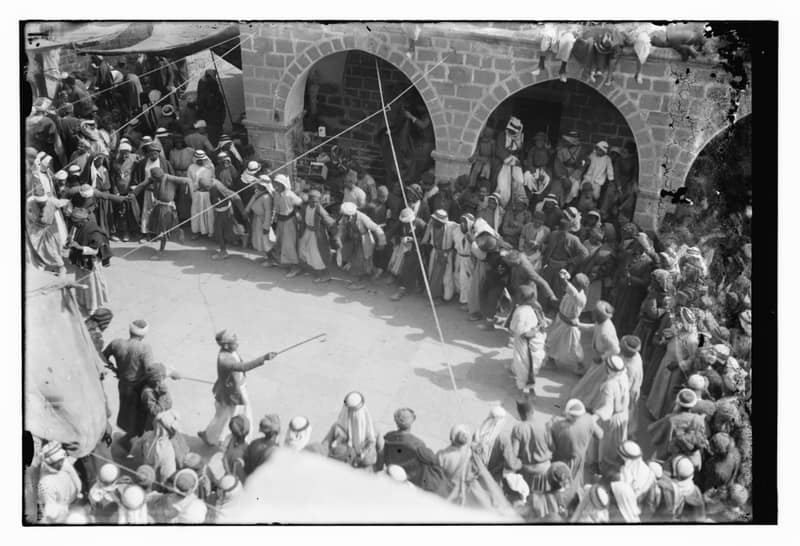
Each year in the week before Easter, Palestinian Muslims walked out of Jerusalem toward a shrine in the desert twenty kilometres east, near Jericho, which local tradition holds to be the tomb of Moses. The week was called mawsim al-Nabi Musa — the season of the Prophet Moses — and it was one of several such seasons in the Palestinian calendar, alongside mawsim al-Nabi Rubin at Jaffa, mawsim al-Nabi Salih at Ramla, and al-Mintar at Gaza.
It was not only a pilgrimage. Days before the walk, Hebron and Nablus sent their own banners to Jerusalem with bands of drums and cymbals; bearers assembled in the compound of the Dome of the Rock; and the week itself, in the account given by the Institute for Palestine Studies’ Jerusalem Story, was made of “prayers, music, dancing, and communal meals.” The shrine’s rituals included dhikr, chanted eulogies, and the playing of drums, cymbals and tambourines. The crowd was villagers, Bedouin, townspeople, scholars, Sufis and notables together.
The timing — the Muslim season set against the Orthodox Easter, in a city filling with Christian pilgrims — was itself the point of the thing, and by the late Ottoman period the municipal council in Jerusalem was organising and funding it. Under the British Mandate the season became one of the largest annual Palestinian gatherings in the country, and the distinction between a procession and a demonstration stopped being a useful one. That ambiguity is legible in the archives themselves: the Library of Congress holds a Matson negative titled Peasants dancing before the Tomb of Moses, and on the negative’s own sleeve someone had written Arab protest demonstration.
Sources
Connected in the archive
7 connected records7 records elsewhere in the archive are linked to this one, each by a piece of evidence you can read below.
set here — 4 records
- Hebronالخليل
Evidence — From a recorded field in this archive: places: "Hebron" → Hebron
- Jerichoأريحا
Evidence — From a recorded field in this archive: places: "Jericho" → Jericho
- Jerusalemالقدس
Evidence — From a recorded field in this archive: places: "Jerusalem" → Jerusalem
- Nablusنابلس
Evidence — From a recorded field in this archive: places: "Nablus" → Nablus
on a related subject — 3 records
Filed near each other — the same Mandate district, or the same uncommon subject tags.
- Bethlehem Mother-of-Pearl
Evidence — Inferred from the text — read the evidence: Shared tag: "pilgrimage".
- Dabke
Evidence — Inferred from the text — read the evidence: Shared tag: "dance".
- El-Funoun Palestinian Popular Dance Troupe
Evidence — Inferred from the text — read the evidence: Shared tag: "dance".
Cite this page
Every claim above carries its sources — citation is the point.
- Chicago
“Mawsim al-Nabi Musa.” Culture, FALASTEEN.AI. Accessed 22 August 2026. https://falasteen.ai/culture/mawsim-al-nabi-musa.- MLA
“Mawsim al-Nabi Musa.” Culture, FALASTEEN.AI, 2026, https://falasteen.ai/culture/mawsim-al-nabi-musa. Accessed 22 August 2026.- BibTeX
@misc{falasteen-mawsim-al-nabi-musa,
  title        = {Mawsim al-Nabi Musa},
  howpublished = {\url{https://falasteen.ai/culture/mawsim-al-nabi-musa}},
  organization = {FALASTEEN.AI — A Living Archive for Palestine},
  year         = {2026},
  note         = {Accessed 2026-08-22}
}