Jericho
أريحا
Jericho — Ariha, the city of palms, some 250 metres below the sea — has lived beside its spring for roughly ten thousand years, longer perhaps than any city on earth. In living memory its valley twice filled with refugees; the camps of 1948, Aqabat Jabr and Ein as-Sultan, are still there.
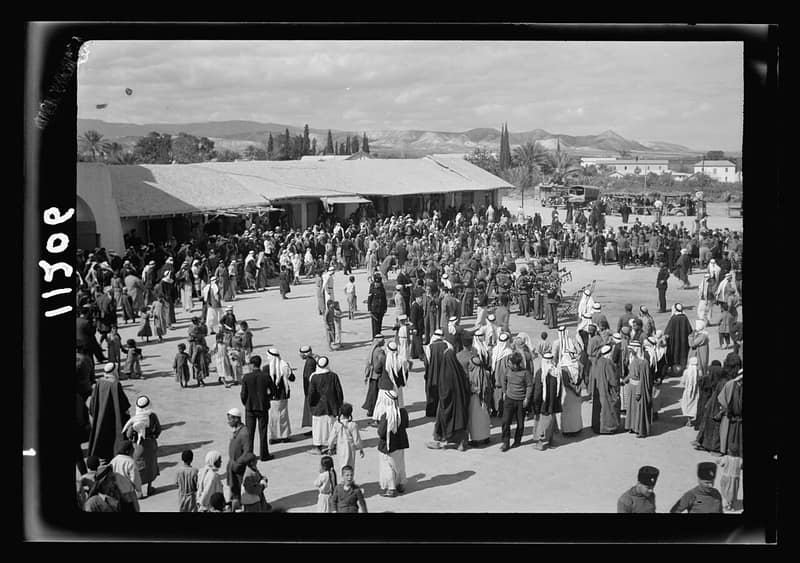
Ariha — Jericho — lies in the Jordan Valley some 250 metres below sea level, watered by the spring of Ain es-Sultan that made everything else possible. Natufian hunter-gatherers settled by the spring around 9000 BCE, and the mound of Tell es-Sultan — inscribed as a UNESCO World Heritage site in 2023 — holds the walls and great stone tower of a town already flourishing by about 8000 BCE, which makes Jericho one of the oldest continuously inhabited places on earth. The Bible gives it Joshua’s trumpets; archaeology gives it Herod’s winter palaces at Tulul Abu al-Alayiq and the Umayyad lodge at Khirbat al-Mafjar with its Tree of Life mosaic; the monastery of the Mount of Temptation hangs on the cliff above.
The modern town lived by its water. Bananas, oranges and dates from the irrigated groves — the “city of palm trees” of Deuteronomy — went by road to Jerusalem and Nablus; the spring festival of Nebi Musa brought pilgrims down the Jericho road in their thousands; winter visitors came for the sun when the hills were cold. The town square gathered crowds of villagers in from the valley — a small market city at peace among its palms.
Then the valley itself became a refuge. In 1948 thousands of Palestinians fled or were driven down to Jericho; UNRWA opened Ein as-Sultan camp beside the spring and Aqabat Jabr to the south, and by 1967 Aqabat Jabr alone held some thirty thousand people, the largest camp in the West Bank. The June war of 1967 emptied the valley: most of the camps’ people, and many townsfolk with them, crossed the Jordan into a second exile, and Aqabat Jabr shrank to a fraction of itself. In May 1994, under the Cairo Agreement — “Gaza and Jericho first” — Jericho became the first West Bank city handed to the new Palestinian Authority.
Today Jericho is an Area A enclave in a valley hemmed in by settlements, closed military zones and checkpoints; its dates and bananas still go out to the world, and Aqabat Jabr still holds several thousand refugees a few kilometres from the spring that started it all. Ten thousand years of settlement have outlasted every power that passed through this valley. Ariha is still there.
Sources
Cited works
3- whc.unesco.org(opens in a new tab)https://whc.unesco.org/en/list/1687/
- britannica.com — Jericho West Bank(opens in a new tab)https://www.britannica.com/place/Jericho-West-Bank
- unrwa.org — aqbat jabr camp(opens in a new tab)https://www.unrwa.org/where-we-work/west-bank/aqbat-jabr-camp
Cite this page
Every claim above carries its sources — citation is the point.
- Chicago
“Jericho.” Places, FALASTEEN.AI. Accessed 22 August 2026. https://falasteen.ai/places/jericho.- MLA
“Jericho.” Places, FALASTEEN.AI, 2026, https://falasteen.ai/places/jericho. Accessed 22 August 2026.- BibTeX
@misc{falasteen-jericho,
  title        = {Jericho},
  howpublished = {\url{https://falasteen.ai/places/jericho}},
  organization = {FALASTEEN.AI — A Living Archive for Palestine},
  year         = {2026},
  note         = {Accessed 2026-08-22}
}