Dabke
دبكة
The communal line dance of Palestine and the Levant, performed at weddings and celebrations, with stamping steps that shake the earth.
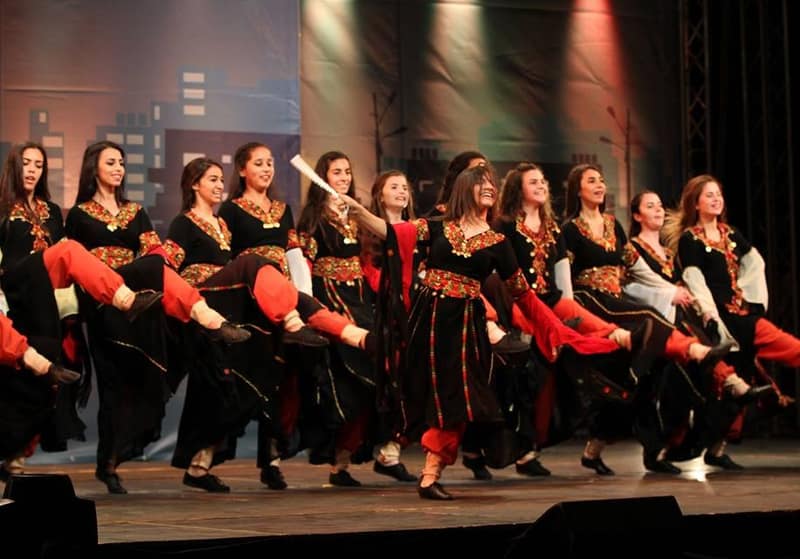
Dabke is a line dance shared across Palestine, Lebanon, Syria, and Jordan, in which dancers link arms or shoulders and move in a semicircle or line, led by a lead dancer — the lawweeh or raas — who improvises with a cane or handkerchief. The name derives from the Arabic root meaning “to stamp,” and the dance is built on synchronized stomping, kicks, and leaps.
One popular account of its origins ties the stamping to the communal trampling of mud-and-straw roofs in village life: when a roof cracked, neighbors gathered to tread it firm again, to the rhythm of song. Whatever its origin, dabke remains inseparable from collective labor, harvest, and celebration, and no Palestinian wedding is complete without it.
Since the mid-twentieth century, professional troupes such as El-Funoun, founded in Palestine in 1979, have staged dabke as a choreographed art form and an assertion of cultural continuity. For Palestinians in the diaspora, teaching children dabke is a way of keeping a homeland under their feet.
Sources
Connected in the archive
10 connected records10 records elsewhere in the archive are linked to this one, each by a piece of evidence you can read below.
names this record — 5 records
One record names the other. A pointer for reading, not a claim that they belong to each other.
- What a People Made
Evidence — From a recorded field in this archive: The line dance whose stamping steps are the point — a communal form that requires a community to be standing in one place.
- Fellahin
Evidence — Inferred from the text — read the evidence: The culture of the fellahin — the embroidered thob with its village-specific patterns, the dabke, the harvest songs, the taboun bread, the olive tree — was raised from the local to the national and became the way Palestinians as a whole represent themselves.
- Land Day
Evidence — Inferred from the text — read the evidence: Every year since, in Palestine and across the diaspora, the day is marked — with strikes and demonstrations, and with dabke danced in the fields whose confiscation the day is about.
- Laylat al-Henna
Evidence — Inferred from the text — read the evidence: Around it sits the rest of the wedding: the zaffe, the march of singers, drummers and dancers that escorts the couple into the hall; the dabke line; the sung poetry of the evening.
- Palestinian Music
Evidence — Inferred from the text — read the evidence: Its oldest forms are sung poetry: the zajal, improvised verse-duels traded between poets at celebrations; the mawwal, a slow, melismatic solo that showcases a singer's voice and grief; and the dal'ouna, the call-and-response song of the dabke line, whose refrains — most famously "ala dal'ouna" — are known across Palestine.
named in this record — 1 record
One record names the other. A pointer for reading, not a claim that they belong to each other.
- El-Funoun
Evidence — Inferred from the text — read the evidence: Since the mid-twentieth century, professional troupes such as El-Funoun, founded in Palestine in 1979, have staged dabke as a choreographed art form and an assertion of cultural continuity.
on a related subject — 4 records
Filed near each other — the same Mandate district, or the same uncommon subject tags.
- El-Funoun Palestinian Popular Dance Troupe
Evidence — Inferred from the text — read the evidence: Shared tag: "dance".
- Mawsim al-Nabi Musa
Evidence — Inferred from the text — read the evidence: Shared tag: "dance".
- Nahr el-Bared Campمخيّم نهر البارد
Evidence — Inferred from the text — read the evidence: Shared tag: "lebanon".
- Shatila Campمخيّم شاتيلا
Evidence — Inferred from the text — read the evidence: Shared tag: "lebanon".
Cite this page
Every claim above carries its sources — citation is the point.
- Chicago
“Dabke.” Culture, FALASTEEN.AI. Accessed 22 August 2026. https://falasteen.ai/culture/dabke.- MLA
“Dabke.” Culture, FALASTEEN.AI, 2026, https://falasteen.ai/culture/dabke. Accessed 22 August 2026.- BibTeX
@misc{falasteen-dabke,
  title        = {Dabke},
  howpublished = {\url{https://falasteen.ai/culture/dabke}},
  organization = {FALASTEEN.AI — A Living Archive for Palestine},
  year         = {2026},
  note         = {Accessed 2026-08-22}
}