Palestinian Music
الموسيقى الفلسطينية
From the improvised verse of zajal and the laments of the mawwal to the hip-hop of DAM — a music that carries memory, celebration, and defiance.
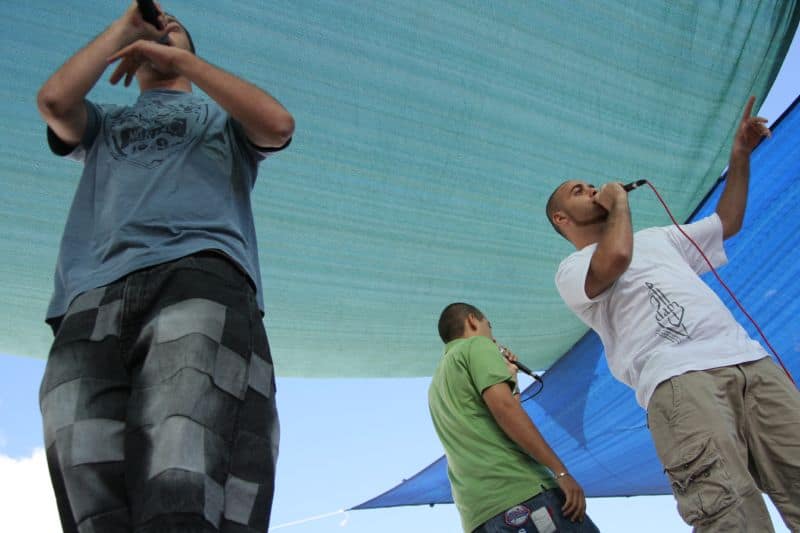
Palestinian folk music is inseparable from the occasions of village life — weddings, harvests, and homecomings. Its oldest forms are sung poetry: the zajal, improvised verse-duels traded between poets at celebrations; the mawwal, a slow, melismatic solo that showcases a singer’s voice and grief; and the dal’ouna, the call-and-response song of the dabke line, whose refrains — most famously “ala dal’ouna” — are known across Palestine. The instruments of the tradition are those of the wider Levant: oud, qanun, nay, tabla, and the piercing mijwiz reed pipe.
Palestine has also been carried by voices beyond its borders. The Lebanese singer Fairuz, who refused to perform in Israel, gave Palestinians some of their most beloved anthems: “Sanarji’u Yawman” (“We Shall Return One Day”) and “Zahrat al-Mada’en” (“Flower of Cities”), her lament for Jerusalem, which she performed across the Arab world after 1967. Within Palestine, wedding singers and folk troupes such as El-Funoun kept the repertoire alive through occupation, recording songs of prisoners, martyrs, and the land.
A new generation has carried the tradition into global forms. DAM, formed in the city of Lydd around 1999, pioneered Palestinian hip-hop in Arabic, Hebrew, and English with tracks like “Min Irhabi?” (“Who Is the Terrorist?”), opening the way for a generation of rappers in Gaza, the West Bank, and the diaspora. Reem Kelani has built an international career researching and reviving traditional Palestinian song, from women’s wedding chants to the music of pre-1948 Palestine. And in 2013, Mohammad Assaf, a wedding singer from Gaza’s Khan Younis refugee camp, won Arab Idol — an event Palestinians across the world celebrated in the streets — with renditions of “Ali al-Keffiyeh” that made him a national voice overnight.
Sources
Connected in the archive
17 connected records17 records elsewhere in the archive are linked to this one, each by a piece of evidence you can read below.
named in this record — 4 records
One record names the other. A pointer for reading, not a claim that they belong to each other.
- Dabke
Evidence — Inferred from the text — read the evidence: Its oldest forms are sung poetry: the zajal, improvised verse-duels traded between poets at celebrations; the mawwal, a slow, melismatic solo that showcases a singer's voice and grief; and the dal'ouna, the call-and-response song of the dabke line, whose refrains — most famously "ala dal'ouna" — are known across Palestine.
- El-Funoun
Evidence — Inferred from the text — read the evidence: …of Cities"), her lament for Jerusalem, which she performed across the Arab world after 1967. Within Palestine, wedding singers and folk troupes such as El-Funoun kept the repertoire alive through occupation, recording songs of prisoners, martyrs, and the land.…
- Khan Younisخان يونس
Evidence — Inferred from the text — read the evidence: And in 2013, Mohammad Assaf, a wedding singer from Gaza's Khan Younis refugee camp, won Arab Idol — an event Palestinians across the world celebrated in the streets — with renditions of "Ali al-Keffiyeh" that made him a national voice overnight.
- Reem Kelaniريم كيلاني
Evidence — Inferred from the text — read the evidence: Reem Kelani has built an international career researching and reviving traditional Palestinian song, from women's wedding chants to the music of pre-1948 Palestine.
names this record — 1 record
One record names the other. A pointer for reading, not a claim that they belong to each other.
- What a People Made
Evidence — From a recorded field in this archive: From the improvised verse of zajal and the mawwal's lament to the hip-hop of DAM: the same argument in four centuries of registers.
on a related subject — 12 records
Filed near each other — the same Mandate district, or the same uncommon subject tags.
- Palestinian Hip-Hop
Evidence — From a recorded field in this archive: Shared tags: "music", "hip-hop".
- A Mountainous Journey: A Poet's Autobiography
Evidence — Inferred from the text — read the evidence: Shared tag: "poetry".
- Dammi Falastini
Evidence — Inferred from the text — read the evidence: Shared tag: "music".
- Dareen Tatourدارين طاطور
Evidence — Inferred from the text — read the evidence: Shared tag: "poetry".
- El-Funoun Palestinian Popular Dance Troupe
Evidence — Inferred from the text — read the evidence: Shared tag: "music".
- In the Presence of Absence
Evidence — Inferred from the text — read the evidence: Shared tag: "poetry".
- and 6 more
Cite this page
Every claim above carries its sources — citation is the point.
- Chicago
“Palestinian Music.” Culture, FALASTEEN.AI. Accessed 22 August 2026. https://falasteen.ai/culture/palestinian-music.- MLA
“Palestinian Music.” Culture, FALASTEEN.AI, 2026, https://falasteen.ai/culture/palestinian-music. Accessed 22 August 2026.- BibTeX
@misc{falasteen-palestinian-music,
  title        = {Palestinian Music},
  howpublished = {\url{https://falasteen.ai/culture/palestinian-music}},
  organization = {FALASTEEN.AI — A Living Archive for Palestine},
  year         = {2026},
  note         = {Accessed 2026-08-22}
}