Palestinian Hip-Hop
الهيب هوب الفلسطيني
Rap in Arabic, from Lydda to London — a generation that took the newest available form and used it to keep the oldest available thing, the language.
DAM formed in the late 1990s in Lydda — the brothers Tamer and Suhell Nafar with Mahmoud Jrere — and were the first Palestinian hip-hop crew, among the first anywhere to rap in Arabic. Their track Min Irhabi (“Who’s the Terrorist?”) was released online in 2001 and downloaded more than a million times, which in 2001 was a great deal; it made them known to young people across the Arab world. Maysa Daw joined the group in 2015.
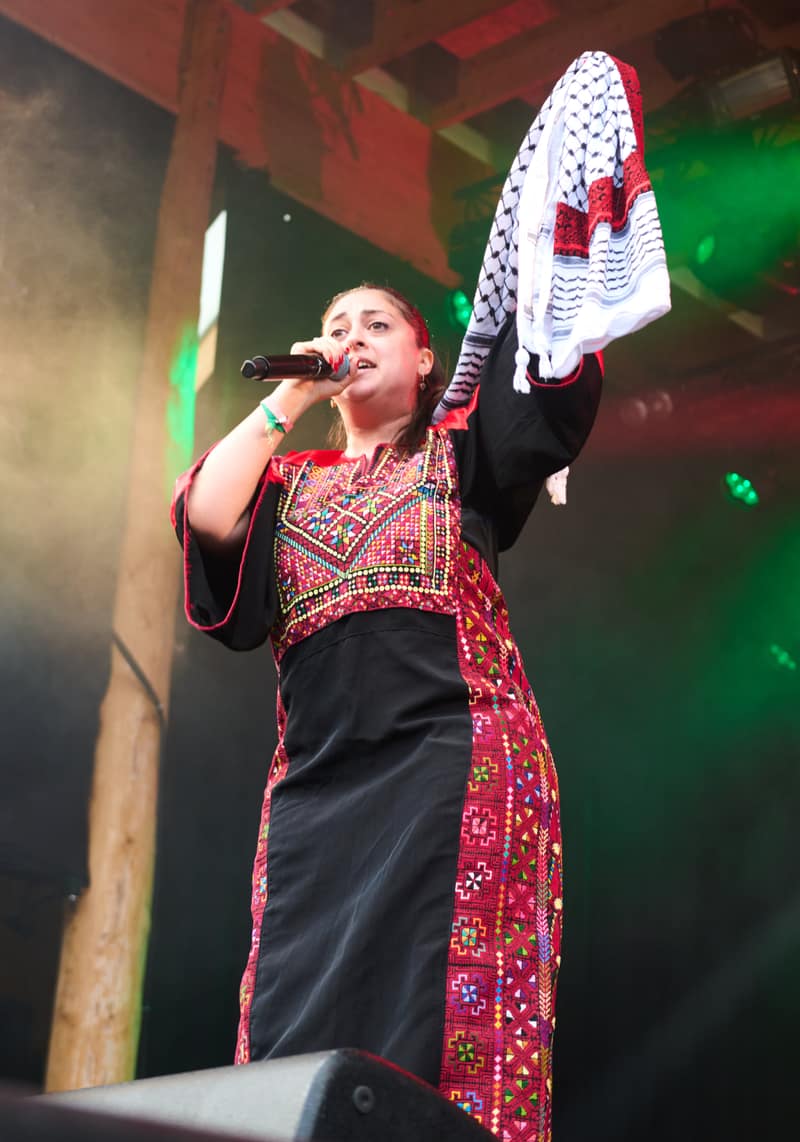
The form travelled fast because it needed almost nothing: a language, a rhythm and a room. Within a decade there were rappers in Gaza, in the West Bank camps, and throughout the diaspora. Shadia Mansour — “a Palestinian MC, singer, and producer who performs in Arabic,” in the words of the Riddu Riđđu festival, which bills her by her established epithet, “The First Lady of Arabic Hip Hop” — entered the scene in 2002 as a teenager at Palestine protests in London, her first public appearance being at a London rally against the occupation. Her signature, the festival notes, is a blend of rapping and singing “paired with performing in a traditional Palestinian thobe.”
That detail is the argument in miniature. A Palestinian raised in London, working in a form invented in the Bronx, on a stage at an Indigenous Sámi festival in Arctic Norway in July 2025 — singing in Arabic, in a dress whose cross-stitch grammar was worked out in Palestinian villages in the nineteenth century, holding a keffiyeh above her head. Nothing about that is preservation. It is a culture doing what living cultures do: turning up somewhere new, in current clothes, still itself.
Sources
Connected in the archive
18 connected records18 records elsewhere in the archive are linked to this one, each by a piece of evidence you can read below.
set here — 1 record
- Lyddaاللد
Evidence — From a recorded field in this archive: places: "Lydda" → Lydda
named in this record — 2 records
One record names the other. A pointer for reading, not a claim that they belong to each other.
- Keffiyeh
Evidence — Inferred from the text — read the evidence: A Palestinian raised in London, working in a form invented in the Bronx, on a stage at an Indigenous Sámi festival in Arctic Norway in July 2025 — singing in Arabic, in a dress whose cross-stitch grammar was worked out in Palestinian villages in the nineteenth century, holding a keffiyeh above her head.
- The Thobe
Evidence — Inferred from the text — read the evidence: Her signature, the festival notes, is a blend of rapping and singing "paired with performing in a traditional Palestinian thobe."
on a related subject — 15 records
Filed near each other — the same Mandate district, or the same uncommon subject tags.
- El-Funoun Palestinian Popular Dance Troupe
Evidence — From a recorded field in this archive: Shared tags: "music", "youth".
- Palestinian Music
Evidence — From a recorded field in this archive: Shared tags: "music", "hip-hop".
- Reem Kelaniريم كيلاني
Evidence — From a recorded field in this archive: Shared tags: "music", "diaspora".
- Suheir Hammadسهير حماد
Evidence — From a recorded field in this archive: Shared tags: "diaspora", "hip-hop".
- Armed Struggle and the Search for State: The Palestinian National Movement, 1949–1993
Evidence — Inferred from the text — read the evidence: Shared tag: "diaspora".
- Dammi Falastini
Evidence — Inferred from the text — read the evidence: Shared tag: "music".
- and 9 more
Cite this page
Every claim above carries its sources — citation is the point.
- Chicago
“Palestinian Hip-Hop.” Culture, FALASTEEN.AI. Accessed 22 August 2026. https://falasteen.ai/culture/palestinian-hip-hop.- MLA
“Palestinian Hip-Hop.” Culture, FALASTEEN.AI, 2026, https://falasteen.ai/culture/palestinian-hip-hop. Accessed 22 August 2026.- BibTeX
@misc{falasteen-palestinian-hip-hop,
  title        = {Palestinian Hip-Hop},
  howpublished = {\url{https://falasteen.ai/culture/palestinian-hip-hop}},
  organization = {FALASTEEN.AI — A Living Archive for Palestine},
  year         = {2026},
  note         = {Accessed 2026-08-22}
}