Laylat al-Henna
ليلة الحنّة
The women's night before a Palestinian wedding — henna ground and mixed, patterns worked onto the bride's hands, and the songs that go with it.
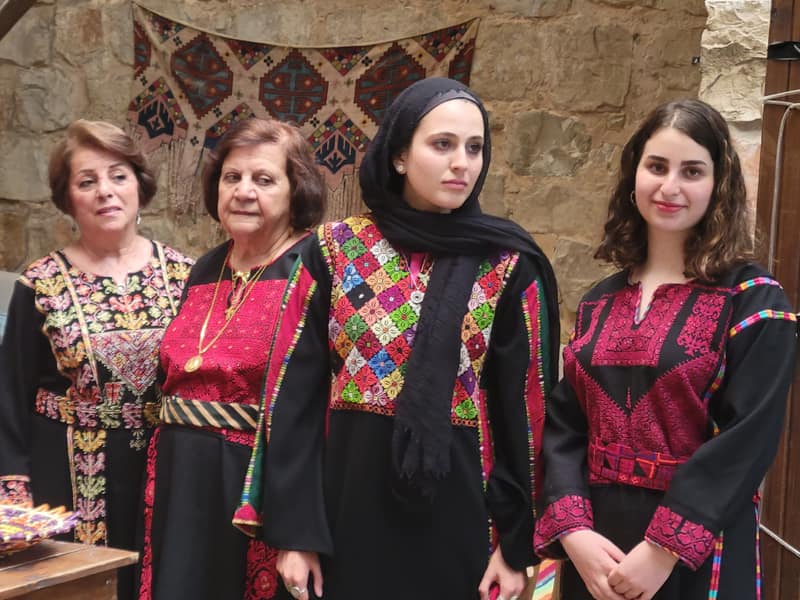
The henna night belongs to the women. It is held before the wedding — sometimes on the sahra, the evening gathering, sometimes on a night of its own — and it brings together the bride’s closest female relatives and friends to mix the henna paste and work it onto her hands, arms and feet in fine patterns, singing while they do it. For Palestinians the dye is understood to stand for a connection to the earth and to joy. Some brides, before entering their new home, press a handful of the henna into the doorframe.
Around it sits the rest of the wedding: the zaffe, the march of singers, drummers and dancers that escorts the couple into the hall; the dabke line; the sung poetry of the evening. The dress code is its own document. The dresses are inherited and lent, so a room can hold several generations and several districts at once — though how commonly, and in which regional grammars, is not something the archive has found a source for. Middle East Eye reports that Palestinians in the diaspora “have resorted to altering certain traditions and creating new ones”; which elements of the henna night travel intact, and which are remade, is not something the archive has found a source for. It is the cheapest ritual to keep and the hardest to give up — a bowl, a paste, a room of women, and the songs.
The photograph on this page was made on 7 August 2023; the Wikimedia record states it shows a gathering waiting for the shooting of a video clip for a wedding song, and we say so rather than present it as an unstaged ritual.
Sources
Connected in the archive
10 connected records10 records elsewhere in the archive are linked to this one, each by a piece of evidence you can read below.
named in this record — 1 record
One record names the other. A pointer for reading, not a claim that they belong to each other.
- Dabke
Evidence — Inferred from the text — read the evidence: Around it sits the rest of the wedding: the zaffe, the march of singers, drummers and dancers that escorts the couple into the hall; the dabke line; the sung poetry of the evening.
on a related subject — 9 records
Filed near each other — the same Mandate district, or the same uncommon subject tags.
- Armed Struggle and the Search for State: The Palestinian National Movement, 1949–1993
Evidence — Inferred from the text — read the evidence: Shared tag: "diaspora".
- Enter Ghost
Evidence — Inferred from the text — read the evidence: Shared tag: "diaspora".
- Maftoul
Evidence — Inferred from the text — read the evidence: Shared tag: "diaspora".
- Palestinian Hip-Hop
Evidence — Inferred from the text — read the evidence: Shared tag: "diaspora".
- Reem Kelaniريم كيلاني
Evidence — Inferred from the text — read the evidence: Shared tag: "diaspora".
- Salt Houses
Evidence — Inferred from the text — read the evidence: Shared tag: "diaspora".
- and 3 more
Cite this page
Every claim above carries its sources — citation is the point.
- Chicago
“Laylat al-Henna.” Culture, FALASTEEN.AI. Accessed 22 August 2026. https://falasteen.ai/culture/laylat-al-henna.- MLA
“Laylat al-Henna.” Culture, FALASTEEN.AI, 2026, https://falasteen.ai/culture/laylat-al-henna. Accessed 22 August 2026.- BibTeX
@misc{falasteen-laylat-al-henna,
  title        = {Laylat al-Henna},
  howpublished = {\url{https://falasteen.ai/culture/laylat-al-henna}},
  organization = {FALASTEEN.AI — A Living Archive for Palestine},
  year         = {2026},
  note         = {Accessed 2026-08-22}
}