Tatreez
تطريز
Palestinian cross-stitch embroidery, inscribed by UNESCO in 2021, encoding village, region, and memory in thread.
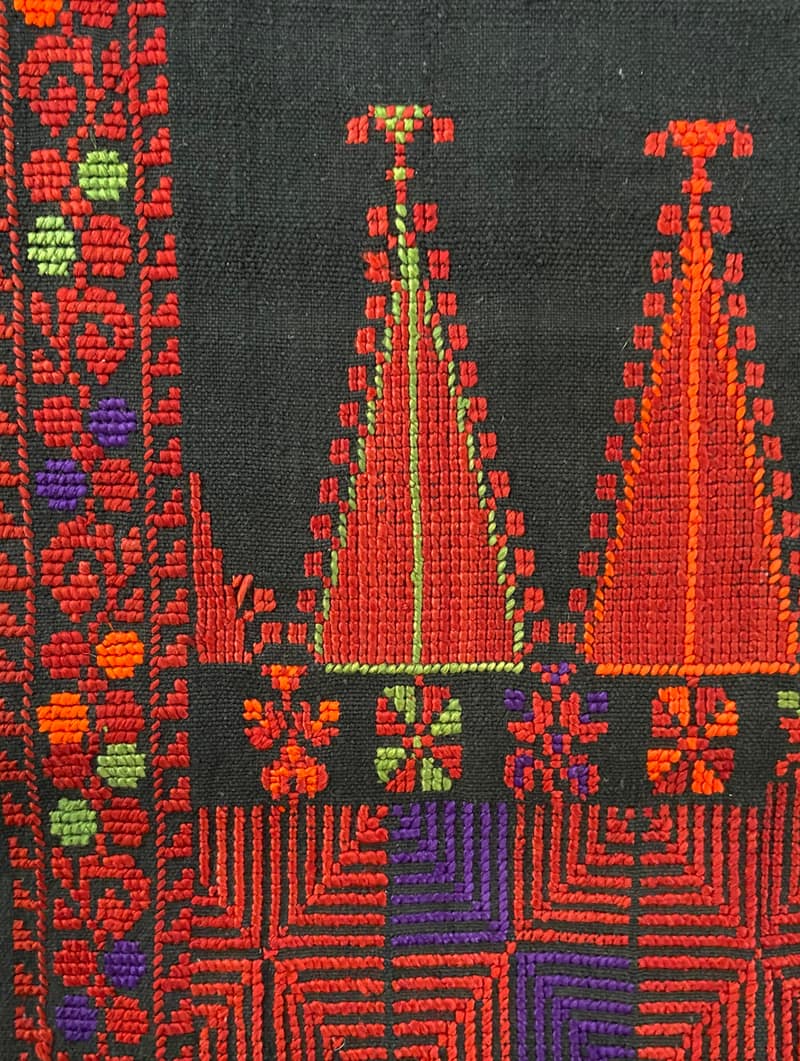
Tatreez is the art of Palestinian embroidery, practiced for centuries primarily by women. Traditionally stitched in cross-stitch with silk threads on linen or cotton, its motifs and colors once identified a woman’s village and region: the cypress trees and eight-pointed stars of Ramallah, the deep reds of the coastal plain, the patterns of Hebron, Gaza, and the Galilee each told a different story. The thobe, the embroidered dress, carried this geography on the chest, sleeves, and hem.
After the Nakba of 1948, tatreez took on new meaning. In refugee camps, where regional dress could no longer be made or worn as before, embroidery became a means of preserving memory and asserting national identity; new motifs appeared, including maps of Palestine, flags, and political symbols. Embroidery cooperatives run by refugee women also became important sources of income.
In 2021, UNESCO inscribed “The art of embroidery in Palestine: practices, skills, knowledge and rituals” on the Representative List of the Intangible Cultural Heritage of Humanity. Tatreez continues to be passed between generations and adapted by contemporary artists and designers.
Sources
Connected in the archive
20 connected records20 records elsewhere in the archive are linked to this one, each by a piece of evidence you can read below.
names this record — 7 records
One record names the other. A pointer for reading, not a claim that they belong to each other.
- What a People Made
Evidence — From a recorded field in this archive: Start with the thread. UNESCO inscribed Palestinian embroidery in 2021; the practice it describes — women embroidering together, at home, with their daughters — long predates the list.
- Darzah
Evidence — Inferred from the text — read the evidence: The work is traditional tatreez and tahriri on contemporary goods.
- Handmade Palestine
Evidence — Inferred from the text — read the evidence: Handmade Palestine curates the work of artisans across Palestine into one fair-trade storefront — tatreez, olive wood, jewelry, olive oil, Nabulsi soap — and reinvests in the makers through training, grants, and materials, including support for the Mashjar Juthour native-tree project.
- Inaash Association
Evidence — Inferred from the text — read the evidence: Its shawls, garments, and home pieces are stitched by more than 350 women across five camps — some of the finest tatreez produced anywhere.
- Palestinian Elegance
Evidence — Inferred from the text — read the evidence: Every piece at Palestinian Elegance is built around the embroidery: hand-finished tatreez on modern silhouettes, from thobes and abayas to keffiyehs and gold jewelry.
- Tatreez & Tea
Evidence — Inferred from the text — read the evidence: Tatreez & Tea — now the Tatreez Institute — is Wafa Ghnaim's project to teach, document, and rematriate Palestinian embroidery: stitch-by-stitch tutorials, dress-history research, and a study collection of historic thobes brought home to be studied and shared.
- and 1 more
named in this record — 4 records
One record names the other. A pointer for reading, not a claim that they belong to each other.
- Hebronالخليل
Evidence — Inferred from the text — read the evidence: Traditionally stitched in cross-stitch with silk threads on linen or cotton, its motifs and colors once identified a woman's village and region: the cypress trees and eight-pointed stars of Ramallah, the deep reds of the coastal plain, the patterns of Hebron, Gaza, and the Galilee each told a different story.
- Ramallahرام الله
Evidence — Inferred from the text — read the evidence: Traditionally stitched in cross-stitch with silk threads on linen or cotton, its motifs and colors once identified a woman's village and region: the cypress trees and eight-pointed stars of Ramallah, the deep reds of the coastal plain, the patterns of Hebron, Gaza, and the Galilee each told a different story.
- Tatreez
Evidence — Inferred from the text — read the evidence: Tatreez is the art of Palestinian embroidery, practiced for centuries primarily by women.
- The Thobe
Evidence — Inferred from the text — read the evidence: The thobe, the embroidered dress, carried this geography on the chest, sleeves, and hem.
on a related subject — 9 records
Filed near each other — the same Mandate district, or the same uncommon subject tags.
- The Blue Thread of Beersheba
Evidence — From a recorded field in this archive: Shared tags: "embroidery", "dress".
- The Qabbeh
Evidence — From a recorded field in this archive: Shared tags: "embroidery", "dress".
- Thob al-Intifada
Evidence — From a recorded field in this archive: Shared tags: "embroidery", "dress".
- Bethlehemبيت لحم
Evidence — Inferred from the text — read the evidence: Shared tag: "unesco".
- Keffiyeh
Evidence — Inferred from the text — read the evidence: Shared tag: "dress".
- The Palestinian Hikaye
Evidence — Inferred from the text — read the evidence: Shared tag: "unesco".
- and 3 more
Cite this page
Every claim above carries its sources — citation is the point.
- Chicago
“Tatreez.” Culture, FALASTEEN.AI. Accessed 22 August 2026. https://falasteen.ai/culture/tatreez.- MLA
“Tatreez.” Culture, FALASTEEN.AI, 2026, https://falasteen.ai/culture/tatreez. Accessed 22 August 2026.- BibTeX
@misc{falasteen-tatreez,
  title        = {Tatreez},
  howpublished = {\url{https://falasteen.ai/culture/tatreez}},
  organization = {FALASTEEN.AI — A Living Archive for Palestine},
  year         = {2026},
  note         = {Accessed 2026-08-22}
}