Thob al-Intifada
ثوب الانتفاضة
The Intifada dress: when the Palestinian flag could not be flown, women cross-stitched it — with the map, the word Palestine, and the letters PLO — onto the dresses they wore in the street.
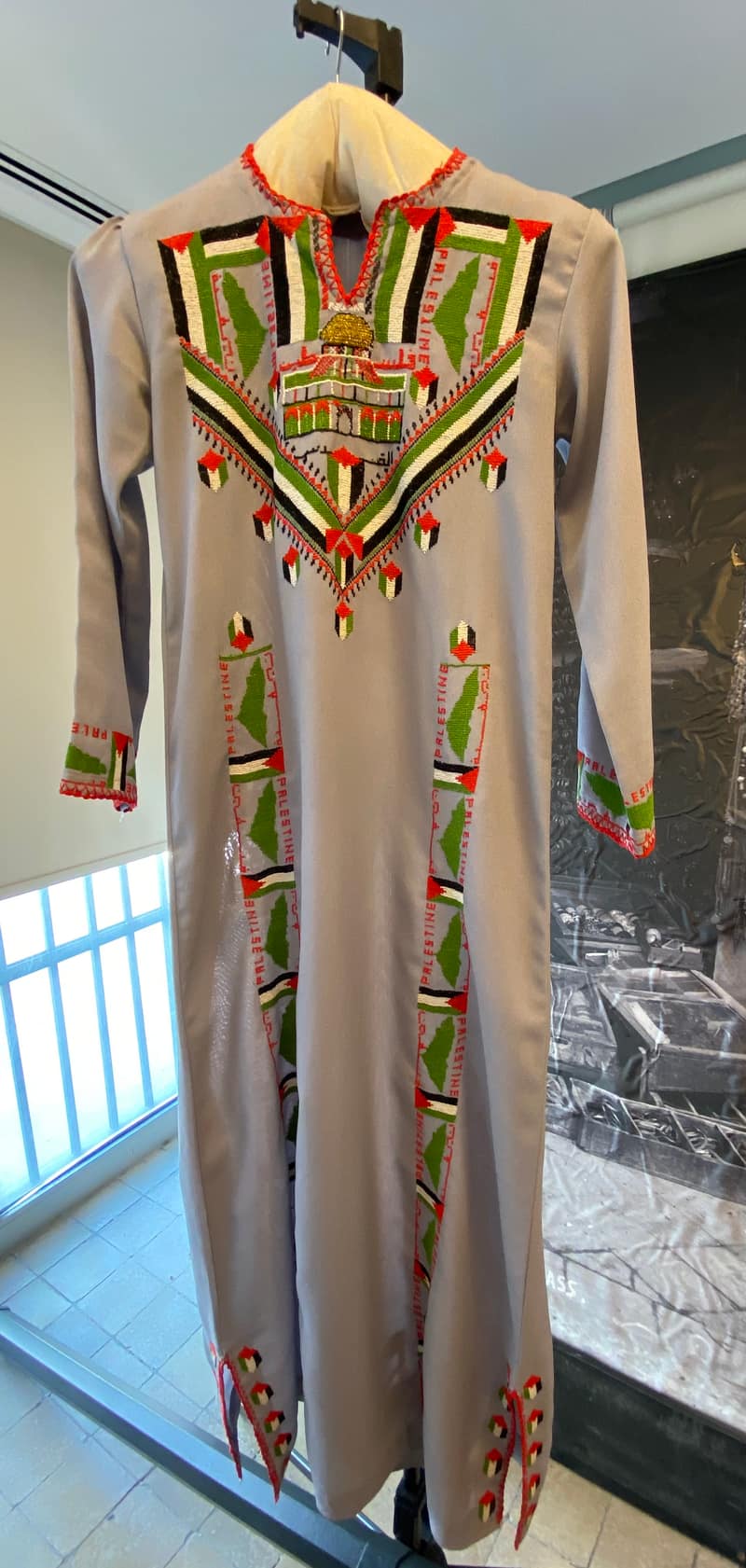
By the 1960s the regional dress system was gone — the villages that had produced it were emptied in 1948 — and a garment the Institute for Palestine Studies calls the “New Dress” had emerged from the camps: cross-stitched all over, mixing European and Palestinian patterns, “undeniably Palestinian but from no identifiable region — at once from nowhere and everywhere in Palestine.”
Its sharpest form arrived with the First Intifada. In the Institute’s words: “The most politicized manifestation of the New Dress was the ‘Intifada Dress,’ made and worn during the popular uprising of the late 1980s and early 1990s. Women defied the Israeli ban on publicly displaying the Palestinian flag by embellishing new dresses with cross-stitched maps of Palestine, the acronym ‘PLO,’ the word ‘Palestine’ in English and Arabic, and even flags using thread in the four colors — red, green, white, and black — of the Palestinian flag.”
The dress photographed here carries exactly that inventory: the map of Palestine repeated in green down both front panels and around the cuffs, the flag worked in bands of red, black, white and green, the Dome of the Rock at the centre of the chest with its cupola in gold thread, and the word PALESTINE stitched in Latin letters along the borders. It is worth being precise about what this is and is not. It is not a village dress and does not pretend to be one; the regional grammar it descends from had already been broken. What it is, is a legal object turned into a wearable one — a flag that a soldier could confiscate, re-made as a garment that a soldier would have to strip off a woman’s back.
The craft it is made of was inscribed by UNESCO in 2021, on the State of Palestine’s own nomination, as “The art of embroidery in Palestine, practices, skills, knowledge and rituals.” UNESCO’s file describes it as transmitted “from mother to daughter and through formal training courses” — which is to say the technique that produced this dress is not a survival being conserved. It is a skill still being handed on.
Sources
Connected in the archive
13 connected records13 records elsewhere in the archive are linked to this one, each by a piece of evidence you can read below.
named in this record — 2 records
One record names the other. A pointer for reading, not a claim that they belong to each other.
- Intifada
Evidence — Inferred from the text — read the evidence: Its sharpest form arrived with the First Intifada.
- The First Intifada
Evidence — Inferred from the text — read the evidence: Its sharpest form arrived with the First Intifada.
on a related subject — 11 records
Filed near each other — the same Mandate district, or the same uncommon subject tags.
- Tatreez
Evidence — From a recorded field in this archive: Shared tags: "embroidery", "dress".
- The Blue Thread of Beersheba
Evidence — From a recorded field in this archive: Shared tags: "embroidery", "dress".
- The Qabbeh
Evidence — From a recorded field in this archive: Shared tags: "embroidery", "dress".
- Keffiyeh
Evidence — Inferred from the text — read the evidence: Shared tag: "dress".
- The Declaration of Independence, Algiers
Evidence — Inferred from the text — read the evidence: Shared tag: "first intifada".
- The Embroidery Cooperatives
Evidence — Inferred from the text — read the evidence: Shared tag: "embroidery".
- and 5 more
Cite this page
Every claim above carries its sources — citation is the point.
- Chicago
“Thob al-Intifada.” Culture, FALASTEEN.AI. Accessed 22 August 2026. https://falasteen.ai/culture/thob-al-intifada.- MLA
“Thob al-Intifada.” Culture, FALASTEEN.AI, 2026, https://falasteen.ai/culture/thob-al-intifada. Accessed 22 August 2026.- BibTeX
@misc{falasteen-thob-al-intifada,
  title        = {Thob al-Intifada},
  howpublished = {\url{https://falasteen.ai/culture/thob-al-intifada}},
  organization = {FALASTEEN.AI — A Living Archive for Palestine},
  year         = {2026},
  note         = {Accessed 2026-08-22}
}