The Qabbeh
القبة
The embroidered square at the chest of a Palestinian dress — worked separately, moved from dress to dress, and the single clearest statement of which district a woman came from.
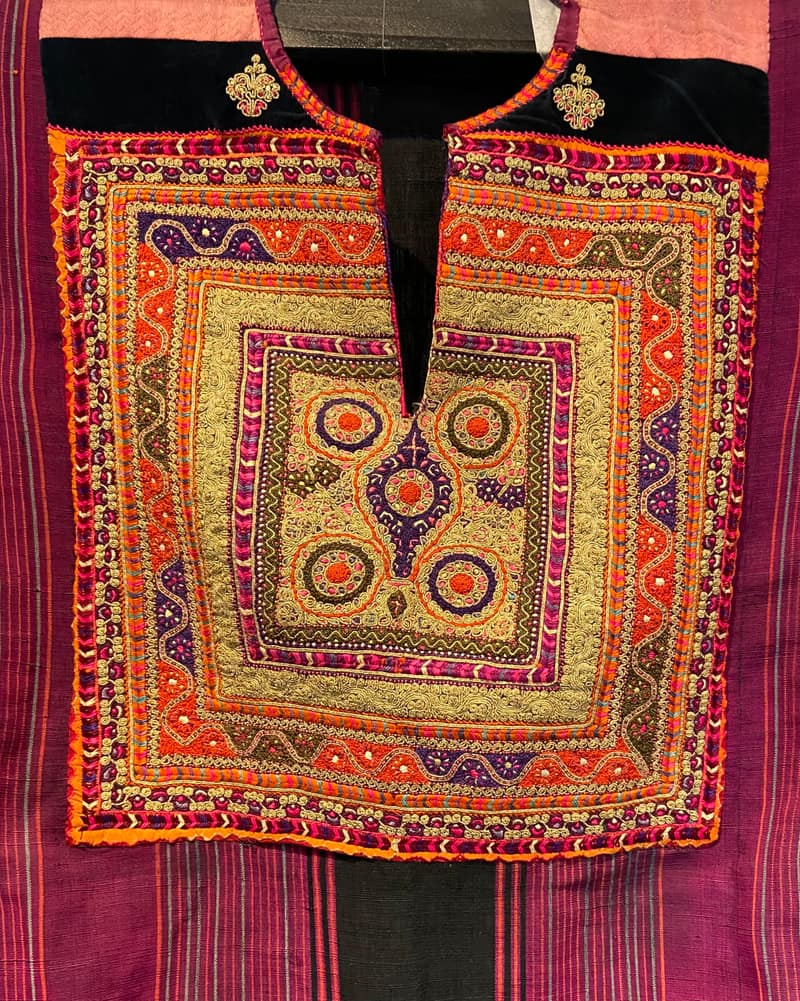
The qabbeh is the embroidered panel set into the chest of a Palestinian dress, framing the neck opening. It was worked on its own piece of cloth and stitched in afterwards, which meant it could outlive the garment: when a dress wore through, the panel was unpicked and set into the next one. Panels were inherited, and a woman might wear her mother’s work on her own dress.
Because it sits where the eye goes first, the qabbeh carried the densest and most deliberate stitching on the dress, and it is where regional difference is easiest to read. Ramallah panels are cross-stitch in silk on undyed linen, dominated by red, with cypress and palm motifs. Gaza and the coastal plain worked darker grounds and different geometry. Bethlehem took a different route altogether: instead of counted cross-stitch it used couching — tahriri in coloured silk cord and qasab in gold and silver thread, laid on the surface and stitched down — a technique with roots in ecclesiastical and court embroidery rather than in village needlework.
Motifs travelled and were renamed as they went. The same pattern of arcs is called sa’ah, the watch, around Bethlehem and Jerusalem, and qubab, domes, in the Jaffa, Lydda and Ramla districts. Naming, not just stitching, was local.
Sources
Connected in the archive
10 connected records10 records elsewhere in the archive are linked to this one, each by a piece of evidence you can read below.
set here — 1 record
- Bethlehemبيت لحم
Evidence — From a recorded field in this archive: places: "Bethlehem" → Bethlehem
on a related subject — 9 records
Filed near each other — the same Mandate district, or the same uncommon subject tags.
- Tatreez
Evidence — From a recorded field in this archive: Shared tags: "embroidery", "dress".
- The Blue Thread of Beersheba
Evidence — From a recorded field in this archive: Shared tags: "embroidery", "dress".
- The Shatweh
Evidence — From a recorded field in this archive: Shared tags: "dress", "bethlehem".
- Thob al-Intifada
Evidence — From a recorded field in this archive: Shared tags: "embroidery", "dress".
- Bethlehem Mother-of-Pearl
Evidence — Inferred from the text — read the evidence: Shared tag: "bethlehem".
- Keffiyeh
Evidence — Inferred from the text — read the evidence: Shared tag: "dress".
- and 3 more
Cite this page
Every claim above carries its sources — citation is the point.
- Chicago
“The Qabbeh.” Culture, FALASTEEN.AI. Accessed 22 August 2026. https://falasteen.ai/culture/the-qabbeh.- MLA
“The Qabbeh.” Culture, FALASTEEN.AI, 2026, https://falasteen.ai/culture/the-qabbeh. Accessed 22 August 2026.- BibTeX
@misc{falasteen-the-qabbeh,
  title        = {The Qabbeh},
  howpublished = {\url{https://falasteen.ai/culture/the-qabbeh}},
  organization = {FALASTEEN.AI — A Living Archive for Palestine},
  year         = {2026},
  note         = {Accessed 2026-08-22}
}