The Shatweh
الشطوة
The tall coin-covered cap of Bethlehem, Beit Jala, Beit Sahour and Lifta — worn by married women, and carrying the coins of her own dowry on her head.
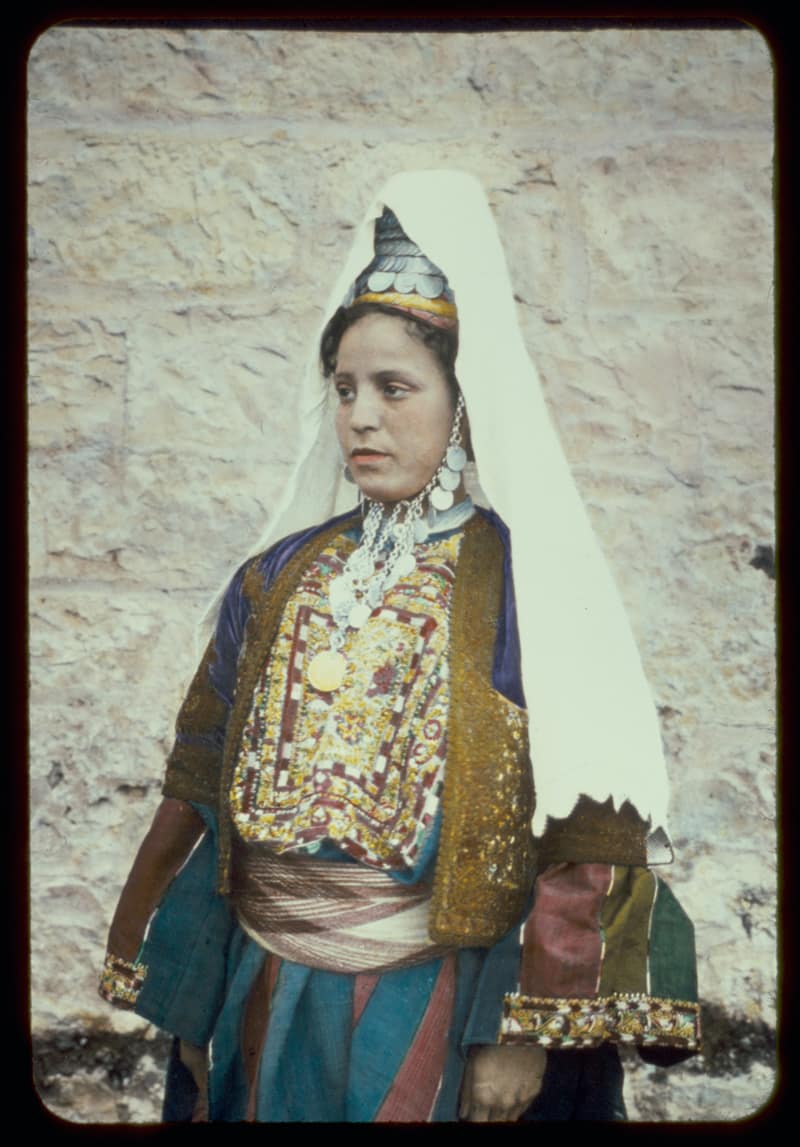
The shatweh is a padded cap, truncated-conical in shape, worn by married women in Bethlehem and the villages around it — Beit Jala, Beit Sahour, and Lifta on the Jerusalem road. It was not a scarf or a covering but a built object: a stiffened form, quilted and embroidered, over which a long white veil was draped so that the cap held the veil away from the face.
What the cap carried mattered as much as the cap. Rows of coins were sewn across it, and from it hung the iznaq, a chin chain of coins that ran under the jaw from one side of the cap to the other. The coins were the woman’s own — part of the bride price paid at her marriage, hers to keep, and worn where everyone could count them. A married woman’s wealth was neither hidden nor held for her; she wore it on her head.
The shatweh was one item in a regional system in which headdress, cut, and stitch together announced where a woman was from. In the Ramallah district the equivalent was the smadeh, a lower cap with a stiff padded rim packed with coins. In the Galilee and the south the forms differed again. The photographs made in Palestine between the 1890s and the 1940s — above all the Matson collection now at the Library of Congress — are the fullest visual record of a system that 1948 ended as a living geography.
Sources
Connected in the archive
14 connected records14 records elsewhere in the archive are linked to this one, each by a piece of evidence you can read below.
set here — 1 record
- Bethlehemبيت لحم
Evidence — From a recorded field in this archive: places: "Bethlehem" → Bethlehem
named in this record — 1 record
One record names the other. A pointer for reading, not a claim that they belong to each other.
- The Smadeh
Evidence — Inferred from the text — read the evidence: In the Ramallah district the equivalent was the smadeh, a lower cap with a stiff padded rim packed with coins.
names this record — 1 record
One record names the other. A pointer for reading, not a claim that they belong to each other.
- The Thobe
Evidence — Inferred from the text — read the evidence: In Bethlehem and Lifta married women wore the shatweh, a tall conical cap that anchored the iznaq, the chin chain of coins.
on a related subject — 11 records
Filed near each other — the same Mandate district, or the same uncommon subject tags.
- The Qabbeh
Evidence — From a recorded field in this archive: Shared tags: "dress", "bethlehem".
- Bethlehem Mother-of-Pearl
Evidence — Inferred from the text — read the evidence: Shared tag: "bethlehem".
- Deqq
Evidence — Inferred from the text — read the evidence: Shared tag: "heritage".
- Hebron Glass
Evidence — Inferred from the text — read the evidence: Shared tag: "heritage".
- Keffiyeh
Evidence — Inferred from the text — read the evidence: Shared tag: "dress".
- Samiha Khalilسميحة خليل
Evidence — Inferred from the text — read the evidence: Shared tag: "heritage".
- and 5 more
Cite this page
Every claim above carries its sources — citation is the point.
- Chicago
“The Shatweh.” Culture, FALASTEEN.AI. Accessed 22 August 2026. https://falasteen.ai/culture/the-shatweh.- MLA
“The Shatweh.” Culture, FALASTEEN.AI, 2026, https://falasteen.ai/culture/the-shatweh. Accessed 22 August 2026.- BibTeX
@misc{falasteen-the-shatweh,
  title        = {The Shatweh},
  howpublished = {\url{https://falasteen.ai/culture/the-shatweh}},
  organization = {FALASTEEN.AI — A Living Archive for Palestine},
  year         = {2026},
  note         = {Accessed 2026-08-22}
}