The Saj
الصاج
The domed iron griddle set over an open fire, and the paper-thin shrak baked on it in seconds — the other Palestinian bread oven, the one that travels.
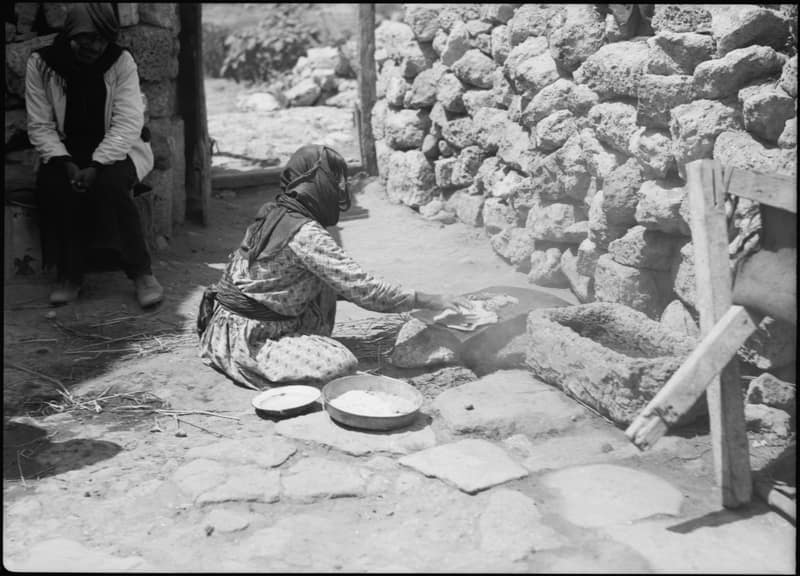
Where the taboon is a clay oven built into the ground, its floor lined with stones that dimple the loaf, the saj is the opposite instrument: a domed or convex iron griddle, roughly sixty centimetres across, laid convex-side-up over an open fire. The dough is not baked in it but over it. A round is worked out by hand until it is thin enough to see light through, thrown across the dome, and cooked in seconds. The bread that comes off it goes by several names across the Levant — markouk, khubz ruqaq, mashrouh — and in Palestine it is shrak.
The two ovens do different jobs, and Palestinian households kept both. The taboon holds its heat for hours and belongs to a settled village with a communal pit; the saj is a sheet of iron and three stones, which is to say it can be lit anywhere. It is the bread of the harvest field, of the shepherd’s camp, of the road — and, after 1948, of the tent.
The photograph on this page was made at Qisarya in June 1938. The Matson registers give the picture as “Caesarea. (Kaisarieh). Baking” and nothing further. Qisarya was a village of the Haifa district; in 1944/45 its Arab population was 960, of whom 930 were Muslims and 30 Christians. On 15 February 1948 a Palmach unit captured it, and — in the words of the Israeli historian Benny Morris, quoted in the Institute for Palestine Studies’ village record — it was “the first pre-planned, organized expulsion of an Arab community by the Haganah in 1948.” PalQuest records that most of the houses were demolished, the site excavated and turned into a tourist area, most of the few remaining houses now restaurants and the village mosque converted into a bar; Or ‘Aqiva and Qesarya were built on village lands. The bread is still made.
Sources
Connected in the archive
2 connected records2 records elsewhere in the archive are linked to this one, each by a piece of evidence you can read below.
named in this record — 1 record
One record names the other. A pointer for reading, not a claim that they belong to each other.
- The Taboon
Evidence — Inferred from the text — read the evidence: Where the taboon is a clay oven built into the ground, its floor lined with stones that dimple the loaf, the saj is the opposite instrument: a domed or convex iron griddle, roughly sixty centimetres across, laid convex-side-up over an open fire.
on a related subject — 1 record
Filed near each other — the same Mandate district, or the same uncommon subject tags.
- Maftoul
Evidence — Inferred from the text — read the evidence: Shared tag: "wheat".
Cite this page
Every claim above carries its sources — citation is the point.
- Chicago
“The Saj.” Culture, FALASTEEN.AI. Accessed 22 August 2026. https://falasteen.ai/culture/the-saj.- MLA
“The Saj.” Culture, FALASTEEN.AI, 2026, https://falasteen.ai/culture/the-saj. Accessed 22 August 2026.- BibTeX
@misc{falasteen-the-saj,
  title        = {The Saj},
  howpublished = {\url{https://falasteen.ai/culture/the-saj}},
  organization = {FALASTEEN.AI — A Living Archive for Palestine},
  year         = {2026},
  note         = {Accessed 2026-08-22}
}