The Sabr
الصبر
The prickly pear, whose Arabic name means patience: planted as a field boundary before 1948, and now growing in hedges that trace the outlines of villages that are no longer there.
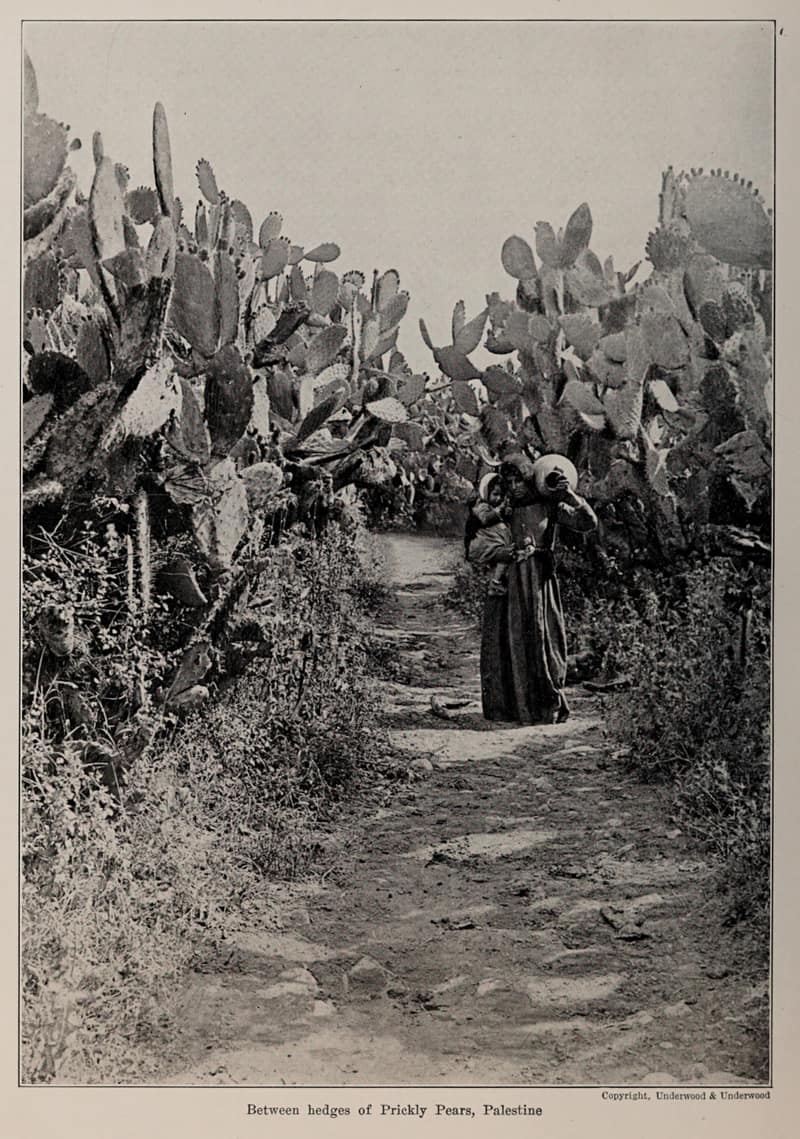
Sabr — the Arabic name for the prickly pear, Opuntia ficus-indica — is also the word for patience. The plant is not native to Palestine; it arrived from the Americas by way of the Mediterranean and was taken up by Palestinian farmers as a living fence. Planted in dense rows it made a barrier that needed no maintenance, marked the edge of a plot or a garden or an olive grove, and produced fruit in high summer as a by-product. Photographs from Ottoman and Mandate Palestine show roads running between hedges of it.
That agricultural function is why it matters now. Cactus does not colonise a landscape in straight lines; as one man standing in the ruins of Bayt Nabala put it, cacti do not grow by themselves — somebody has to cultivate them. Where villages were emptied and demolished after 1948, the built fabric could be cleared and planted over, but the cactus hedges that had marked field boundaries and house plots kept growing, and kept the geometry. Researchers and returning families use them, with the surviving olive and fig trees, to locate the outline of a village on ground that has been re-covered by forest or park. The cemetery of Bayt Nabala — one of hundreds of villages depopulated in 1948 — is still ringed by cactus.
The plant’s second life is symbolic. It survives drought, roots in poor ground, is hard to remove, and grows back from a single cut pad; since 1948 it has served Palestinians as an emblem of endurance and of dispossession at once, appearing constantly in painting, poetry, and design. The pun is exact and everybody uses it. The fruit is sweet, the plant is armed, and its name means patience.
Sources
Connected in the archive
17 connected records17 records elsewhere in the archive are linked to this one, each by a piece of evidence you can read below.
named in this record — 1 record
One record names the other. A pointer for reading, not a claim that they belong to each other.
- Bayt Nabalaبيت نبالا
Evidence — Inferred from the text — read the evidence: Cactus does not colonise a landscape in straight lines; as one man standing in the ruins of Bayt Nabala put it, cacti do not grow by themselves — somebody has to cultivate them.
on a related subject — 16 records
Filed near each other — the same Mandate district, or the same uncommon subject tags.
- All That Remains: The Palestinian Villages Occupied and Depopulated by Israel in 1948
Evidence — From a recorded field in this archive: Shared tags: "nakba", "villages".
- A History of Modern Palestine: One Land, Two Peoples
Evidence — Inferred from the text — read the evidence: Shared tag: "nakba".
- Baladi Seeds
Evidence — Inferred from the text — read the evidence: Shared tag: "land".
- Emily Jacirإميلي جاسر
Evidence — Inferred from the text — read the evidence: Shared tag: "villages".
- Gate of the Sun
Evidence — Inferred from the text — read the evidence: Shared tag: "nakba".
- Land Day
Evidence — Inferred from the text — read the evidence: Shared tag: "land".
- and 10 more
Cite this page
Every claim above carries its sources — citation is the point.
- Chicago
“The Sabr.” Culture, FALASTEEN.AI. Accessed 22 August 2026. https://falasteen.ai/culture/the-sabr-cactus.- MLA
“The Sabr.” Culture, FALASTEEN.AI, 2026, https://falasteen.ai/culture/the-sabr-cactus. Accessed 22 August 2026.- BibTeX
@misc{falasteen-the-sabr-cactus,
  title        = {The Sabr},
  howpublished = {\url{https://falasteen.ai/culture/the-sabr-cactus}},
  organization = {FALASTEEN.AI — A Living Archive for Palestine},
  year         = {2026},
  note         = {Accessed 2026-08-22}
}