Tiberias
طبريا
Tiberias — Tabariyya — was sacred to Jews since the Sanhedrin sat by its shore, and Palestine's most evenly mixed city, until April 1948, when its entire Arab population was convoyed out in two days. The childhood town of Fayez Sayegh; most of its Ottoman old city was later demolished.
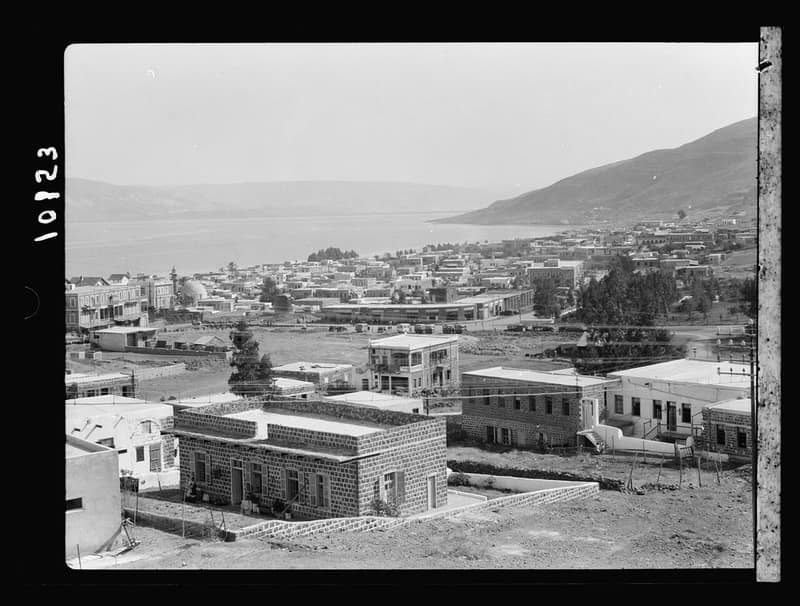
Herod Antipas founded Tiberias around 18 CE on the western shore of the Sea of Galilee, naming it for the emperor. Under Rome and Byzantium it became a capital of Jewish life: the Sanhedrin settled there, the Jerusalem Talmud was completed in its academies, the Masoretes of Tiberias fixed the vocalization of the Hebrew Bible, and Maimonides was buried within its walls in 1204. To the early Muslim state it was the capital of the military district of Jund al-Urdunn; Saladin broke the Crusader kingdom at the Horns of Hattin above the town in 1187. In the eighteenth century Daher el-Omar rebuilt its walls and the al-Omari mosque rose over the market — the Ottoman town that the 1837 earthquake would ruin and rebuild.
By the late Mandate, Tiberias was Palestine’s most evenly mixed city: some twelve thousand people, close to half Arab Muslims and Christians and half Jews, living quarter by quarter along the lake. There were the hot baths of Hammat, the lakeside market and the fishing boats that pull St. Peter’s fish from the Kinneret, the Scots mission hospital and its schools, and the first hotels of the lake resort. The Sayeghs were among its families: the Reverend Abdallah Sayegh, a Presbyterian minister, settled in Tiberias, and his son Fayez — born in Kharaba, Syria, in 1922 — spent his childhood in the town before going up to school in Safed.
In April 1948 the balance broke. After days of fighting between the Haganah and the town’s Arab quarters, British forces convoyed the entire Arab population — some five to six thousand people — out of the city on 18–19 April, toward Nazareth and across the Jordan. It was the first time in the war that a whole urban community was removed at once. The Arab neighborhoods were repopulated with new immigrants, and in the decades that followed most of the Ottoman old town by the lake was demolished; of old Tabariyya, stretches of Daher el-Omar’s wall, the citadel and the small sea mosque survive.
Tiberias today is an Israeli resort city, and its Palestinian families live in Nazareth, in Jordan, and in the camps of Lebanon and Syria. For Palestinian memory it is proof that mixture was possible — a city where Arabs and Jews shared one shore for centuries — and proof of how quickly it could be undone: two April days, and the lake town of Fayez Sayegh’s childhood was gone.
Sources
Cited works
2- britannica.com — Tiberias Israel(opens in a new tab)https://www.britannica.com/place/Tiberias-Israel
- palestineremembered.com — index(opens in a new tab)https://www.palestineremembered.com/Tiberias/Tiberias/index.html
Cite this page
Every claim above carries its sources — citation is the point.
- Chicago
“Tiberias.” Places, FALASTEEN.AI. Accessed 22 August 2026. https://falasteen.ai/places/tiberias.- MLA
“Tiberias.” Places, FALASTEEN.AI, 2026, https://falasteen.ai/places/tiberias. Accessed 22 August 2026.- BibTeX
@misc{falasteen-tiberias,
  title        = {Tiberias},
  howpublished = {\url{https://falasteen.ai/places/tiberias}},
  organization = {FALASTEEN.AI — A Living Archive for Palestine},
  year         = {2026},
  note         = {Accessed 2026-08-22}
}