Acre district · depopulated 1948 · 2 min read
Suhmata
سحماتا
Suhmata stood on two hilltops at six hundred metres in the upper Galilee, a village of 1,130 Muslims and Christians holding 17,056 dunums in 1944/45, with a Byzantine church of 555 CE and a Crusader castle on its ground. It was bombed from the air on 28 October 1948 and taken on 30 October by the Golani Brigade's First Battalion during Operation Hiram. The site was renamed Tzuriel and made ready for Jewish immigrants by May 1949.
See Suhmata on the Atlas33.0052°N · 35.3038°E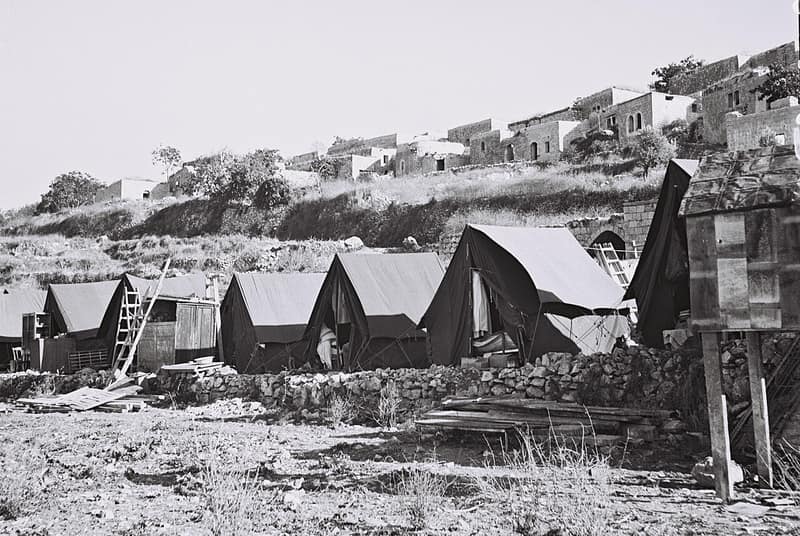
Suhmata was built on the tops of two hills that looked down on lower ground in every direction but the north, twenty-five kilometres from Acre and about six hundred metres above sea level, on a road connecting it to Safad, to the coast at Nahariyya and to the surrounding villages. It had a Christian population at least until the Persian invasion of the early seventh century and presumably for some time after; the Crusaders built a castle on the site and called it Samueth, and Zahir al-Umar, the effective ruler of northern Palestine in the mid-eighteenth century, repaired some of the damage the Crusades had done to it. In 1932 a Byzantine church was excavated on a hill nearby, its mosaic floor bearing an inscription dating the building to 555 CE.
By the 1940s the village was of stone, with an elementary school founded by the Ottomans in 1886, an agricultural school established during the Mandate, a mosque and a church. Its people drew drinking water from five springs and from domestic wells collecting rainwater, and irrigated from two rainfed pools, the larger holding some five thousand cubic metres, set between the two hills. More than seventy per cent of the village land was rocky and uncultivated, covered with oak and wild pear; the rest carried wheat, barley, maize, tobacco and vegetables, and Suhmata’s tobacco had a reputation for quality. Of 17,056 dunums, 3,290 were sown in cereals and 1,901 irrigated or planted in orchards. The 1944/45 population was 1,130, of whom seventy were Christians.
The village was bombed from the air on 28 October 1948. Two days later, as units of the Golani Brigade’s First Battalion advanced on the southern front of Operation Hiram, they met units of the Oded Brigade moving east at the Suhmata junction, where retreating Arab Liberation Army units narrowly escaped capture though their vehicles and equipment were taken. The official Israeli account states that Suhmata showed some resistance but was occupied after being encircled by an infantry platoon; it says nothing about the inhabitants, though neighbouring villages that resisted were punished by the expulsion of their people across the border into Lebanon.
By 27 May 1949 the village, renamed Tzuriel, was being prepared for the arrival of Jewish immigrants, with the main part of the new settlement northeast of the site; Hosen was established on village land the same year by immigrants from Romania. The site is covered with debris and broken walls from fallen stone houses scattered among the olive trees, and the Crusader castle and a wall enclosing the western quarter still stand. The surrounding land is partly forested and partly grazed. Former inhabitants formed a village committee in 1993 which organises volunteer work at the site and has surveyed the displaced Suhmata families living inside Israel.
Sources
Cited works
3- palquest.org — suhmata(opens in a new tab)https://www.palquest.org/en/place/17152/suhmata
- zochrot.org — en(opens in a new tab)https://www.zochrot.org/villages/village_details/49348/en
- en.wikipedia.org — Suhmata(opens in a new tab)https://en.wikipedia.org/wiki/Suhmata
Connected in the archive
23 connected records23 records elsewhere in the archive are linked to this one, each by a piece of evidence you can read below.
named in this record — 2 records
One record names the other. A pointer for reading, not a claim that they belong to each other.
- Acreعكا
Evidence — Inferred from the text — read the evidence: Suhmata was built on the tops of two hills that looked down on lower ground in every direction but the north, twenty-five kilometres from Acre and about six hundred metres above sea level, on a road connecting it to Safad, to the coast at Nahariyya and to the surrounding villages.
- Safedصفد
Evidence — Inferred from the text — read the evidence: Suhmata was built on the tops of two hills that looked down on lower ground in every direction but the north, twenty-five kilometres from Acre and about six hundred metres above sea level, on a road connecting it to Safad, to the coast at Nahariyya and to the surrounding villages.
in the same district — 21 records
Filed near each other — the same Mandate district, or the same uncommon subject tags.
- Al-Bassaالبصة
Evidence — From a recorded field in this archive: Both recorded in the Acre district.
- Al-Birwaالبروة
Evidence — From a recorded field in this archive: Both recorded in the Acre district.
- Al-Damunالدامون
Evidence — From a recorded field in this archive: Both recorded in the Acre district.
- Al-Ghabisiyyaالغابسية
Evidence — From a recorded field in this archive: Both recorded in the Acre district.
- Al-Kabriالكابري
Evidence — From a recorded field in this archive: Both recorded in the Acre district.
- Al-Manshiyya (Acre)المَنْشِيَّة
Evidence — From a recorded field in this archive: Both recorded in the Acre district.
- and 15 more
Cite this page
Every claim above carries its sources — citation is the point.
- Chicago
“Suhmata.” Village Memory, FALASTEEN.AI. Accessed 22 August 2026. https://falasteen.ai/memory/suhmata.- MLA
“Suhmata.” Village Memory, FALASTEEN.AI, 2026, https://falasteen.ai/memory/suhmata. Accessed 22 August 2026.- BibTeX
@misc{falasteen-suhmata,
  title        = {Suhmata},
  howpublished = {\url{https://falasteen.ai/memory/suhmata}},
  organization = {FALASTEEN.AI — A Living Archive for Palestine},
  year         = {2026},
  note         = {Accessed 2026-08-22}
}