Acre district · depopulated 1948 · 2 min read
Al-Bassa
البصة
Al-Bassa was a large, prosperous Muslim-Christian village on the Lebanese border — a regional market center with schools, churches, and mosques. Punished by the British with a massacre in 1938, it was stormed by the Haganah in May 1948 and almost completely razed; its ruins lie inside Shlomi and Betzet.
See Al-Bassa on the Atlas33.0761°N · 35.1408°E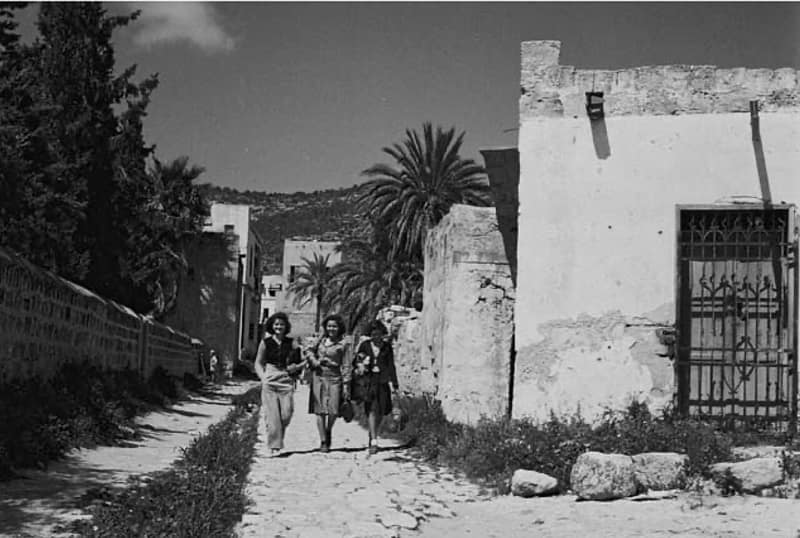
Al-Bassa stood close to the Lebanese border, nineteen kilometers north of Acre. It was an ancient place — the Bezeth of Roman sources and probably a Crusading village — and under the early Ottomans it was the seat of the nahiya; Napoleon described it in 1799 as a village of 600. By the Mandate years it had become one of the largest and most developed villages in the north, its population divided almost evenly between Muslims and Greek Catholic Christians: some 25,258 dunums of hills and plains, more than sixty shops and eleven coffeehouses along the Haifa–Beirut highway, a Sunday wholesale produce market, an agricultural cooperative with over 150 members, and a village council that had paved roads and running water. Among its institutions were two mosques, two churches, three schools — including the only Christian high school in the Galilee — and eighteen shrines holy to both faiths. The 1945 survey counted 2,950 people.
The village suffered twice in a decade. On 7 September 1938, during the Arab Revolt, a company of the Royal Ulster Rifles and a detachment of the 11th Hussars carried out a reprisal in al-Bassa after four of their soldiers were killed by a landmine nearby: houses were blown up, and villagers collected by the troops were put on a bus that was forced over a mine laid by the soldiers themselves; at least twenty Palestinians were killed. Then, on 14 May 1948, in the last days of the Mandate, the Haganah stormed al-Bassa in Operation Ben-Ami. After its capture, Palmach troops concentrated the villagers in the local church and shot a number of youths — one witness said five were killed inside the church, another counted seven outside it — before the population was driven out. The village was almost completely destroyed; at least sixty of its Christians were held at al-Mazra’a for more than a year, and eighty-one residents became internally displaced citizens of Israel. The great majority, around ninety-five percent, were pushed north into Lebanon, concentrating in the Dbayeh refugee camp east of Beirut.
The site was repopulated with Jewish immigrants and renamed Betzet in 1951, and the ruins spread into the northern quarters of the town of Shlomi. A 1992 inspection found that although most houses had been destroyed, a number of historic buildings survived — two churches, a mosque, and a maqam — among them the domed shrine of al-Khidr. Al-Bassa’s refugees keep a village association with branches as far as Lansing, Michigan, whose annual gatherings draw hundreds.
Sources
Cited works
3- palestineremembered.com — index(opens in a new tab)https://www.palestineremembered.com/Acre/al-Bassa/index.html
- zochrot.org — en(opens in a new tab)https://www.zochrot.org/villages/village_details/49033/en
- palquest.org — al bassa(opens in a new tab)https://www.palquest.org/en/place/16794/al-bassa
Connected in the archive
24 connected records24 records elsewhere in the archive are linked to this one, each by a piece of evidence you can read below.
names this place — 3 records
One record names the other. A pointer for reading, not a claim that they belong to each other.
- Dayr al-Qassiدير القاسي
Evidence — Inferred from the text — read the evidence: Its people were not expelled at once: some 700 were still living there, in al-Bassa and in Tarshiha that December.
- Fayez Sayeghفايز صايغ
Evidence — Inferred from the text — read the evidence: Fayez Abdullah Sayegh was born in 1922 in Kharaba, in the Hauran region of Syria, where his father was a Presbyterian minister; his mother came from al-Bassa in Palestine, and he grew up in Tiberias and went to school in Safed.
- Zakaria Elnatour
Evidence — Inferred from the text — read the evidence: In 1948 armed men in Arab dress entered the village early one morning and opened fire; the inhabitants fled north through al-Bassa and Tarshiha into Lebanon, and the village was destroyed except for its mosque and one old building.
named in this record — 1 record
One record names the other. A pointer for reading, not a claim that they belong to each other.
- Acreعكا
Evidence — Inferred from the text — read the evidence: Al-Bassa stood close to the Lebanese border, nineteen kilometers north of Acre.
in the same district — 20 records
Filed near each other — the same Mandate district, or the same uncommon subject tags.
- Al-Birwaالبروة
Evidence — From a recorded field in this archive: Both recorded in the Acre district.
- Al-Damunالدامون
Evidence — From a recorded field in this archive: Both recorded in the Acre district.
- Al-Ghabisiyyaالغابسية
Evidence — From a recorded field in this archive: Both recorded in the Acre district.
- Al-Kabriالكابري
Evidence — From a recorded field in this archive: Both recorded in the Acre district.
- Al-Manshiyya (Acre)المَنْشِيَّة
Evidence — From a recorded field in this archive: Both recorded in the Acre district.
- Al-Mansuraالمنصورة
Evidence — From a recorded field in this archive: Both recorded in the Acre district.
- and 14 more
Cite this page
Every claim above carries its sources — citation is the point.
- Chicago
“Al-Bassa.” Village Memory, FALASTEEN.AI. Accessed 22 August 2026. https://falasteen.ai/memory/al-bassa.- MLA
“Al-Bassa.” Village Memory, FALASTEEN.AI, 2026, https://falasteen.ai/memory/al-bassa. Accessed 22 August 2026.- BibTeX
@misc{falasteen-al-bassa,
  title        = {Al-Bassa},
  howpublished = {\url{https://falasteen.ai/memory/al-bassa}},
  organization = {FALASTEEN.AI — A Living Archive for Palestine},
  year         = {2026},
  note         = {Accessed 2026-08-22}
}