Acre district · depopulated 1948 · 2 min read
Al-Kabri
الكابري
Al-Kabri was a stone village northeast of Acre whose famous springs supplied the city's water through Ottoman aqueducts. Punished for the ambush of the Yehiam convoy, it was occupied in Operation Ben-Ami in May 1948 and leveled; today only rubble and the cemetery remain, beside the kibbutz that took its name.
See Al-Kabri on the Atlas33.0155°N · 35.1509°E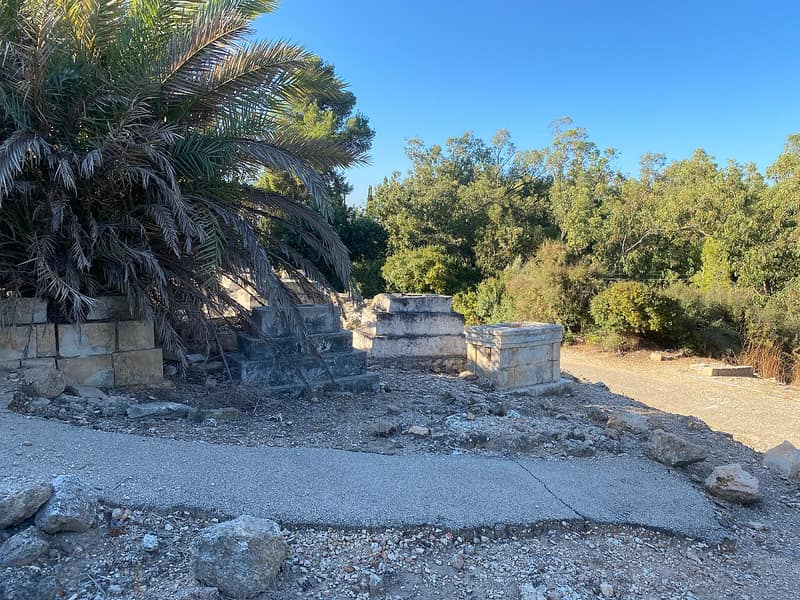
Al-Kabri lay at the eastern end of the western Galilee coastal plain, twelve and a half kilometers northeast of Acre and less than five from the sea. Under the Crusaders it was Le Quiebre, a dependency of Casal Imbert (al-Zeeb), and in 1596 it paid taxes as a village of ten households. The village was famed for its springs — Ayn Mafshuh, Ayn Fawwar, Ayn al-‘Asal, and Ayn Kabri — which made it the principal source of water for the district of Acre: ancient aqueducts carried the water to the city, and Ahmad Pasha al-Jazzar and Sulayman Pasha added two more canals in 1800 and 1814. Its people grew olives, citrus, and bananas and raised cattle; the village had a mosque and a boys’ elementary school. The 1945 survey counted 1,530 people, all Muslims, sharing with neighboring Tarshiha more than 47,000 dunums of land.
The village was marked early in the war. On the night of 31 January–1 February 1948 a Palmach raid partly blew up the house of Fares Efendi Sirhan, the leading al-Husayni-affiliated notable, who fled with his family to Lebanon. On 27 March a Haganah supply convoy to besieged Kibbutz Yehiam was ambushed as it passed al-Kabri, and 46 of its members were killed — a loss the Haganah did not forget. Haganah operatives also repeatedly damaged the Kabri aqueduct that fed Acre and, according to later historical accounts, contaminated its waters with typhoid bacteria. The village was occupied on the night of 20–21 May 1948, during the second stage of Operation Ben-Ami, by which time most of its people had fled; some villagers were later killed when discovered among the displaced of other Galilee villages, in retaliation for the convoy ambush.
Walid Khalidi, inspecting the site in 1992, found crumbled walls and stone rubble overgrown with thorns, weeds, and bushes; the village cemetery and the springs remain. A Jewish agricultural community named Kabri was established on adjacent village land, and the ruins of the old village lie within its pasture.
Sources
Cited works
3- palestineremembered.com — index(opens in a new tab)https://www.palestineremembered.com/Acre/al-Kabri/index.html
- zochrot.org — en(opens in a new tab)https://www.zochrot.org/villages/village_details/49215/en
- palquest.org — al kabri(opens in a new tab)https://www.palquest.org/en/place/16826/al-kabri
Connected in the archive
23 connected records23 records elsewhere in the archive are linked to this one, each by a piece of evidence you can read below.
names this place — 3 records
One record names the other. A pointer for reading, not a claim that they belong to each other.
- Al-Manshiyya (Acre)المَنْشِيَّة
Evidence — Inferred from the text — read the evidence: Half a kilometre to the west ran the stone-built al-Basha canal, carrying water from the springs of al-Kabri into the city.
- Al-Nahrالنهر
Evidence — Inferred from the text — read the evidence: The day before launching the incursion, the commander of the Haganah's Carmeli Brigade ordered his battalion commanders "to attack in order to conquer, to kill among the men, to destroy and burn the villages of Al Kabri, Umm al Faraj and An Nahr." Zochrot dates the occupation to 21 May and names the Carmeli Brigade.
- Al-Sumayriyyaالسميرية
Evidence — Inferred from the text — read the evidence: South of it were the historic aqueducts of al-Kabri, on the wadis of al-Majnuna — "the mad woman" — and Tall al-Zuhur, "the mound of flowers", so named for its masses of wild flowers; the tell served as a recreation ground for Acre and the villages around.
named in this record — 2 records
One record names the other. A pointer for reading, not a claim that they belong to each other.
- Acreعكا
Evidence — Inferred from the text — read the evidence: Al-Kabri lay at the eastern end of the western Galilee coastal plain, twelve and a half kilometers northeast of Acre and less than five from the sea.
- Walid Khalidiوليد خالدي
Evidence — Inferred from the text — read the evidence: Walid Khalidi, inspecting the site in 1992, found crumbled walls and stone rubble overgrown with thorns, weeds, and bushes; the village cemetery and the springs remain.
in the same district — 18 records
Filed near each other — the same Mandate district, or the same uncommon subject tags.
- Al-Bassaالبصة
Evidence — From a recorded field in this archive: Both recorded in the Acre district.
- Al-Birwaالبروة
Evidence — From a recorded field in this archive: Both recorded in the Acre district.
- Al-Damunالدامون
Evidence — From a recorded field in this archive: Both recorded in the Acre district.
- Al-Ghabisiyyaالغابسية
Evidence — From a recorded field in this archive: Both recorded in the Acre district.
- Al-Mansuraالمنصورة
Evidence — From a recorded field in this archive: Both recorded in the Acre district.
- Al-Nabi Rubinالنبي روبين
Evidence — From a recorded field in this archive: Both recorded in the Acre district.
- and 12 more
Cite this page
Every claim above carries its sources — citation is the point.
- Chicago
“Al-Kabri.” Village Memory, FALASTEEN.AI. Accessed 22 August 2026. https://falasteen.ai/memory/al-kabri.- MLA
“Al-Kabri.” Village Memory, FALASTEEN.AI, 2026, https://falasteen.ai/memory/al-kabri. Accessed 22 August 2026.- BibTeX
@misc{falasteen-al-kabri,
  title        = {Al-Kabri},
  howpublished = {\url{https://falasteen.ai/memory/al-kabri}},
  organization = {FALASTEEN.AI — A Living Archive for Palestine},
  year         = {2026},
  note         = {Accessed 2026-08-22}
}