Tiberias district · depopulated 1948 · 3 min read
Samakh
سمخ
Samakh was the largest village of the Tiberias subdistrict, 3,460 people on the southern shore of Lake Tiberias with a station on the line to the Hijaz railway and the border crossing to Mandate Syria. The Golani Brigade took it on 28 April 1948, ten days after the fall of Tiberias; Syrian and Iraqi forces briefly retook it in May. Only the ruins of the railway station and a water reservoir remain.
See Samakh on the Atlas32.7049°N · 35.5876°E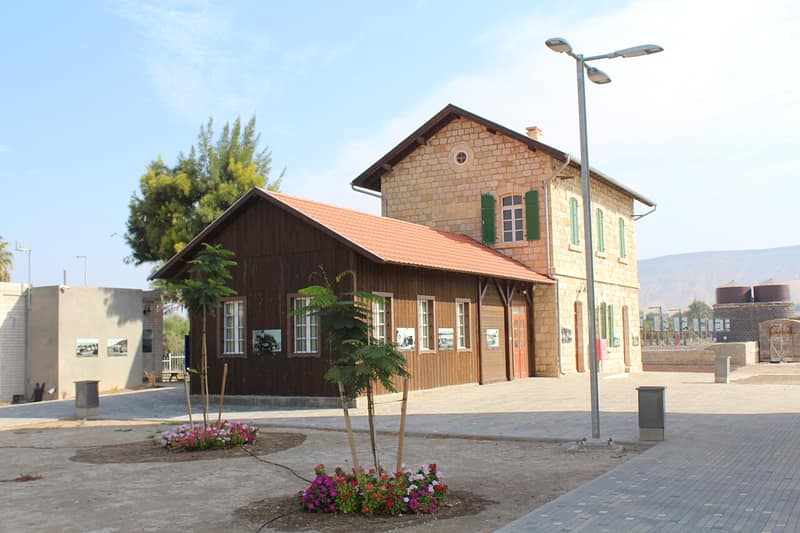
Samakh lay on flat ground in the Jordan valley on the southernmost shore of Lake Tiberias, a little east of the point where the Jordan leaves the lake and two hundred metres below sea level. It was the largest village of the Tiberias subdistrict in both area and population, and a junction: a station on the railway running from Haifa to the Hijaz line, a lakeside highway to the city of Tiberias, sailing routes across the water to the city’s harbour, and the roads connecting the country east of the Jordan with the country west of it. The village had been founded early in the nineteenth century on the remains of Roman-period Kefar Semah. Burckhardt saw it in 1812 as thirty or forty mud houses standing beside costlier ones of the black basalt abundant in the nearby Golan.
By 1945 Samakh had 3,460 inhabitants — 3,320 Muslims, 130 Christians and ten of other faiths — most of them from the settled Bedouin tribes of the Arab al-Suqur and Arab al-Bashatiwa. A local council created in 1923 saw its expenditure rise from £P310 in 1929 to £P1,111 in 1944. There were two schools, one for boys and one for girls. Grain and bananas were the chief crops, with 8,523 dunums sown in cereals in 1944/45, and the village’s position on the crossroads sustained a range of trades and services.
Some villagers left in the early months of the war, but Samakh was not emptied until the end of April. After Tiberias fell on 18 April the Golani Brigade turned to the village; Benny Morris records that Golani troops had earlier burned a nearby village after training in it for the assault. The History of the Haganah states only that on 28 April the police station at Samakh was occupied and the inhabitants evacuated the town. Arif al-Arif observed that the fall of Tiberias had already cut Samakh off from the rest of Palestine, leaving only the road to al-Hamma. On 18 May a Syrian column supported by Iraqi forces retook the village and a nearby Jewish settlement in a four-hour attack begun at four in the morning; a Yiftach Brigade counter-attack that night inflicted heavy losses on the Syrian defenders but failed to recover the place. The arrival on 20 May of four heavy guns landed days earlier at Tel Aviv harbour decided the matter: the Syrians withdrew under their fire and Golani units re-entered Samakh on the morning of 21 May.
Massada and Sha’ar ha-Golan, founded southeast of the site in 1937, expanded onto village land; Ma’agan was built on the village site itself in 1949 and Tel Qatzir on its land the same year. Most of the refugees went to Nazareth. Of the village there remain only the ruins of the railway station and a water reservoir; the settlers of Deganya Alef laid out a public park, a filling station and a factory on the site, and the surrounding land is farmed.
Sources
Cited works
3- palquest.org — samakh(opens in a new tab)https://www.palquest.org/en/place/17136/samakh
- zochrot.org — en(opens in a new tab)https://www.zochrot.org/villages/village_details/49339/en
- en.wikipedia.org — Samakh, Tiberias(opens in a new tab)https://en.wikipedia.org/wiki/Samakh,_Tiberias
Connected in the archive
10 connected records10 records elsewhere in the archive are linked to this one, each by a piece of evidence you can read below.
named in this record — 4 records
One record names the other. A pointer for reading, not a claim that they belong to each other.
- Haifaحيفا
Evidence — Inferred from the text — read the evidence: It was the largest village of the Tiberias subdistrict in both area and population, and a junction: a station on the railway running from Haifa to the Hijaz line, a lakeside highway to the city of Tiberias, sailing routes across the water to the city's harbour, and the roads connecting the country east of the Jordan with the country west of it.
- Nazarethالناصرة
Evidence — Inferred from the text — read the evidence: Most of the refugees went to Nazareth.
- Tiberiasطبريا
Evidence — Inferred from the text — read the evidence: It was the largest village of the Tiberias subdistrict in both area and population, and a junction: a station on the railway running from Haifa to the Hijaz line, a lakeside highway to the city of Tiberias, sailing routes across the water to the city's harbour, and the roads connecting the country east of the Jordan with the country west of it.
- Al-Hamma, Tiberiasالحمة السوريةmapped, not yet written up
Evidence — Inferred from the text — read the evidence: Arif al-Arif observed that the fall of Tiberias had already cut Samakh off from the rest of Palestine, leaving only the road to al-Hamma.
names this place — 1 record
One record names the other. A pointer for reading, not a claim that they belong to each other.
- Sirinسيرين
Evidence — Inferred from the text — read the evidence: A secondary road carried it to the highway running north to Samakh and south to Baysan.
in the same district — 5 records
Filed near each other — the same Mandate district, or the same uncommon subject tags.
- Ghuwayr Abu Shushaغوير أبو شوشة
Evidence — From a recorded field in this archive: Both recorded in the Tiberias district.
- Hittinحطّين
Evidence — From a recorded field in this archive: Both recorded in the Tiberias district.
- Khirbat al-Wa'ra al-Sawda'خربة الوعرة السوداء
Evidence — From a recorded field in this archive: Both recorded in the Tiberias district.
- Lubyaلوبيا
Evidence — From a recorded field in this archive: Both recorded in the Tiberias district.
- Nasir al-Dinناصر الدين
Evidence — From a recorded field in this archive: Both recorded in the Tiberias district.
Cite this page
Every claim above carries its sources — citation is the point.
- Chicago
“Samakh.” Village Memory, FALASTEEN.AI. Accessed 22 August 2026. https://falasteen.ai/memory/samakh.- MLA
“Samakh.” Village Memory, FALASTEEN.AI, 2026, https://falasteen.ai/memory/samakh. Accessed 22 August 2026.- BibTeX
@misc{falasteen-samakh,
  title        = {Samakh},
  howpublished = {\url{https://falasteen.ai/memory/samakh}},
  organization = {FALASTEEN.AI — A Living Archive for Palestine},
  year         = {2026},
  note         = {Accessed 2026-08-22}
}