Tulkarm district · depopulated 1948 · 2 min read
Qaqun
قاقون
Qaqun, crowned by a Crusader-Mamluk fortress northwest of Tulkarm, was stormed by the Alexandroni Brigade in June 1948 in one of the bloodiest battles of the war, fought trench-to-trench against Iraqi defenders. Some villagers held on in their homes into 1949; the fortress and the school still stand above its orchards.
See Qaqun on the Atlas32.3600°N · 34.9953°E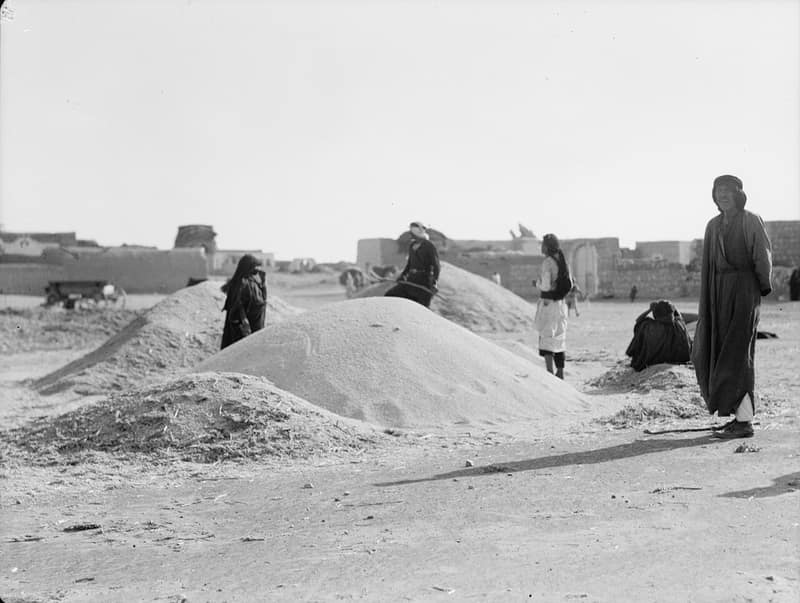
Qaqun stood on a hill overlooking its plain, northwest of Tulkarm, with the Tulkarm–Haifa railway passing half a kilometer to the east. Few Palestinian villages carried so much history: the Crusaders fortified it as Quaquo or Caco, within the jurisdiction of Caesarea; the Mamluk sultan Baybars captured it in 1267, rebuilt its fortress, and turned its church into a mosque; under the Mamluks it became a commercial center and a postal station on the Gaza–Damascus road. Al-Qalqashandi, writing before 1418, described a pleasant town with a mosque, a bath, a handsome fort, and wells. In 1596 Qaqun was itself the center of a nahiya in the liwa’ of Nablus, with 127 people. Napoleon’s forces defeated Ottoman troops there in 1799, and in the 1830s Ibrahim Pasha’s Egyptian army destroyed the town for joining the rebellion against Egypt. Rebuilt, it grew around the central tower of the old fort, its stone and mud houses spread over the hill. Its people were Muslims, with a boys’ elementary school under the Mandate; watermelons, cucumbers, olives, citrus, and grain filled its lands — 34,376 dunums of cereals in 1944/45. The 1945 survey counted 1,970 people.
The war reached Qaqun early: an Irgun raid on 6–7 March 1948 failed to penetrate the village, though grenades wounded two women, Filastin reported. On 9 May Haganah intelligence officers agreed to ‘expel or subdue’ Qaqun and other remaining coastal communities, according to records cited by Benny Morris. The blow fell on the night of 4–5 June, when the Alexandroni Brigade’s Third Battalion attacked behind heavy mortar and artillery fire. Iraqi army units held three lines of trenches outside the village and, in the New York Times’ account of ‘one of the bloodiest’ battles to date, fought hand-to-hand for hours before the position was decided in daylight. The official Israeli version claimed an entire Iraqi battalion of 450 men was wiped out, at an initially reported cost of twelve Israeli dead. Qaqun’s own story did not end that night: some inhabitants remained in their homes for more than a year, and in July 1949 Foreign Minister Moshe Sharett noted of Qaqun and other villages that ‘the Arabs learned the lesson; they are not running away,’ as Israel came under international warning not to expel them. The remaining villagers were gone soon after.
Kibbutz ha-Ma’pil had been built on traditional village land in 1945; Gan Yoshiyya, Ometz, and Olesh followed on village lands in 1949, and Channi’el in 1950. What remains of Qaqun is the fortress on its hill, ringed by the stone rubble of houses; a well that belonged to the Abu Hantash family; and the school building, still used as a school by Israelis. Orchards cover the lands around.
Sources
Cited works
3- palestineremembered.com — index(opens in a new tab)https://www.palestineremembered.com/Tulkarm/Qaqun/index.html
- zochrot.org — en(opens in a new tab)https://www.zochrot.org/villages/village_details/49445/en
- palquest.org — qaqun(opens in a new tab)https://www.palquest.org/en/place/17114/qaqun
Connected in the archive
6 connected records6 records elsewhere in the archive are linked to this one, each by a piece of evidence you can read below.
named in this record — 2 records
One record names the other. A pointer for reading, not a claim that they belong to each other.
- Nablusنابلس
Evidence — Inferred from the text — read the evidence: In 1596 Qaqun was itself the center of a nahiya in the liwa' of Nablus, with 127 people.
- Tulkarmطولكرم
Evidence — Inferred from the text — read the evidence: Qaqun stood on a hill overlooking its plain, northwest of Tulkarm, with the Tulkarm–Haifa railway passing half a kilometer to the east.
in the same district — 4 records
Filed near each other — the same Mandate district, or the same uncommon subject tags.
- Kafr Sabaكفر صابا
Evidence — From a recorded field in this archive: Both recorded in the Tulkarm district.
- Miskaمِسْكَة
Evidence — From a recorded field in this archive: Both recorded in the Tulkarm district.
- Umm Khalidأم خالد
Evidence — From a recorded field in this archive: Both recorded in the Tulkarm district.
- Wadi al-Hawarithوادي الحوارث
Evidence — From a recorded field in this archive: Both recorded in the Tulkarm district.
Cite this page
Every claim above carries its sources — citation is the point.
- Chicago
“Qaqun.” Village Memory, FALASTEEN.AI. Accessed 22 August 2026. https://falasteen.ai/memory/qaqun.- MLA
“Qaqun.” Village Memory, FALASTEEN.AI, 2026, https://falasteen.ai/memory/qaqun. Accessed 22 August 2026.- BibTeX
@misc{falasteen-qaqun,
  title        = {Qaqun},
  howpublished = {\url{https://falasteen.ai/memory/qaqun}},
  organization = {FALASTEEN.AI — A Living Archive for Palestine},
  year         = {2026},
  note         = {Accessed 2026-08-22}
}