Tulkarm district · depopulated 1948 · 2 min read
Kafr Saba
كفر صابا
Kafr Saba, a village on the coastal plain southeast of Qalqilya with shrines to two prophets, had pledged peace with its Jewish neighbors in December 1947 — yet the Alexandroni Brigade seized it two days before Israel declared statehood, driving its people toward Qalqilya. Modern Kfar Saba has spread over its lands, but old houses, the two shrines, and the cemetery remain.
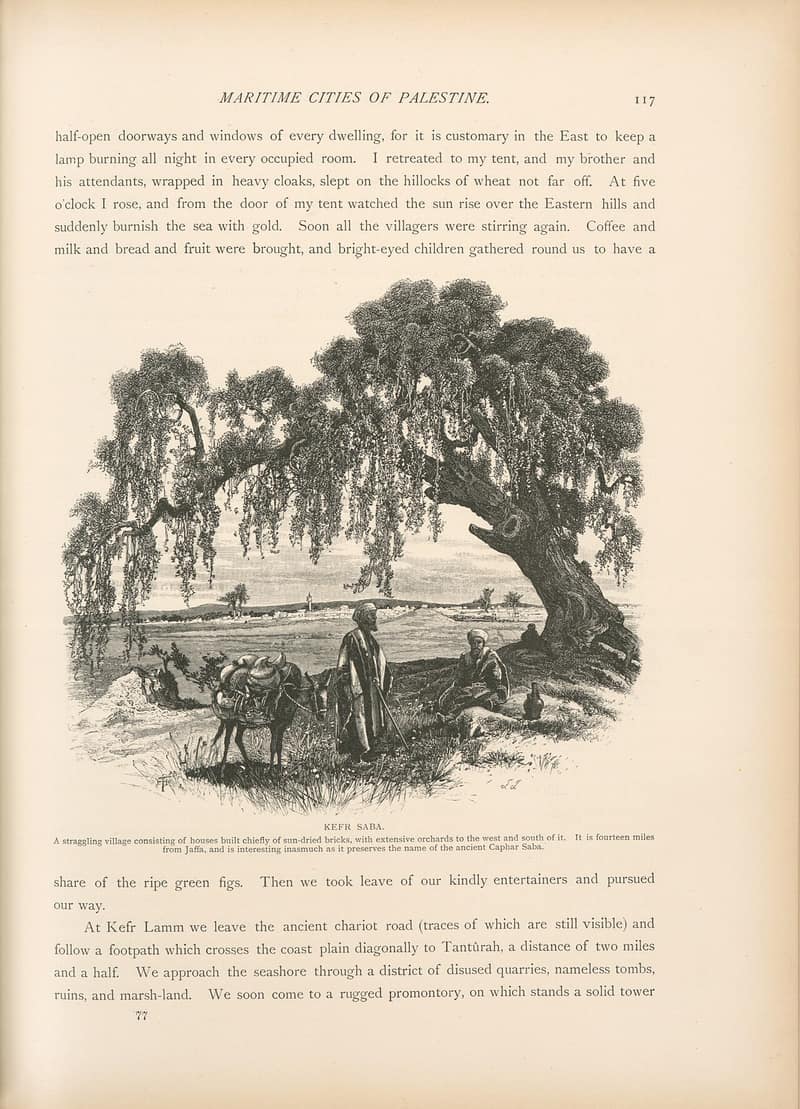
Kafr Saba stood on flat ground on the coastal plain, with the Jaffa–Tulkarm highway two and a half kilometers to the east and a secondary road linking it to Qalqilya, three kilometers northwest. It was built near Khirbat Sabya, identified with the Roman Caphar Saba, and the Crusaders knew it as Kapharseb. The geographers remembered it well: al-Maqdisi, writing in 985, described a large village with a mosque on the road to Damascus, and Nasir Khusraw in 1047 a town rich in fig and olive trees on the road to Ramla. In 1596 it was a village in the nahiya of Bani Sa’b with 231 people. The Sufi traveler al-Luqaymi visited in 1730 and saw the shrine of a local holy figure, Binyamin — al-Nabi Yamin; the village also kept a shrine for al-Nabi Yahya, John the Baptist. In the late nineteenth century it was a stone and adobe village of some 800 people on a low hill, ringed by sandy ground with olive groves to the north. Under the Mandate it expanded toward the highway; its people grew grain, watermelons, cucumbers, and vegetables, with 4,600 dunums of cereals and 1,026 of citrus and bananas in 1944/45. The 1945 survey counted 1,270 people, all Muslims.
Kafr Saba had tried to stay out of the war: the New York Times reported that its leaders met Jewish community leaders as early as December 1947 and that both sides pledged to keep the peace. But Haganah General Staff policy called for the area north of Tel Aviv to be emptied of its Arab residents by 15 May 1948, and the Alexandroni Brigade was charged with the village’s capture. A first ‘surprise’ assault on 10 May was repelled, according to Arab Liberation Army commander Fawzi al-Qawuqji, though it panicked the villagers; on 13 May the brigade attacked again, in daylight because of the terrain, and occupied the village, according to Benny Morris. The villagers fled or were expelled toward Qalqilya, and their arrival there helped prompt that town’s own temporary evacuation.
The Jewish town of Kefar Sava, founded in 1903 southwest of the village, has since expanded over much of the village land; Beyt Berl (1947) and Newe Yamin (1949, named after al-Nabi Yamin) were also built on it. Yet much survives in place: some of the old village houses stand within the modern town, several used as commercial buildings, and the two domed shrines, the school, and the ruins of the village cemetery remain.
Sources
Cited works
3- palestineremembered.com — index(opens in a new tab)https://www.palestineremembered.com/Tulkarm/Kafr-Saba/index.html
- zochrot.org — en(opens in a new tab)https://www.zochrot.org/villages/village_details/49226/en
- palquest.org — kafr saba(opens in a new tab)https://www.palquest.org/en/place/17035/kafr-saba
Connected in the archive
7 connected records7 records elsewhere in the archive are linked to this one, each by a piece of evidence you can read below.
named in this record — 2 records
One record names the other. A pointer for reading, not a claim that they belong to each other.
- Qalqilyaقلقيلية
Evidence — Inferred from the text — read the evidence: Kafr Saba stood on flat ground on the coastal plain, with the Jaffa–Tulkarm highway two and a half kilometers to the east and a secondary road linking it to Qalqilya, three kilometers northwest.
- Ramleالرملة
Evidence — Inferred from the text — read the evidence: The geographers remembered it well: al-Maqdisi, writing in 985, described a large village with a mosque on the road to Damascus, and Nasir Khusraw in 1047 a town rich in fig and olive trees on the road to Ramla.
names this place — 1 record
One record names the other. A pointer for reading, not a claim that they belong to each other.
- Balata Campمخيّم بلاطة
Evidence — Inferred from the text — read the evidence: About sixty percent came from a handful of places on the coastal plain: Jaffa and its satellite villages — Salama, al-Shaykh Muwannis, al-Abbasiyya, Arab Abu Kishk, al-Jammasin — together with Lydda, al-Tira, Kafr Saba and Bayt Dajan.
in the same district — 4 records
Filed near each other — the same Mandate district, or the same uncommon subject tags.
- Miskaمِسْكَة
Evidence — From a recorded field in this archive: Both recorded in the Tulkarm district.
- Qaqunقاقون
Evidence — From a recorded field in this archive: Both recorded in the Tulkarm district.
- Umm Khalidأم خالد
Evidence — From a recorded field in this archive: Both recorded in the Tulkarm district.
- Wadi al-Hawarithوادي الحوارث
Evidence — From a recorded field in this archive: Both recorded in the Tulkarm district.
Cite this page
Every claim above carries its sources — citation is the point.
- Chicago
“Kafr Saba.” Village Memory, FALASTEEN.AI. Accessed 22 August 2026. https://falasteen.ai/memory/kafr-saba.- MLA
“Kafr Saba.” Village Memory, FALASTEEN.AI, 2026, https://falasteen.ai/memory/kafr-saba. Accessed 22 August 2026.- BibTeX
@misc{falasteen-kafr-saba,
  title        = {Kafr Saba},
  howpublished = {\url{https://falasteen.ai/memory/kafr-saba}},
  organization = {FALASTEEN.AI — A Living Archive for Palestine},
  year         = {2026},
  note         = {Accessed 2026-08-22}
}