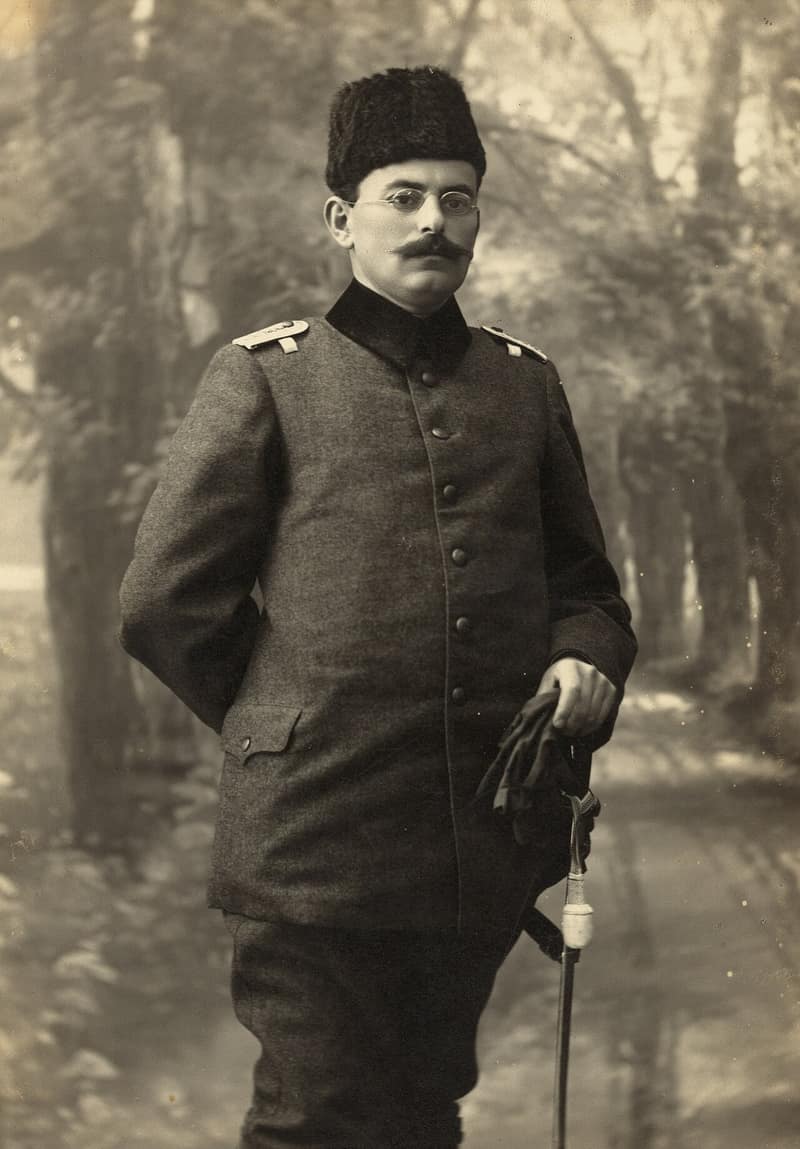
Tawfiq Canaan
توفيق كنعان
Physician and ethnographer
Jerusalem physician who documented Palestinian folk life — amulets, saints' shrines, and popular medicine — in foundational works of early twentieth-century ethnography.
Tawfiq Canaan was born in Beit Jala on 24 September 1882, the son of the first Arab Lutheran pastor in Palestine. After the Schneller School in Jerusalem he studied medicine at the Syrian Protestant College in Beirut — later the American University of Beirut — graduating with honours in 1905. He built a distinguished medical career in Jerusalem: municipal doctor, Ottoman medical officer in the First World War, director of the city’s leprosy hospital from 1919 until the end of the Mandate, founder and first president of the Palestine Arab Medical Association in 1944, and first director of the Augusta Victoria Hospital from 1950 until his death.
Alongside medicine, Canaan built a second career recording a folk world he saw disappearing. Beginning with the amulets his patients carried, he documented popular medicine, demonology, saints’ shrines, and seasonal customs, assembling a collection of more than 1,400 amulets and talismans — now the Tawfiq Canaan Collection at Birzeit University. His Mohammedan Saints and Sanctuaries in Palestine (1927) remains a standard reference. Politically outspoken, he was arrested by the British in 1939; in 1948 he lost his Musrara home, his clinic, his library, and several unpublished manuscripts. He died in Jerusalem on 15 January 1964 and was buried in Bethlehem.
Selected works
- Aberglaube und Volksmedizin im Lande der Bibel (Superstition and Popular Medicine in the Land of the Bible) (1914)
- Mohammedan Saints and Sanctuaries in Palestine (1927)
- Dämonenglaube im Lande der Bibel (Demon Belief in the Land of the Bible) (1929)
Sources
Further reading
An external biography or archive holding more on this life than the entry above.
Connected in the archive
10 connected records10 records elsewhere in the archive are linked to this one, each by a piece of evidence you can read below.
named in this record — 2 records
One record names the other. A pointer for reading, not a claim that they belong to each other.
- Bethlehemبيت لحم
Evidence — Inferred from the text — read the evidence: He died in Jerusalem on 15 January 1964 and was buried in Bethlehem.
- Jerusalemالقدس
Evidence — Inferred from the text — read the evidence: After the Schneller School in Jerusalem he studied medicine at the Syrian Protestant College in Beirut — later the American University of Beirut — graduating with honours in 1905.
on a related subject — 8 records
Filed near each other — the same Mandate district, or the same uncommon subject tags.
- Armenian Ceramics of Jerusalem
Evidence — Inferred from the text — read the evidence: Shared tag: "Jerusalem".
- El-Funoun Palestinian Popular Dance Troupe
Evidence — Inferred from the text — read the evidence: Shared tag: "folklore".
- The Abu Khdeir familyأبو خضير
Evidence — Inferred from the text — read the evidence: Shared tag: "Jerusalem".
- The Al-Alami familyالعلمي
Evidence — Inferred from the text — read the evidence: Shared tag: "Jerusalem".
- The Ansari familyالأنصاري
Evidence — Inferred from the text — read the evidence: Shared tag: "Jerusalem".
- The Dajani familyالدجاني
Evidence — Inferred from the text — read the evidence: Shared tag: "Jerusalem".
- and 2 more
Cite this page
Every claim above carries its sources — citation is the point.
- Chicago
“Tawfiq Canaan.” Figures, FALASTEEN.AI. Accessed 22 August 2026. https://falasteen.ai/figures/tawfiq-canaan.- MLA
“Tawfiq Canaan.” Figures, FALASTEEN.AI, 2026, https://falasteen.ai/figures/tawfiq-canaan. Accessed 22 August 2026.- BibTeX
@misc{falasteen-tawfiq-canaan,
  title        = {Tawfiq Canaan},
  howpublished = {\url{https://falasteen.ai/figures/tawfiq-canaan}},
  organization = {FALASTEEN.AI — A Living Archive for Palestine},
  year         = {2026},
  note         = {Accessed 2026-08-22}
}