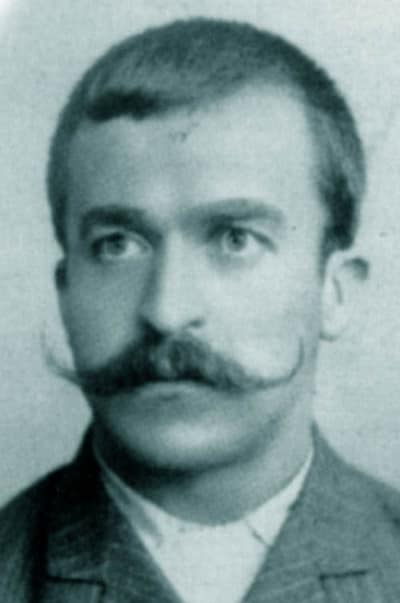
Khalil al-Sakakini
خليل السكاكيني
Educator and diarist
Jerusalem teacher who built a school without grades or punishments, and kept a diary for forty-five years that is now one of the fullest private records of Palestinian life before 1948.
Khalil al-Sakakini was born in Jerusalem on 23 January 1878, the son of Qustandi al-Sakakini and Mariam Harami. He was schooled at the Greek Orthodox school, the Anglican mission school, Bishop Gobat’s School, and the college where he studied under the Arabist Nakhla Zurayq, graduating in 1893; he went to the United States in October 1907 and worked there as an Arabic teacher, translator, shop salesman, and factory hand before returning. In 1909 he co-founded the Dusturiyya — the Constitutional School — which admitted students of every religion and sect and ran on principles that were radical for the late Ottoman city: no grades, no prizes, no punishments, serious attention to music and athletics, and instruction in Arabic rather than Turkish.
Public life followed. He took part in the Fifth Palestinian National Congress at Nablus in August 1922, served as secretary of the Arab Executive Committee in 1923 and 1924, rejoined the Department of Education as inspector-general of the Arabic language in 1925, and was elected to the Arab Academy in Damascus the same year. He remained, throughout, first a teacher.
In 1917 the Ottoman authorities arrested him for sheltering Alter Levine, a Polish-American Jewish resident of Jerusalem. The two men were sent to prison in Damascus and became close friends there — an episode Sakakini recorded at length, and one that complicates any flat account of the period’s communal lines.
He kept a journal from 1907 to 1952. Nothing else of its kind survives from Palestinian Jerusalem: a private, daily, self-interrogating record of a city across the last Ottoman decade, the whole of the British Mandate, and the catastrophe at the end of it. His daughter Hala edited the diaries, and publication began in 2003 through the Khalil Sakakini Cultural Centre in Ramallah, planned across eight volumes.
The Sakakinis were among the last families to leave the Katamon quarter of Jerusalem before the city was divided in 1948, and fled to Cairo. The house and the library in it were left behind. He died in Cairo on 13 August 1953, three months after the death of his son Sari. Streets and schools in Jerusalem and Cairo carry his name.
Sources
Further reading
An external biography or archive holding more on this life than the entry above.
Connected in the archive
10 connected records10 records elsewhere in the archive are linked to this one, each by a piece of evidence you can read below.
born in — 1 record
- Jerusalemالقدس
Evidence — From a recorded field in this archive: birthplace: "Jerusalem, Palestine" → Jerusalem (Jerusalem Governorate)
named in this record — 1 record
One record names the other. A pointer for reading, not a claim that they belong to each other.
- Ramallahرام الله
Evidence — Inferred from the text — read the evidence: His daughter Hala edited the diaries, and publication began in 2003 through the Khalil Sakakini Cultural Centre in Ramallah, planned across eight volumes.
names this person — 1 record
One record names the other. A pointer for reading, not a claim that they belong to each other.
- The Ansari familyالأنصاري
Evidence — Inferred from the text — read the evidence: "A hero fell yesterday on the field of honor," Khalil al-Sakakini wrote in his diary, "the greatest hero Palestine has known."
on a related subject — 7 records
Filed near each other — the same Mandate district, or the same uncommon subject tags.
- Hind al-Husseiniهند الحسيني
Evidence — From a recorded field in this archive: Shared tags: "education", "Jerusalem".
- Armenian Ceramics of Jerusalem
Evidence — Inferred from the text — read the evidence: Shared tag: "Jerusalem".
- The Abu Khdeir familyأبو خضير
Evidence — Inferred from the text — read the evidence: Shared tag: "Jerusalem".
- The Al-Alami familyالعلمي
Evidence — Inferred from the text — read the evidence: Shared tag: "Jerusalem".
- The Dajani familyالدجاني
Evidence — Inferred from the text — read the evidence: Shared tag: "Jerusalem".
- The Husayni familyالحسيني
Evidence — Inferred from the text — read the evidence: Shared tag: "Jerusalem".
- and 1 more
Cite this page
Every claim above carries its sources — citation is the point.
- Chicago
“Khalil al-Sakakini.” Figures, FALASTEEN.AI. Accessed 22 August 2026. https://falasteen.ai/figures/khalil-al-sakakini.- MLA
“Khalil al-Sakakini.” Figures, FALASTEEN.AI, 2026, https://falasteen.ai/figures/khalil-al-sakakini. Accessed 22 August 2026.- BibTeX
@misc{falasteen-khalil-al-sakakini,
  title        = {Khalil al-Sakakini},
  howpublished = {\url{https://falasteen.ai/figures/khalil-al-sakakini}},
  organization = {FALASTEEN.AI — A Living Archive for Palestine},
  year         = {2026},
  note         = {Accessed 2026-08-22}
}