Jaffa district · depopulated 1948 · 2 min read
Salama
سلمة
Salama, the largest village on Jaffa's eastern approaches and home of the shrine of the Prophet's companion Salama Abu Hashim, fought off attack after attack from December 1947 — the Haganah's own history calls its December assault 'the first attack on an Arab village' — before falling on 29 April 1948. Its mosque, shrine, and shuttered houses stand inside Tel Aviv's sprawl.
See Salama on the Atlas32.0491°N · 34.8050°E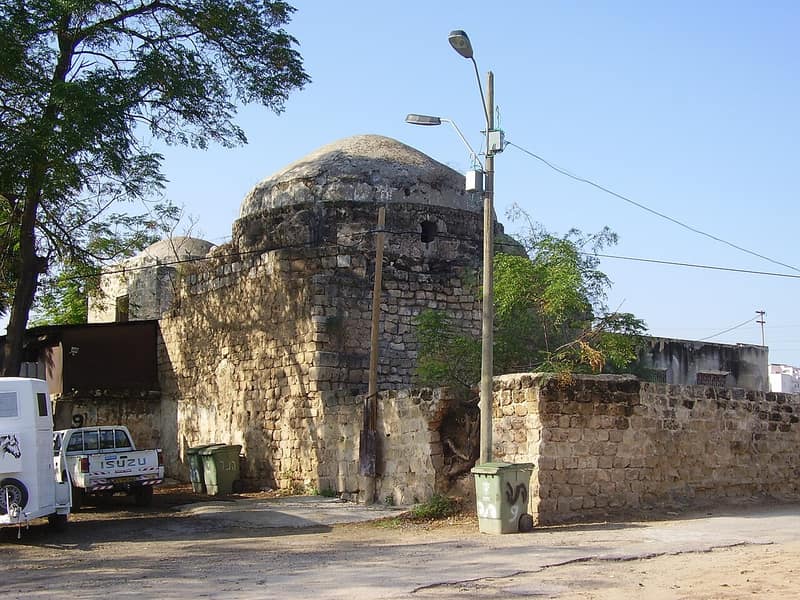
Salama stood on flat terrain on the central coastal plain, on the north side of a highway leading to Jaffa. Its people believed the village was named for Salama Abu Hashim, a companion of the Prophet Muhammad buried there in 634, whose tomb on the northwest side became the shrine of Sayyiduna Salama. In 1596 it was a village in the nahiya of Ramla with ninety-four people. Under the Mandate it grew into one of the largest villages of the plain: quarters for each clan were grouped around shared courtyards, houses of adobe and stone and even wooden ‘Baghdadi’ houses going up among the orchards. It had two elementary schools — boys (1920) and girls (1936), with 504 boys and 121 girls in 1941 — five coffee shops, a soccer team, and its own bus line, the Salama–al-Abbasiyya Automobile Company. Some eighty-five artesian wells irrigated 2,853 dunums of citrus and bananas; produce went to Jaffa’s markets, milk to a Jaffa dairy owned by two men of the village. The 1945 survey counted 6,730 people, of whom sixty were Christians.
Hemmed in by Jewish settlements, Salama came under almost continuous attack for five months. The first came on 5 December 1947, a week after the UN partition resolution, when the New York Times reported Haganah machine-gun fire on the village and Arab families evacuating toward Ramla and Lydda. ‘In December 1947 the Haganah leadership in Tel Aviv decided to attack the infamous village of Salama,’ the History of the Haganah records, adding that ‘this was the first attack on an Arab village’; the dawn assault of 19 December failed, and a larger raid on 28 December was not only driven back but answered with a counterattack toward Petah Tiqva by the villagers joined by militiamen from Lydda and al-Abbasiyya. Filastin counted no fewer than ten separate attacks in January alone. On 18 January the Alexandroni Brigade’s Third Battalion mounted a major operation whose orders, as quoted by Benny Morris, were ‘to cause deaths, blow up houses and to burn everything possible.’ The village held out until Operation Hametz, the encirclement of Jaffa: by nightfall on 29 April 1948 Salama had fallen to units of the Kiryati and Giv’ati brigades, and its remaining people joined the flight toward Lydda and al-Ramla.
The village and its lands have been engulfed by the expansion of Tel Aviv; the neighborhood of Kfar Shalem was built on the site. Yet much of Salama still stands: numerous houses, four named coffee shops, the mosque, the domed shrine, a cemetery, and the two schools. Most houses are deserted and dilapidated, a few inhabited; one cemetery lies overgrown while the other has been made into a small park. Fig, cypress, and palm trees and cactuses grow between the buildings.
Sources
Cited works
3- palestineremembered.com — index(opens in a new tab)https://www.palestineremembered.com/Jaffa/Salama/index.html
- zochrot.org — en(opens in a new tab)https://www.zochrot.org/villages/village_details/49897/en
- palquest.org — salama(opens in a new tab)https://www.palquest.org/en/place/17133/salama
Connected in the archive
15 connected records15 records elsewhere in the archive are linked to this one, each by a piece of evidence you can read below.
named in this record — 3 records
One record names the other. A pointer for reading, not a claim that they belong to each other.
- Jaffaيافا
Evidence — Inferred from the text — read the evidence: Salama stood on flat terrain on the central coastal plain, on the north side of a highway leading to Jaffa.
- Lyddaاللد
Evidence — Inferred from the text — read the evidence: …and a larger raid on 28 December was not only driven back but answered with a counterattack toward Petah Tiqva by the villagers joined by militiamen from Lydda and al-Abbasiyya.…
- Ramleالرملة
Evidence — Inferred from the text — read the evidence: In 1596 it was a village in the nahiya of Ramla with ninety-four people.
in the same district — 12 records
Filed near each other — the same Mandate district, or the same uncommon subject tags.
- Abu Kishkأبو كِشْك
Evidence — From a recorded field in this archive: Both recorded in the Jaffa district.
- Al-'Abbasiyyaالعَبّاسِيَّة
Evidence — From a recorded field in this archive: Both recorded in the Jaffa district.
- al-Jammasin al-Gharbiالجَمّاسِين الغربي
Evidence — From a recorded field in this archive: Both recorded in the Jaffa district.
- al-Jammasin al-Sharqiالجَمّاسِين الشرقي
Evidence — From a recorded field in this archive: Both recorded in the Jaffa district.
- Al-Khayriyyaالخيرية
Evidence — From a recorded field in this archive: Both recorded in the Jaffa district.
- Al-Manshiyyaالمنشية
Evidence — From a recorded field in this archive: Both recorded in the Jaffa district.
- and 6 more
Cite this page
Every claim above carries its sources — citation is the point.
- Chicago
“Salama.” Village Memory, FALASTEEN.AI. Accessed 22 August 2026. https://falasteen.ai/memory/salama-jaffa.- MLA
“Salama.” Village Memory, FALASTEEN.AI, 2026, https://falasteen.ai/memory/salama-jaffa. Accessed 22 August 2026.- BibTeX
@misc{falasteen-salama-jaffa,
  title        = {Salama},
  howpublished = {\url{https://falasteen.ai/memory/salama-jaffa}},
  organization = {FALASTEEN.AI — A Living Archive for Palestine},
  year         = {2026},
  note         = {Accessed 2026-08-22}
}