Jaffa district · depopulated 1948 · 2 min read
Al-Manshiyya
المنشية
Al-Manshiyya was the mixed Arab-Jewish quarter of Jaffa on the seafront north of the harbor. It fell to the Irgun in late April 1948 after a battle that drew in British armor, and its ruined streets were erased for a planned business district; the Hassan Bek Mosque and two other buildings are all that remain.
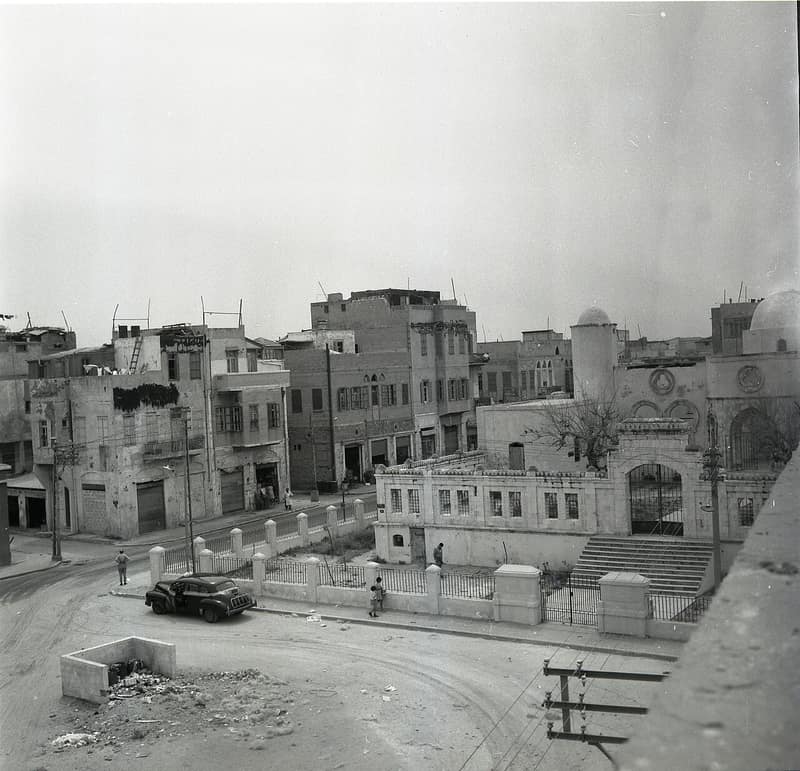
Al-Manshiyya grew up in the late 1870s, when Jaffa burst its old walls — demolished in 1879 — and spread north along the seafront toward the new Jewish neighborhoods. The quarter stood on the border between Jaffa and Tel Aviv, north of the harbor, and from the start it was mixed: mainly Muslim Arabs, but also Jews, who knew the area as Neve Shalom and built houses, a synagogue, and a ritual bath there; at one point the quarter had four mukhtars, three Arabs and a Jew. A 1944 British police report estimated its population at some 12,000 Arabs and 1,000 Jews. Its best-known landmark was the Ottoman-era Hassan Bek Mosque, standing at the edge of the shore road.
In the last weeks of the Mandate, al-Manshiyya became the front line of the battle for Jaffa. The quarter was broken by Irgun bombardments during the civil war, and in late April 1948, during Operation Hametz, the Irgun captured it along with the villages around Jaffa. The British, then withdrawing through Arab-held territory and fearing retaliation against their troops, deployed 4,500 men to Jaffa and shelled the Irgun positions in al-Manshiyya with artillery and tanks; when British armor pushed into the quarter, the Irgun knocked out a tank with a bazooka and dropped dynamite into others, and the British withdrew — the only direct battle ever fought between British forces and the Irgun. Al-Manshiyya fell on 28 April 1948 after scores of Palestinians were killed or wounded, and the quarter was severed from Jaffa; its remaining Arab residents fled, many by sea.
What was left of the quarter’s houses was left to decay and then demolished between the late 1960s and early 1980s, to make way for a central business district that was only ever partly built. Some forty hectares are now office buildings, parking lots, and public gardens, and the seaside strip became Charles Clore Park. Three buildings survive from the old quarter: the Hassan Bek Mosque, restored and returned to prayer; the shell of the house known as Beit Gidi, which holds part of the Irgun Museum; and a derelict house on Mered Street.
Sources
Cited works
3- zochrot.org — en(opens in a new tab)https://www.zochrot.org/villages/village_details/56077/en
- en.wikipedia.org — Manshiya(opens in a new tab)https://en.wikipedia.org/wiki/Manshiya
- journal.urbantranscripts.org — al manshiyya bordering and spatializations of difference on the vanishing palestinian coastline taylor kathryn miller(opens in a new tab)https://journal.urbantranscripts.org/article/al-manshiyya-bordering-and-spatializations-of-difference-on-the-vanishing-palestinian-coastline-taylor-kathryn-miller/
Connected in the archive
13 connected records13 records elsewhere in the archive are linked to this one, each by a piece of evidence you can read below.
named in this record — 1 record
One record names the other. A pointer for reading, not a claim that they belong to each other.
- Jaffaيافا
Evidence — Inferred from the text — read the evidence: The quarter was broken by Irgun bombardments during the civil war, and in late April 1948, during Operation Hametz, the Irgun captured it along with the villages around Jaffa.
in the same district — 12 records
Filed near each other — the same Mandate district, or the same uncommon subject tags.
- Abu Kishkأبو كِشْك
Evidence — From a recorded field in this archive: Both recorded in the Jaffa district.
- Al-'Abbasiyyaالعَبّاسِيَّة
Evidence — From a recorded field in this archive: Both recorded in the Jaffa district.
- al-Jammasin al-Gharbiالجَمّاسِين الغربي
Evidence — From a recorded field in this archive: Both recorded in the Jaffa district.
- al-Jammasin al-Sharqiالجَمّاسِين الشرقي
Evidence — From a recorded field in this archive: Both recorded in the Jaffa district.
- Al-Khayriyyaالخيرية
Evidence — From a recorded field in this archive: Both recorded in the Jaffa district.
- Al-Mas'udiyyaالمَسْعُودِيَّة
Evidence — From a recorded field in this archive: Both recorded in the Jaffa district.
- and 6 more
Cite this page
Every claim above carries its sources — citation is the point.
- Chicago
“Al-Manshiyya.” Village Memory, FALASTEEN.AI. Accessed 22 August 2026. https://falasteen.ai/memory/al-manshiyya-jaffa.- MLA
“Al-Manshiyya.” Village Memory, FALASTEEN.AI, 2026, https://falasteen.ai/memory/al-manshiyya-jaffa. Accessed 22 August 2026.- BibTeX
@misc{falasteen-al-manshiyya-jaffa,
  title        = {Al-Manshiyya},
  howpublished = {\url{https://falasteen.ai/memory/al-manshiyya-jaffa}},
  organization = {FALASTEEN.AI — A Living Archive for Palestine},
  year         = {2026},
  note         = {Accessed 2026-08-22}
}