Gaza district · depopulated 1948 · 2 min read
Kaufakha
كوفخة
Kaufakha was a farming village east of Gaza, founded by Gaza city families in the late nineteenth century around a well-known mosque. Its people repeatedly asked to surrender and stay, to no avail: the Palmach's Negev Brigade expelled them in late May 1948. Only the mosque remains, used as a stable and fodder store.
See Kaufakha on the Atlas31.4782°N · 34.6616°E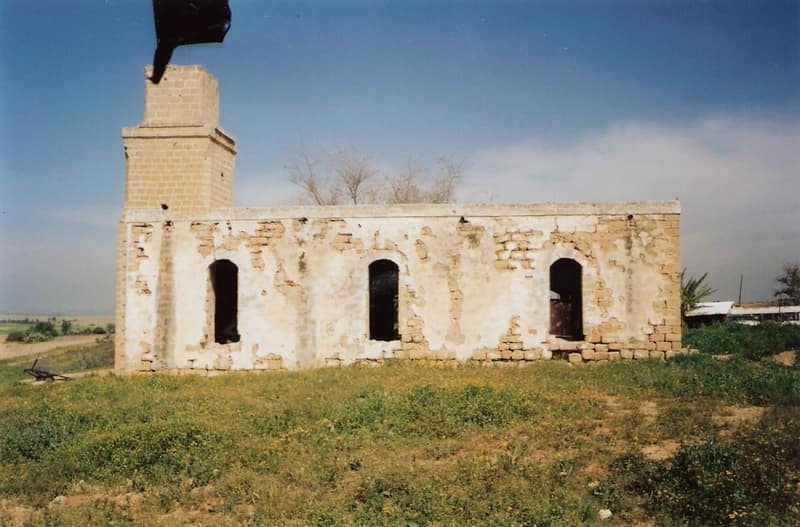
Kaufakha stood on sandy, rolling land in the northern Negev, eighteen kilometers east of Gaza, along the southern bank of Wadi Abu Shunnar. The site was old — Byzantine ceramics have been found there, and in 1472–73 the Mamluk sultan Qaitbay endowed it for the benefit of his madrasa in Jerusalem — but by 1838 it was recorded as deserted. The modern village was founded in the late nineteenth century by residents of Gaza city who came to cultivate the surrounding land, and at its center rose a mosque, well known in the region, built in the reign of Sultan Abd al-Hamid II. The village had an elementary school and small shops, drew water from two wells, and planted its northern lands with apricots, olives, almonds, grapes, and figs while the rest grew grain. The 1945 survey counted 500 people, all Muslims, on 8,569 dunums, most of it public land.
During the war the villagers of Kaufakha repeatedly asked to surrender, to accept Jewish rule, and to be allowed to stay in their homes — all to no avail. On the night of 27–28 May 1948 the Palmach’s Negev Brigade raided Kaufakha together with neighboring al-Muharraqa, and the inhabitants of both villages were expelled or driven out; a New York Times correspondent reported their capture on 30 May.
Only the mosque remains on the site, a stone structure with arched entrances and windows on all sides, its roof topped by three shallow domes and a thick square minaret at its corner; in recent decades it has served a nearby ranch as a storehouse for animal fodder and a horse stable. The site, fenced in and overgrown with cactuses and desert plants, is used as pasture, with a citrus grove to its west and grain grown on the surrounding land. In 1953 the moshav of Nir Akiva was established on village lands, southwest of the site.
Sources
Cited works
3- palestineremembered.com — index(opens in a new tab)https://www.palestineremembered.com/Gaza/Kawfakha/index.html
- zochrot.org — en(opens in a new tab)https://www.zochrot.org/villages/village_details/49219/en
- palquest.org — kawfakha(opens in a new tab)https://www.palquest.org/en/place/17040/kawfakha
Connected in the archive
36 connected records36 records elsewhere in the archive are linked to this one, each by a piece of evidence you can read below.
named in this record — 1 record
One record names the other. A pointer for reading, not a claim that they belong to each other.
- Jerusalemالقدس
Evidence — Inferred from the text — read the evidence: The site was old — Byzantine ceramics have been found there, and in 1472–73 the Mamluk sultan Qaitbay endowed it for the benefit of his madrasa in Jerusalem — but by 1838 it was recorded as deserted.
names this place — 1 record
One record names the other. A pointer for reading, not a claim that they belong to each other.
- Gaza, by Name
Evidence — From a recorded field in this archive: Its people asked repeatedly to surrender and stay. They were expelled in late May 1948 regardless. Only the mosque remains.
in the same district — 34 records
Filed near each other — the same Mandate district, or the same uncommon subject tags.
- 'Iraq al-Manshiyyaعِراق المَنْشِيَّة
Evidence — From a recorded field in this archive: Both recorded in the Gaza district.
- Al-Falujaالفالوجة
Evidence — From a recorded field in this archive: Both recorded in the Gaza district.
- Al-Jiyyaالجِيَّة
Evidence — From a recorded field in this archive: Both recorded in the Gaza district.
- Al-Juraالجُورَة
Evidence — From a recorded field in this archive: Both recorded in the Gaza district.
- Al-Majdalالمجدل
Evidence — From a recorded field in this archive: Both recorded in the Gaza district.
- Al-Masmiyya al-Kabiraالمَسْمِيَّة الكَبِيرَة
Evidence — From a recorded field in this archive: Both recorded in the Gaza district.
- and 28 more
Cite this page
Every claim above carries its sources — citation is the point.
- Chicago
“Kaufakha.” Village Memory, FALASTEEN.AI. Accessed 22 August 2026. https://falasteen.ai/memory/kaufakha.- MLA
“Kaufakha.” Village Memory, FALASTEEN.AI, 2026, https://falasteen.ai/memory/kaufakha. Accessed 22 August 2026.- BibTeX
@misc{falasteen-kaufakha,
  title        = {Kaufakha},
  howpublished = {\url{https://falasteen.ai/memory/kaufakha}},
  organization = {FALASTEEN.AI — A Living Archive for Palestine},
  year         = {2026},
  note         = {Accessed 2026-08-22}
}