Gaza district · depopulated 1949 · 1 min read
Al-Faluja
الفالوجة
Al-Faluja was the anchor of the besieged 'Faluja pocket,' where Egyptian forces — among them a young Gamal Abdel Nasser — held out through the winter of 1948–49. Weeks after the Egyptian withdrawal under the armistice, the town's remaining civilians were driven out and its houses destroyed.
See Al-Faluja on the Atlas31.6246°N · 34.7477°E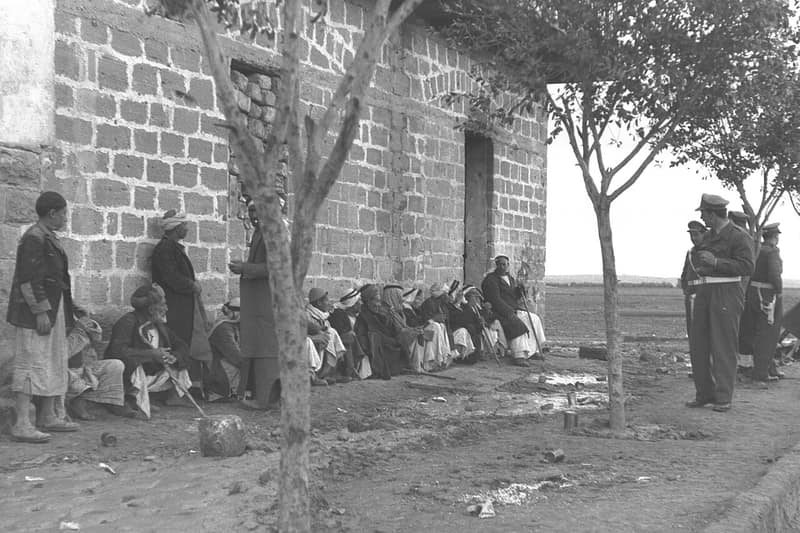
Al-Faluja sat on hilly ground thirty kilometers east of Gaza, ringed by the bends of Wadi al-Faluja and commanding a junction of roads to Hebron, Jerusalem, and Bir al-Sab’. It was a market village of mud-brick and stone houses, its people farming grain, olives, and orchards; the 1945 British survey counted about 4,700 residents.
The town’s name became famous in the war’s final months. When the Egyptian army advanced into Palestine in May 1948, its brigades dug in around al-Faluja and neighboring Iraq al-Manshiyya; cut off by the Israeli offensives of October, the garrison — including a staff officer named Gamal Abdel Nasser — held out through the winter in what became known as the Faluja pocket. Under the February 1949 armistice with Egypt the soldiers marched out with their weapons, but the civilians who had stayed were promised they could remain. Within weeks, according to accounts documented by historians on both sides, they were subjected to shootings, beatings, and looting intended to drive them out; by mid-March 1949 the town was empty, its people expelled toward Gaza and Hebron over the protests of UN observers and the American embassy.
Al-Faluja was then demolished. Qiryat Gat and several smaller settlements later rose on and around its lands, and its refugees scattered mainly to the camps of the Gaza Strip — carrying with them the memory of a town that survived a famous siege only to be emptied after the fighting had formally ended.
Sources
Cited works
4- palestineremembered.com — index(opens in a new tab)https://www.palestineremembered.com/Gaza/al-Faluja/index.html
- zochrot.org — en(opens in a new tab)https://www.zochrot.org/villages/village_details/49437/en
- palquest.org — al faluja(opens in a new tab)https://www.palquest.org/en/place/16807/al-faluja
- en.wikipedia.org — Al Faluja(opens in a new tab)https://en.wikipedia.org/wiki/Al-Faluja
Connected in the archive
36 connected records36 records elsewhere in the archive are linked to this one, each by a piece of evidence you can read below.
names this place — 4 records
One record names the other. A pointer for reading, not a claim that they belong to each other.
- Al-Masmiyya al-Saghiraالمسمية الصغيرة
Evidence — Inferred from the text — read the evidence: The villagers raised an estimated 4,000 animals — sheep, goats, cows, camels, and mules among them — took part in the weekly Thursday market in al-Faluja, and sold produce in al-Majdal, Gaza, and Jaffa.
- Karatiyyaكَرَتِيّا
Evidence — Inferred from the text — read the evidence: Karatiyya stood on flat ground in the coastal region twenty-nine kilometers from Gaza, with Wadi al-Mufrid, descending from al-Faluja to the east, cutting across its southern and western edges.
- Summilسميل
Evidence — Inferred from the text — read the evidence: …hundred feet deep and 'a portion of an ancient wall apparently once belonging to a castle.' Under the Mandate the village expanded southwestward and looked to al-Faluja, six kilometers away, for commerce, medicine, and administration.…
- Umm Omar
Evidence — Inferred from the text — read the evidence: Umm Omar was eight when her family was driven out of Jusayr, a farming village near al-Faluja, and ended up in Jabaliya camp in the northern Gaza Strip.
named in this record — 2 records
One record names the other. A pointer for reading, not a claim that they belong to each other.
- 'Iraq al-Manshiyyaعِراق المَنْشِيَّة
Evidence — Inferred from the text — read the evidence: When the Egyptian army advanced into Palestine in May 1948, its brigades dug in around al-Faluja and neighboring Iraq al-Manshiyya; cut off by the Israeli offensives of October, the garrison — including a staff officer named Gamal Abdel Nasser — held out through the winter in what became known as the Faluja pocket.
- Hebronالخليل
Evidence — Inferred from the text — read the evidence: Al-Faluja sat on hilly ground thirty kilometers east of Gaza, ringed by the bends of Wadi al-Faluja and commanding a junction of roads to Hebron, Jerusalem, and Bir al-Sab'.
in the same district — 30 records
Filed near each other — the same Mandate district, or the same uncommon subject tags.
- Al-Jiyyaالجِيَّة
Evidence — From a recorded field in this archive: Both recorded in the Gaza district.
- Al-Juraالجُورَة
Evidence — From a recorded field in this archive: Both recorded in the Gaza district.
- Al-Majdalالمجدل
Evidence — From a recorded field in this archive: Both recorded in the Gaza district.
- Al-Masmiyya al-Kabiraالمَسْمِيَّة الكَبِيرَة
Evidence — From a recorded field in this archive: Both recorded in the Gaza district.
- Al-Muharraqaالمحرقة
Evidence — From a recorded field in this archive: Both recorded in the Gaza district.
- Al-Sawafir al-Gharbiyyaالسَوافِير الغربية
Evidence — From a recorded field in this archive: Both recorded in the Gaza district.
- and 24 more
Cite this page
Every claim above carries its sources — citation is the point.
- Chicago
“Al-Faluja.” Village Memory, FALASTEEN.AI. Accessed 22 August 2026. https://falasteen.ai/memory/al-faluja.- MLA
“Al-Faluja.” Village Memory, FALASTEEN.AI, 2026, https://falasteen.ai/memory/al-faluja. Accessed 22 August 2026.- BibTeX
@misc{falasteen-al-faluja,
  title        = {Al-Faluja},
  howpublished = {\url{https://falasteen.ai/memory/al-faluja}},
  organization = {FALASTEEN.AI — A Living Archive for Palestine},
  year         = {2026},
  note         = {Accessed 2026-08-22}
}