Haifa district · depopulated 1948 · 2 min read
Kafr Lam
كفر لام
Kafr Lam was a small grain-farming village on the coast south of Haifa, crowded inside the walls of an early Islamic ribat that the Crusaders called Cafarlet. Cleared of its people by July 1948, it escaped demolition thanks to its ruins; the fortress and several houses still stand within the moshav of HaBonim.
See Kafr Lam on the Atlas32.6374°N · 34.9344°E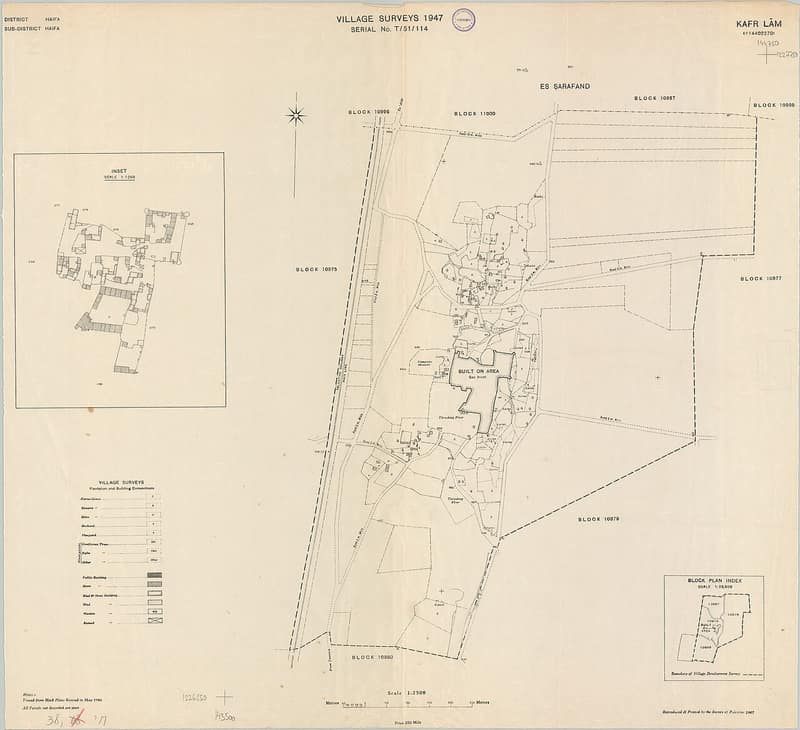
Kafr Lam lay on the Mediterranean coast twenty-six kilometers south of Haifa. Few villages wore their age so openly: the geographer Yaqut attributes its founding to the Umayyad caliph Hisham ibn Abd al-Malik (r. 724–743), and the fortress at its heart, built like a Roman castrum, was a ribat raised in the late Umayyad or early Abbasid period to guard the coast against the Byzantines. The Crusaders knew village and fort as Cafarlet, a fief of the lord of Caesarea sold to the Hospitallers in 1232 and later held by the Templars. Nineteenth-century travelers found a small village of mud-and-stone houses crowded within the ancient walls; Mary Rogers, visiting in 1856, noted fields of wheat, millet, sesame, and tobacco around it. Its people farmed grain and drew water from five wells on their lands. The 1945 survey counted 340 people, all Muslims, on 6,838 dunums.
The village emptied early in May 1948, but by mid-May some of its people had returned. On 15 May, the first day of the war, troops of the Carmeli Brigade occupied Kafr Lam and neighboring al-Sarafand and briefly garrisoned them; both villages were re-occupied and cleared of their inhabitants by mid-July, in an operation that saw the first use of Israeli naval support fire, two warships directing light-weapons fire at Kafr Lam and al-Sarafand. Demolition followed — until archaeologists protested. On 7 October 1948 the Haifa district headquarters ordered the 123rd Battalion to stop all demolition in Caesarea, Atlit, Kafr Lam, and Tiberias, sites rich in Roman and Crusader remains.
The moshavim of HaBonim and Ein Ayala were established on village lands in 1949. Because of the archaeological interest, much of Kafr Lam was left standing: in 1992 the abandoned Crusader fortress and several houses still stood, one of them — the house of Ahmad Bey Khalil — converted into a school, another serving as an Israeli post office.
Sources
Cited works
3- palestineremembered.com — index(opens in a new tab)https://www.palestineremembered.com/Haifa/Kafr-Lam/index.html
- zochrot.org — en(opens in a new tab)https://www.zochrot.org/villages/village_details/49236/en
- palquest.org — kafr lam(opens in a new tab)https://www.palquest.org/en/place/20677/kafr-lam
Connected in the archive
18 connected records18 records elsewhere in the archive are linked to this one, each by a piece of evidence you can read below.
named in this record — 1 record
One record names the other. A pointer for reading, not a claim that they belong to each other.
- Haifaحيفا
Evidence — Inferred from the text — read the evidence: Kafr Lam lay on the Mediterranean coast twenty-six kilometers south of Haifa.
names this place — 1 record
One record names the other. A pointer for reading, not a claim that they belong to each other.
- Al-Tiraالطيرة
Evidence — Inferred from the text — read the evidence: Al-Tira finally fell on 16 July during the Ten Days between the truces, in an operation that the Haganah's history singled out as the first in which naval firepower supported land forces: the warship Eilat bombarded the village before the ground units moved in, in the same operation that took Kafr Lam and al-Sarafand.
in the same district — 16 records
Filed near each other — the same Mandate district, or the same uncommon subject tags.
- Abu Shushaأبو شوشة
Evidence — From a recorded field in this archive: Both recorded in the Haifa district.
- Abu Zurayqأبو زريق
Evidence — From a recorded field in this archive: Both recorded in the Haifa district.
- Al-Kafraynالكفرين
Evidence — From a recorded field in this archive: Both recorded in the Haifa district.
- Al-Sindiyanaالسنديانة
Evidence — From a recorded field in this archive: Both recorded in the Haifa district.
- Ayn Ghazalعين غزال
Evidence — From a recorded field in this archive: Both recorded in the Haifa district.
- Ayn Hawdعين حوض
Evidence — From a recorded field in this archive: Both recorded in the Haifa district.
- and 10 more
Cite this page
Every claim above carries its sources — citation is the point.
- Chicago
“Kafr Lam.” Village Memory, FALASTEEN.AI. Accessed 22 August 2026. https://falasteen.ai/memory/kafr-lam.- MLA
“Kafr Lam.” Village Memory, FALASTEEN.AI, 2026, https://falasteen.ai/memory/kafr-lam. Accessed 22 August 2026.- BibTeX
@misc{falasteen-kafr-lam,
  title        = {Kafr Lam},
  howpublished = {\url{https://falasteen.ai/memory/kafr-lam}},
  organization = {FALASTEEN.AI — A Living Archive for Palestine},
  year         = {2026},
  note         = {Accessed 2026-08-22}
}