Haifa district · depopulated 1948 · 2 min read
Jaba'
جبع
Jaba' was a village on the western slopes of Mount Carmel whose fighters blocked the coast road for months in 1948. It asked to negotiate a surrender and got no answer; days into the second truce it was taken in Operation Shoter, and its people fled or were expelled. A lone shrine still stands over the rubble.
See Jaba' on the Atlas32.6513°N · 34.9620°E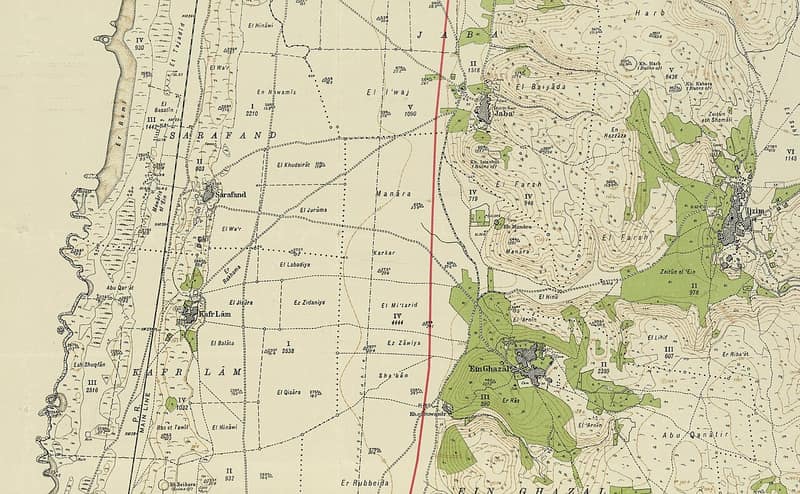
Jaba’ stood in a recess on the western slope of Mount Carmel, eighteen and a half kilometers south of Haifa and about three kilometers from the sea. An old place — rock-cut tombs and caves were surveyed around it in the 1870s — it was identified by some scholars with Gaba, the ‘city of horsemen’ that Herod settled with his veteran cavalry in the time of Josephus, though that identification is disputed. In the Ottoman registers of 1596 it was a village of eighteen households in the nahiya of Jabal Atlit, taxed on wheat, barley, goats, and beehives. The village had an elementary school for boys founded under the Ottomans in 1885, and its water came from a well worked by a wheel. The 1945 survey counted 1,140 people, all Muslims, on 7,012 dunums.
During the war, fighters from Jaba’ fired on Jewish vehicles along the coast road, the essential artery between Tel Aviv and Haifa. In early June 1948, Jaba’ — together with its neighbors Ijzim and Ayn Ghazal — asked the Israeli forces to open negotiations for surrender; nothing came of the request. On 14 July the Israeli cabinet discussed the three villages of the ‘Little Triangle,’ and Ben-Gurion counseled patience: ‘these villages are in our pocket… this will be a police action.’ The second truce began on 18 July and was not violated by the villagers. A week later Israel launched Operation Shoter (‘policeman’), combining army brigades and military police; on 25 July there was street fighting in Ayn Ghazal and Jaba’, and by the morning of 26 July the villages were found deserted. Jaba’ was depopulated on 24–26 July 1948. When the UN demanded that the villagers be allowed to return, Israel refused, citing the firing on the coast road.
The moshav of Geva Carmel was established about a kilometer northwest of the old site, on village land. In 1992 the site held piles of stone rubble with a shrine still standing on its elevated part, the remains of old tombs around it; the surrounding land, fenced and planted with pine forest, is used for grazing.
Sources
Cited works
3- palestineremembered.com — index(opens in a new tab)https://www.palestineremembered.com/Haifa/Jaba%27/index.html
- zochrot.org — en(opens in a new tab)https://www.zochrot.org/villages/village_details/49081/en
- palquest.org — jaba(opens in a new tab)https://www.palquest.org/en/place/17017/jaba
Connected in the archive
18 connected records18 records elsewhere in the archive are linked to this one, each by a piece of evidence you can read below.
named in this record — 2 records
One record names the other. A pointer for reading, not a claim that they belong to each other.
- Ayn Ghazalعين غزال
Evidence — Inferred from the text — read the evidence: In early June 1948, Jaba' — together with its neighbors Ijzim and Ayn Ghazal — asked the Israeli forces to open negotiations for surrender; nothing came of the request.
- Haifaحيفا
Evidence — Inferred from the text — read the evidence: Jaba' stood in a recess on the western slope of Mount Carmel, eighteen and a half kilometers south of Haifa and about three kilometers from the sea.
in the same district — 16 records
Filed near each other — the same Mandate district, or the same uncommon subject tags.
- Abu Shushaأبو شوشة
Evidence — From a recorded field in this archive: Both recorded in the Haifa district.
- Abu Zurayqأبو زريق
Evidence — From a recorded field in this archive: Both recorded in the Haifa district.
- Al-Kafraynالكفرين
Evidence — From a recorded field in this archive: Both recorded in the Haifa district.
- Al-Sindiyanaالسنديانة
Evidence — From a recorded field in this archive: Both recorded in the Haifa district.
- Al-Tiraالطيرة
Evidence — From a recorded field in this archive: Both recorded in the Haifa district.
- Ayn Hawdعين حوض
Evidence — From a recorded field in this archive: Both recorded in the Haifa district.
- and 10 more
Cite this page
Every claim above carries its sources — citation is the point.
- Chicago
“Jaba'.” Village Memory, FALASTEEN.AI. Accessed 22 August 2026. https://falasteen.ai/memory/jaba-haifa.- MLA
“Jaba'.” Village Memory, FALASTEEN.AI, 2026, https://falasteen.ai/memory/jaba-haifa. Accessed 22 August 2026.- BibTeX
@misc{falasteen-jaba-haifa,
  title        = {Jaba'},
  howpublished = {\url{https://falasteen.ai/memory/jaba-haifa}},
  organization = {FALASTEEN.AI — A Living Archive for Palestine},
  year         = {2026},
  note         = {Accessed 2026-08-22}
}