Ramla district · depopulated 1948 · 2 min read
Dayr Ayyub
دير أيوب
Dayr Ayyub, a hamlet on the slopes above the Ramla–Jerusalem highway that revered the tomb of the prophet Job, changed hands repeatedly in the Latrun battles of 1948 and ended the war depopulated near the armistice line. No settlement was built on its lands; the eastern edge of Canada Park lies over the site.
See Dayr Ayyub on the Atlas31.8272°N · 35.0185°E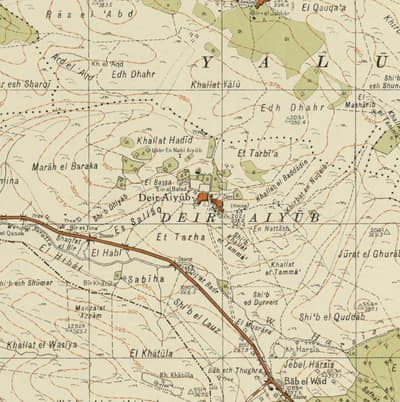
Dayr Ayyub stood on slopes facing southwest, overlooking the Ramla–Jerusalem highway and linked to it by a secondary road; on the village’s northwestern side was a plot the inhabitants believed held the tomb of the prophet Ayyub — the biblical Job. In 1596 it was a village in the nahiya of Ramla with ninety-four people, taxed on wheat, barley, fruits, goats, beehives, and vineyards. In the late nineteenth century it was a small hamlet of stone and mud houses on the hillside, mostly Muslim, growing along the roads to neighboring localities. Its people financed and built their own school in 1947, paying the teacher’s salary themselves; fifty-one children enrolled. Rainfed farming was their living — grain, grapes, figs, pomegranates, and vegetables, with 2,769 dunums of cereals in 1944/45. The 1945 survey counted 320 people.
Its position above the road to Jerusalem made it a target long before it fell. On 21 December 1947 twenty-five men raided the village and bombed three houses, in what the New York Times called ‘another reprisal attack by Jews’; six weeks later, on 7 February 1948, British troops themselves demolished two houses, saying they had been used to fire on Jewish convoys. In the battles for the Latrun salient the village was taken and retaken: the History of the Haganah records that Dayr Ayyub was occupied three times — first on 16 May 1948 by the Palmach’s Har’el Brigade during Operation Makkabi, then reoccupied at the end of May by Giv’ati and Seventh Brigade units in Operation Ben-Nun, entering ‘without resistance’ only to withdraw immediately under fire. Benny Morris records simply that the village was depopulated by military assault. Another attempt may have come during the fourth attack on Latrun on the night of 8–9 June; through the second truce it stayed unoccupied, and Arab Legion sources reported a further Israeli attempt on 15 August, which they said was repulsed. When the fighting ended, the empty village lay close to the 1949 armistice lines.
No Israeli settlement was built on the village lands; Mevo Choron, founded in 1970, stands nearby to the north. The eastern segment of Canada Park — planted over the ruins of Imwas, Yalo, and Bayt Nuba, destroyed in 1967 — lies across the site of Dayr Ayyub as well. Debris of houses and walls connected to iron rafters litters the site; on the hill opposite, the village cemetery keeps a tombstone inscribed to al-Hajj Muhammad Ulayyan Taha, who died in April 1936. Cypress, eucalyptus, carob, and fig trees dominate the slopes.
Sources
Cited works
3- palestineremembered.com — index(opens in a new tab)https://www.palestineremembered.com/al-Ramla/Dayr-Ayyub/index.html
- zochrot.org — en(opens in a new tab)https://www.zochrot.org/villages/village_details/49102/en
- palquest.org — dayr ayyub(opens in a new tab)https://www.palquest.org/en/place/16978/dayr-ayyub
Connected in the archive
25 connected records25 records elsewhere in the archive are linked to this one, each by a piece of evidence you can read below.
named in this record — 4 records
One record names the other. A pointer for reading, not a claim that they belong to each other.
- Bayt Nubaبيت نوبا
Evidence — Inferred from the text — read the evidence: The eastern segment of Canada Park — planted over the ruins of Imwas, Yalo, and Bayt Nuba, destroyed in 1967 — lies across the site of Dayr Ayyub as well.
- Imwasعمواس
Evidence — Inferred from the text — read the evidence: The eastern segment of Canada Park — planted over the ruins of Imwas, Yalo, and Bayt Nuba, destroyed in 1967 — lies across the site of Dayr Ayyub as well.
- Jerusalemالقدس
Evidence — Inferred from the text — read the evidence: Its position above the road to Jerusalem made it a target long before it fell.
- Ramleالرملة
Evidence — Inferred from the text — read the evidence: In 1596 it was a village in the nahiya of Ramla with ninety-four people, taxed on wheat, barley, fruits, goats, beehives, and vineyards.
in the same district — 21 records
Filed near each other — the same Mandate district, or the same uncommon subject tags.
- Abu Shushaأبو شوشة
Evidence — From a recorded field in this archive: Both recorded in the Ramla district.
- Al-Magharالمَغار
Evidence — From a recorded field in this archive: Both recorded in the Ramla district.
- Al-Muzayri'aالمُزَيْرِعَة
Evidence — From a recorded field in this archive: Both recorded in the Ramla district.
- Al-Na'aniالنَعاني
Evidence — From a recorded field in this archive: Both recorded in the Ramla district.
- Al-Nabi Rubinالنبي رُوبِين
Evidence — From a recorded field in this archive: Both recorded in the Ramla district.
- Al-Qubabالقُباب
Evidence — From a recorded field in this archive: Both recorded in the Ramla district.
- and 15 more
Cite this page
Every claim above carries its sources — citation is the point.
- Chicago
“Dayr Ayyub.” Village Memory, FALASTEEN.AI. Accessed 22 August 2026. https://falasteen.ai/memory/dayr-ayyub.- MLA
“Dayr Ayyub.” Village Memory, FALASTEEN.AI, 2026, https://falasteen.ai/memory/dayr-ayyub. Accessed 22 August 2026.- BibTeX
@misc{falasteen-dayr-ayyub,
  title        = {Dayr Ayyub},
  howpublished = {\url{https://falasteen.ai/memory/dayr-ayyub}},
  organization = {FALASTEEN.AI — A Living Archive for Palestine},
  year         = {2026},
  note         = {Accessed 2026-08-22}
}