Gaza district · depopulated 1948 · 2 min read
Burayr
برير
Burayr, one of the largest grain-growing villages of the Gaza coast, twice drove off attackers in early 1948 before the Palmach's Negev Brigade seized it in a single night in May, days before the Mandate ended. Five Israeli settlements were planted on its lands; scattered cactuses and the trace of its streets mark the site.
See Burayr on the Atlas31.5706°N · 34.6392°E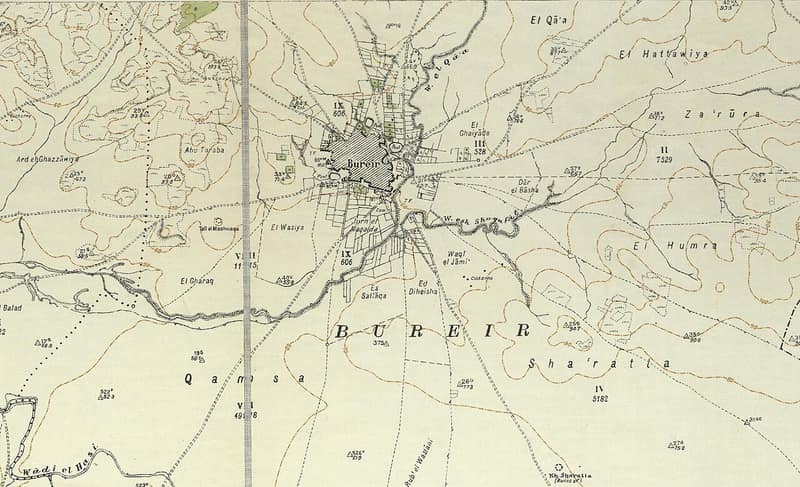
Burayr stood on uneven ground on the southern coastal plain, about twenty-five kilometers northeast of Gaza, with Wadi al-Qa’a crossing its eastern edge and a major inland highway linking it to Gaza and the coastal towns. It has been identified with the Buriron of Byzantine sources; in 1596 it was a village in the nahiya of Gaza with 1,155 people. Edward Robinson, passing in 1838, found ‘a flourishing village forming a sort of central point in the plain,’ with a large public well where camels drew water by a sâkieh, or water wheel. Its mostly adobe houses formed a rough circle around a center that held the mosque, the marketplace, a clinic, and a grain mill; two primary schools, founded in 1920, had 241 pupils in 1947. The economy got a lift in the 1940s when the Iraq Petroleum Company drilled an oil well a kilometer north of the village, and its Wednesday market drew villagers and Bedouin. Its lands were vast: in 1944/45 some 43,319 dunums were sown with cereals, among the largest of any village in the district. The 1945 survey counted 2,740 people, all Muslims.
The village fought before it fell. On 29 January 1948 an attack with five armored cars was repulsed, and a second clash followed on 14 February, when a Jewish convoy shot its way through the village, according to the newspaper Filastin. The first step in its conquest came from outside: on 20 April 1948 the settlement of Beror Chayil was thrown up on a hilltop less than a mile away — ‘When the Arabs [of Burayr] awoke,’ the New York Times correspondent wrote, ‘they found the Jews setting up prefabricated houses and building a defensive wall and watchtower.’ Just over three weeks later, on the night of 12–13 May, the Palmach’s Negev Brigade struck in coordination with the Giv’ati Brigade’s Operation Barak; the History of the Haganah says the village was occupied ‘in one strike,’ and its people were driven out or fled.
Five Israeli settlements were established on village lands: Beror Chayil in 1948, Telamim and Cheletz in 1950, Sde Dawid in 1955, and Zohar in 1956. Of the village itself, scattered cactuses and lotus and sycamore trees grow over the site, with fragments of cement walls among the eucalyptus at one house’s entrance; some village streets are still traceable, and the lands around are cultivated.
Sources
Cited works
3- palestineremembered.com — index(opens in a new tab)https://www.palestineremembered.com/Gaza/Burayr/index.html
- zochrot.org — en(opens in a new tab)https://www.zochrot.org/villages/village_details/49047/en
- palquest.org — burayr(opens in a new tab)https://www.palquest.org/en/place/16962/burayr
Connected in the archive
36 connected records36 records elsewhere in the archive are linked to this one, each by a piece of evidence you can read below.
gave testimony about this village — 1 record
- Omar Abedelal
Evidence — From a recorded field in this archive: village: "Burayr" → Burayr (Gaza)
names this place — 2 records
One record names the other. A pointer for reading, not a claim that they belong to each other.
- Gaza, by Name
Evidence — From a recorded field in this archive: One of the largest grain-growing villages of the Gaza coast. It twice drove off attackers before the Palmach's Negev Brigade took it in a single night in May 1948.
- Simsimسمسم
Evidence — Inferred from the text — read the evidence: Just before 15 May 1948 — in the wake of the occupation of Burayr on 12–13 May, according to Israeli historian Benny Morris — the Palmach's Negev Brigade captured Simsim in one of its northward thrusts and expelled its inhabitants.
in the same district — 33 records
Filed near each other — the same Mandate district, or the same uncommon subject tags.
- 'Iraq al-Manshiyyaعِراق المَنْشِيَّة
Evidence — From a recorded field in this archive: Both recorded in the Gaza district.
- Al-Falujaالفالوجة
Evidence — From a recorded field in this archive: Both recorded in the Gaza district.
- Al-Jiyyaالجِيَّة
Evidence — From a recorded field in this archive: Both recorded in the Gaza district.
- Al-Juraالجُورَة
Evidence — From a recorded field in this archive: Both recorded in the Gaza district.
- Al-Majdalالمجدل
Evidence — From a recorded field in this archive: Both recorded in the Gaza district.
- Al-Masmiyya al-Kabiraالمَسْمِيَّة الكَبِيرَة
Evidence — From a recorded field in this archive: Both recorded in the Gaza district.
- and 27 more
Cite this page
Every claim above carries its sources — citation is the point.
- Chicago
“Burayr.” Village Memory, FALASTEEN.AI. Accessed 22 August 2026. https://falasteen.ai/memory/burayr.- MLA
“Burayr.” Village Memory, FALASTEEN.AI, 2026, https://falasteen.ai/memory/burayr. Accessed 22 August 2026.- BibTeX
@misc{falasteen-burayr,
  title        = {Burayr},
  howpublished = {\url{https://falasteen.ai/memory/burayr}},
  organization = {FALASTEEN.AI — A Living Archive for Palestine},
  year         = {2026},
  note         = {Accessed 2026-08-22}
}