Safad district · depopulated 1948 · 3 min read
Ayn al-Zaytun
عين الزيتون
Ayn al-Zaytun stood a kilometre and a half north of Safad and was treated as its suburb; 820 people held 1,100 dunums in 1944/45. Palmach troops took it on 1 May 1948 as a prelude to the capture of Safad, and thirty-seven men held as prisoners were probably among some seventy people killed in a gully between the village and the city. The houses were blown up on 2 and 3 May in full view of Safad.
See Ayn al-Zaytun on the Atlas32.9872°N · 35.4915°E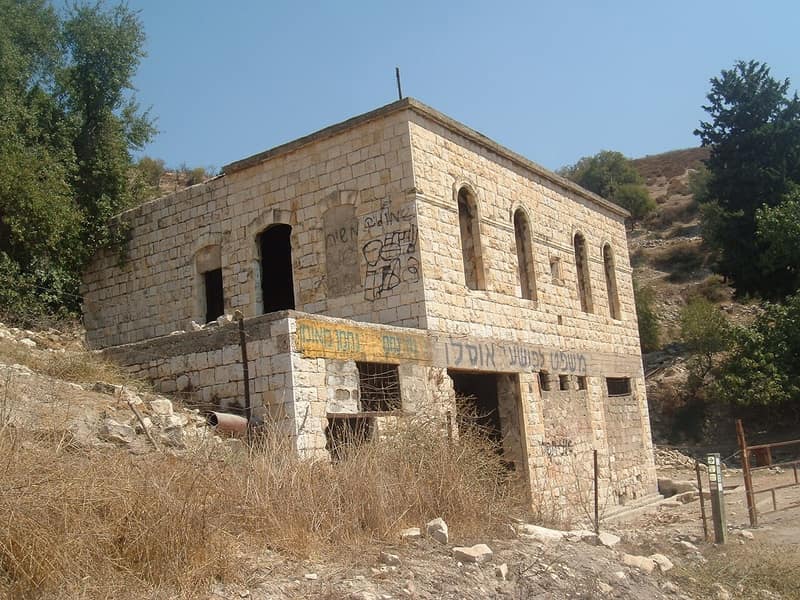
Ayn al-Zaytun lay on the western slope of Wadi al-Dilb beside the road into Safad, at about seven hundred metres. Its name — spring of the olives — points to the water in the wadi, which the fourteenth-century geographer al-Dimashqi may have had in mind when he described a spring between Mirun and Safad that gushed for an hour or two and then abruptly withdrew. In 1596 the village had 622 people and paid tax on wheat, barley and olives as well as on vineyards and orchards. Nineteenth-century visitors found a stone-built village of two to three hundred people on a hill north of Safad, ringed by arable land. Because it stood so close to the subdistrict capital it was regarded as a suburb of Safad, and as it grew its stone houses extended southwards towards the city. The population was entirely Muslim, with an elementary school and a mosque; the villagers grew olives, grain and fruit, especially grapes, and drew drinking water from a well and a spring 800 metres to the north. In 1944/45 they numbered 820 and held 1,100 dunums, 280 sown in cereals and 477 irrigated or planted in orchards.
The village was attacked well before it was taken. The New York Times reported that early on the morning of 3 January 1948 a raiding party killed one villager and bombed four houses, and that firing continued in the neighbourhood through the day. Then, as a prelude to the occupation of Safad during Operation Yiftach, Palmach troops came down on Ayn al-Zaytun from the north and occupied it on 1 May 1948. Villagers interviewed in 1973 recalled that the assault began at three in the morning with a barrage from eleven mortars followed by two platoons on the ground; the armed men decided on a tactical withdrawal, but the rest of the villagers stayed in their homes.
When the troops entered, the inhabitants were rounded up. The men were separated out and taken away; the others were humiliated and driven off with shots fired over their heads, an account given both by the villagers and in Israeli sources. Some of the men were later expelled and allowed to rejoin their families, but thirty-seven, selected at random, were held. According to Benny Morris they were probably among a group of about seventy people killed in a gully between Ayn al-Zaytun and Safad on the orders of Moshe Kelman, commander of the Palmach’s Third Battalion; Morris records that Kelman had difficulty finding soldiers willing to do it and finally gave the task to two men, and that in anticipation of a Red Cross visit he ordered the prisoners’ hands untied to conceal that the killing had been done in cold blood. Several villagers who tried to go home over the following days were fired on and one was killed. Palmach sappers burned or blew up the houses on 2 and 3 May, partly in order to terrify the population of Safad, who could watch from the hills nearby; the sight had a demoralising effect in the city and in the villages of eastern Galilee.
No Israeli settlement was built on the village lands. The rubble of the stone houses is scattered across the site among olive trees and cactus. A few deserted houses remain, some with round arched entrances and tall arched windows, and above one doorway the smooth stone is carved with Arabic calligraphy. The well and the village spring survive; the mosque had been converted into a milk shed by 2004, its foundation stone removed and Hebrew graffiti added.
Sources
Cited works
3- palquest.org — ayn al zaytun(opens in a new tab)https://www.palquest.org/en/place/16925/ayn-al-zaytun
- zochrot.org — en(opens in a new tab)https://www.zochrot.org/villages/village_details/49380/en
- en.wikipedia.org — Ein al Zeitun(opens in a new tab)https://en.wikipedia.org/wiki/Ein_al-Zeitun
Connected in the archive
19 connected records19 records elsewhere in the archive are linked to this one, each by a piece of evidence you can read below.
named in this record — 1 record
One record names the other. A pointer for reading, not a claim that they belong to each other.
- Safedصفد
Evidence — Inferred from the text — read the evidence: Ayn al-Zaytun lay on the western slope of Wadi al-Dilb beside the road into Safad, at about seven hundred metres.
names this place — 1 record
One record names the other. A pointer for reading, not a claim that they belong to each other.
- The Villages of the Galilee
Evidence — From a recorded field in this archive: Safad's northern suburb, taken on 1 May 1948 as the prelude to the town — with thirty-seven of its prisoners killed.
in the same district — 17 records
Filed near each other — the same Mandate district, or the same uncommon subject tags.
- Al-'Abisiyyaالعابسية
Evidence — From a recorded field in this archive: Both recorded in the Safad district.
- Al-Dawwaraالدوارة
Evidence — From a recorded field in this archive: Both recorded in the Safad district.
- Al-Ja'unaالجاعونة
Evidence — From a recorded field in this archive: Both recorded in the Safad district.
- Al-Khalisaالخالصة
Evidence — From a recorded field in this archive: Both recorded in the Safad district.
- Al-Khisasالخصاص
Evidence — From a recorded field in this archive: Both recorded in the Safad district.
- Al-Na'imaالناعمة
Evidence — From a recorded field in this archive: Both recorded in the Safad district.
- and 11 more
Cite this page
Every claim above carries its sources — citation is the point.
- Chicago
“Ayn al-Zaytun.” Village Memory, FALASTEEN.AI. Accessed 22 August 2026. https://falasteen.ai/memory/ayn-al-zaytun.- MLA
“Ayn al-Zaytun.” Village Memory, FALASTEEN.AI, 2026, https://falasteen.ai/memory/ayn-al-zaytun. Accessed 22 August 2026.- BibTeX
@misc{falasteen-ayn-al-zaytun,
  title        = {Ayn al-Zaytun},
  howpublished = {\url{https://falasteen.ai/memory/ayn-al-zaytun}},
  organization = {FALASTEEN.AI — A Living Archive for Palestine},
  year         = {2026},
  note         = {Accessed 2026-08-22}
}