Safad district · depopulated 1948 · 3 min read
Al-Khisas
الخصاص
Al-Khisas, on a terrace in the northern Hula plain, was raided by a Haganah strike force on the night of 18 December 1947 — one of the first such operations of the war. Houses were blown up and about a dozen civilians killed, four of them children by Benny Morris's figures, ten including five children according to the New York Times. Those who stayed on were finally driven out by army trucks at midnight on 5 June 1949 and dumped on a hillside near Akbara.
See Al-Khisas on the Atlas33.2252°N · 35.6194°E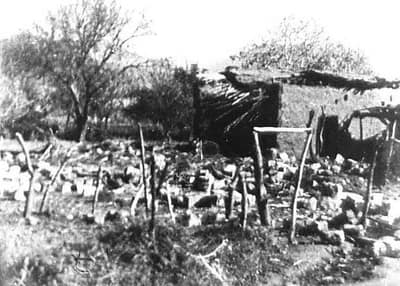
Al-Khisas lay in the northern part of the Hula plain on a natural terrace about a hundred metres wide, formed when the ancient lake that once filled the whole basin shrank away. Wadi al-Hasibani cut a trough through the mountains west of the village, which was linked by secondary roads to the highway running down to Safad and Tiberias, thirty-one kilometres to the southwest. Yaqut al-Hamawi placed it within the jurisdiction of Banyas. In 1945 it had 470 Arab inhabitants — 400 Muslims and 70 Christians — alongside sixty Jews, and of its 4,795 dunums, 1,480 were Arab-owned and 2,738 Jewish-owned. Agriculture was the mainstay: orchards south of the village along the Hasibani, olives to the west, and 1,438 dunums irrigated or planted in orchards in 1944/45. The nearby shrine of a Shaykh Ali and rock-hewn tombs showed the site had been inhabited long before.
The village was the target of a Haganah hit-and-run attack in the very first weeks of the war. On the night of 18 December 1947 members of a strike force drove through al-Khisas firing their guns and throwing bombs, and several houses were blown up. Benny Morris cites figures of about a dozen civilians killed, four of them children; the New York Times put the dead at ten, including five children, and reported that some of the victims were buried in the wreckage of their houses. The Haganah at first denied that children had been killed and later admitted it, and a spokesman explained a few days afterwards that one of the dynamited houses had been a base for Syrian and Lebanese forces, adding that it was very unfortunate that children should have been sleeping in that sort of small-scale military centre. The paper reported that the raid was revenge for the killing of two men of the Jewish Settlement Police in the Safad area. Some local Haganah intelligence officers and civilian leaders had opposed the operation; it was approved by the Palmach commanding officer, Yigal Allon. At a high-level meeting of Zionist military and civilian officials on 1–2 January 1948, attended by David Ben-Gurion and Moshe Dayan, the majority view — as Morris summarises it — was that however unpleasant, the use of force, even if occasionally excessive, was in the long run fruitful.
The villagers fled on 25 May 1948, at the very end of Operation Yiftach, and an Israeli intelligence report credited their dispersal to the campaign of psychological warfare mounted during that operation. But the exodus was only partial. Some remained in their homes for a further year, until at midnight on 5 June 1949 the village was surrounded by trucks and its people forced aboard — with kicks, curses and maltreatment, in the words of a Mapam member of the Knesset quoted by Morris. The villagers said they had been made to destroy their own dwellings with their hands and treated like cattle. They were left on a bare, sun-scorched hillside near the village of Akbara, where they lived for years in the same conditions alongside people expelled from Qaddita and al-Ja’una.
The settlement of ha-Gosherim, established in 1948 before the last villagers were driven out, stands a few hundred metres south of the site on village land and farms it; the manor house of the Emir Faour on the land became a hotel. Most of the ground is woods and grass, with scattered cactus, piles of stone, the remains of an old building and a large arched stone barrage.
Sources
Cited works
3- palquest.org — al khisas(opens in a new tab)https://www.palquest.org/en/place/16830/al-khisas
- zochrot.org — en(opens in a new tab)https://www.zochrot.org/villages/village_details/49168/en
- en.wikipedia.org — Al Khisas(opens in a new tab)https://en.wikipedia.org/wiki/Al-Khisas
Connected in the archive
19 connected records19 records elsewhere in the archive are linked to this one, each by a piece of evidence you can read below.
named in this record — 2 records
One record names the other. A pointer for reading, not a claim that they belong to each other.
- Safedصفد
Evidence — Inferred from the text — read the evidence: Wadi al-Hasibani cut a trough through the mountains west of the village, which was linked by secondary roads to the highway running down to Safad and Tiberias, thirty-one kilometres to the southwest.
- Qadditaقديتاmapped, not yet written up
Evidence — Inferred from the text — read the evidence: They were left on a bare, sun-scorched hillside near the village of Akbara, where they lived for years in the same conditions alongside people expelled from Qaddita and al-Ja'una.
in the same district — 17 records
Filed near each other — the same Mandate district, or the same uncommon subject tags.
- Al-'Abisiyyaالعابسية
Evidence — From a recorded field in this archive: Both recorded in the Safad district.
- Al-Dawwaraالدوارة
Evidence — From a recorded field in this archive: Both recorded in the Safad district.
- Al-Ja'unaالجاعونة
Evidence — From a recorded field in this archive: Both recorded in the Safad district.
- Al-Khalisaالخالصة
Evidence — From a recorded field in this archive: Both recorded in the Safad district.
- Al-Na'imaالناعمة
Evidence — From a recorded field in this archive: Both recorded in the Safad district.
- Al-Salihiyyaالصالحية
Evidence — From a recorded field in this archive: Both recorded in the Safad district.
- and 11 more
Cite this page
Every claim above carries its sources — citation is the point.
- Chicago
“Al-Khisas.” Village Memory, FALASTEEN.AI. Accessed 22 August 2026. https://falasteen.ai/memory/al-khisas.- MLA
“Al-Khisas.” Village Memory, FALASTEEN.AI, 2026, https://falasteen.ai/memory/al-khisas. Accessed 22 August 2026.- BibTeX
@misc{falasteen-al-khisas,
  title        = {Al-Khisas},
  howpublished = {\url{https://falasteen.ai/memory/al-khisas}},
  organization = {FALASTEEN.AI — A Living Archive for Palestine},
  year         = {2026},
  note         = {Accessed 2026-08-22}
}