Jaffa district · depopulated 1948 · 2 min read
Al-Shaykh Muwannis
الشيخ مونّس
Al-Shaykh Muwannis stood on a sandstone rise north of the Awja river, a citrus village of 1,930 people holding 15,972 dunums in 1944/45, whose leaders had reached a truce understanding with the Haganah. In March 1948 the Irgun kidnapped five of its notables; the village emptied on 30 March. Tel Aviv University stands on its land, and the sheikh's Green House is the university's faculty club.
See Al-Shaykh Muwannis on the Atlas32.1083°N · 34.8031°E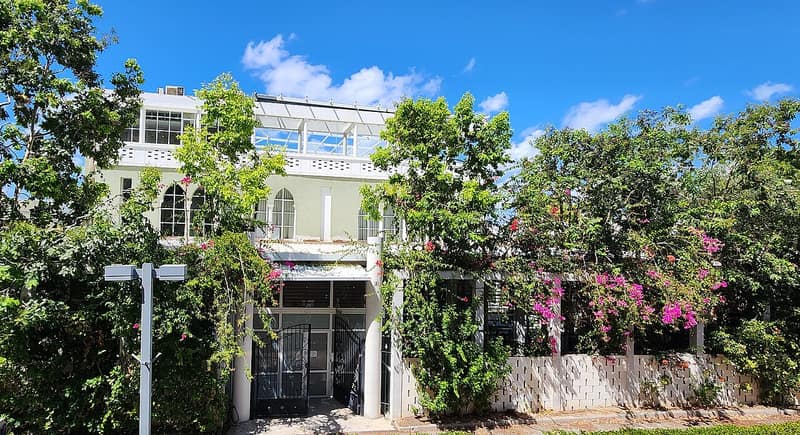
Al-Shaykh Muwannis stood on a sandstone hill on the central coastal plain, two and a half kilometres from the sea and eight hundred metres north of the Awja river, about eight and a half kilometres from Jaffa. It took its name from a local religious figure whose maqam stood in the village. Its people built first in adobe and then, as their income from citrus exports rose, in stone and cement. There were two elementary schools, for boys from 1932 and for girls from 1943; the boys’ school held thirty-six dunums and an artesian well and doubled as an agricultural and vocational training centre. The villagers worked in citrus and the trades that went with it, irrigating from the Awja and from a large number of artesian wells. In 1944/45 they numbered 1,930 and held 15,972 dunums, of which 3,749 were in citrus and bananas and 7,165 in cereals; Jewish organisations by then owned some 3,545 dunums of the village land.
The village lay directly beyond the northern edge of Tel Aviv, and relations with its Jewish neighbours were on the whole peaceable. Village leaders reached an understanding with the Haganah under which they would keep Arab Liberation Army irregulars from using the village as a base against Jewish forces, in exchange for protection. The agreement did not restrain the Irgun. In March 1948 its men infiltrated the village and kidnapped five of the community’s leaders. Jewish intelligence noted that many villagers began to leave after the abduction of the notables, and although the five were released on 23 March, fear stayed. Benny Morris writes that the final evacuation of the area just north of Tel Aviv was prompted in large measure by Irgun actions. Roadblocks, restrictions on movement, the theft of vehicles and the severing of access to Jaffa completed the work, and al-Shaykh Muwannis was abandoned on 30 March 1948, six weeks before the end of the Mandate. Many of its people resettled in Qalqilya and Tulkarm.
No settlement was built on the village land in the ordinary sense; instead the whole of it was absorbed into the municipal area of Tel Aviv, and Tel Aviv University was built across it, together with the northern neighbourhoods of Ramat Aviv, Neve Avivim, Afeka and others. A number of village houses remain among the campus and the apartment blocks, occupied by Jewish families — a two-storey house of cement with rectangular openings and flat roofs, a symmetrical two-unit house whose upper porches are each framed by five lancet arches, and elsewhere a single wall standing alone with a post on top carrying an electric wire. The cemetery is fenced and unkempt. The Green House, which belonged to the village sheikh, was used after 1948 as a military headquarters and later became the university’s faculty club.
Sources
Cited works
3- palquest.org — al shaykh muwannis(opens in a new tab)https://www.palquest.org/en/place/16890/al-shaykh-muwannis
- zochrot.org — en(opens in a new tab)https://www.zochrot.org/villages/village_details/49480/en
- en.wikipedia.org — Al Shaykh Muwannis(opens in a new tab)https://en.wikipedia.org/wiki/Al-Shaykh_Muwannis
Connected in the archive
15 connected records15 records elsewhere in the archive are linked to this one, each by a piece of evidence you can read below.
names this place — 4 records
One record names the other. A pointer for reading, not a claim that they belong to each other.
- Abu Kishkأبو كِشْك
Evidence — Inferred from the text — read the evidence: The village was likely caught up in what happened at adjacent al-Shaykh Muwannis: both lay just beyond the edge of Tel Aviv and both were targeted early.
- al-Jammasin al-Gharbiالجَمّاسِين الغربي
Evidence — Inferred from the text — read the evidence: Children attended school in nearby al-Shaykh Muwannis.
- al-Jammasin al-Sharqiالجَمّاسِين الشرقي
Evidence — Inferred from the text — read the evidence: Children attended school in nearby al-Shaykh Muwannis.
- Balata Campمخيّم بلاطة
Evidence — Inferred from the text — read the evidence: About sixty percent came from a handful of places on the coastal plain: Jaffa and its satellite villages — Salama, al-Shaykh Muwannis, al-Abbasiyya, Arab Abu Kishk, al-Jammasin — together with Lydda, al-Tira, Kafr Saba and Bayt Dajan.
named in this record — 2 records
One record names the other. A pointer for reading, not a claim that they belong to each other.
- Jaffaيافا
Evidence — Inferred from the text — read the evidence: Al-Shaykh Muwannis stood on a sandstone hill on the central coastal plain, two and a half kilometres from the sea and eight hundred metres north of the Awja river, about eight and a half kilometres from Jaffa.
- Qalqilyaقلقيلية
Evidence — Inferred from the text — read the evidence: Many of its people resettled in Qalqilya and Tulkarm.
in the same district — 9 records
Filed near each other — the same Mandate district, or the same uncommon subject tags.
- Al-'Abbasiyyaالعَبّاسِيَّة
Evidence — From a recorded field in this archive: Both recorded in the Jaffa district.
- Al-Khayriyyaالخيرية
Evidence — From a recorded field in this archive: Both recorded in the Jaffa district.
- Al-Manshiyyaالمنشية
Evidence — From a recorded field in this archive: Both recorded in the Jaffa district.
- Al-Mas'udiyyaالمَسْعُودِيَّة
Evidence — From a recorded field in this archive: Both recorded in the Jaffa district.
- Beit Dajanبيت دجن
Evidence — From a recorded field in this archive: Both recorded in the Jaffa district.
- Fajjaفَجَّة
Evidence — From a recorded field in this archive: Both recorded in the Jaffa district.
- and 3 more
Cite this page
Every claim above carries its sources — citation is the point.
- Chicago
“Al-Shaykh Muwannis.” Village Memory, FALASTEEN.AI. Accessed 22 August 2026. https://falasteen.ai/memory/al-shaykh-muwannis.- MLA
“Al-Shaykh Muwannis.” Village Memory, FALASTEEN.AI, 2026, https://falasteen.ai/memory/al-shaykh-muwannis. Accessed 22 August 2026.- BibTeX
@misc{falasteen-al-shaykh-muwannis,
  title        = {Al-Shaykh Muwannis},
  howpublished = {\url{https://falasteen.ai/memory/al-shaykh-muwannis}},
  organization = {FALASTEEN.AI — A Living Archive for Palestine},
  year         = {2026},
  note         = {Accessed 2026-08-22}
}