Jaffa district · depopulated 1948 · 2 min read
Beit Dajan
بيت دجن
Beit Dajan — biblical Beth Dagon — stood at the crossroads south of Jaffa, a citrus village of nearly four thousand people with two schools. Raided through the winter of 1948, it fell in Operation Hametz at the end of April; a moshav took its name and its lands, and one surviving house serves as a synagogue.
See Beit Dajan on the Atlas32.0035°N · 34.8293°E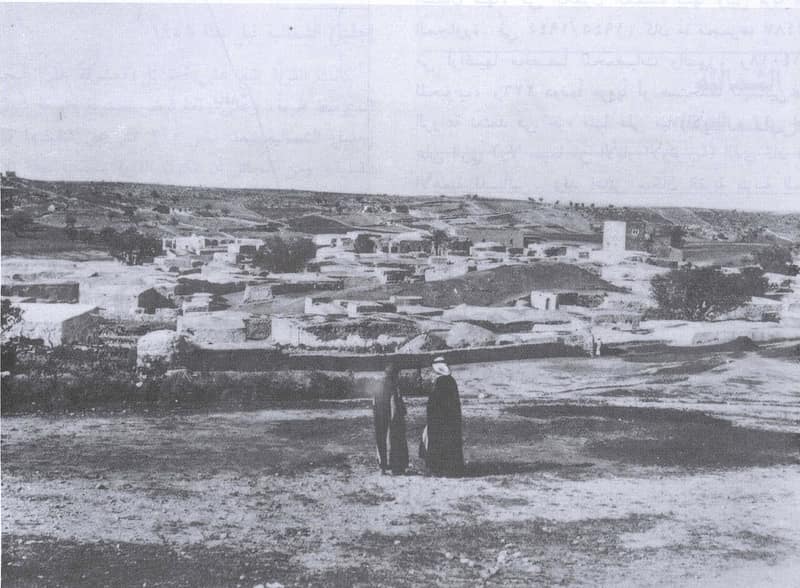
Beit Dajan stood on a sandy hill on the central coastal plain, nine kilometers southwest of Jaffa, at the intersection of the Jaffa–al-Ramla highway with the coastal highway south to Gaza. Its name is ancient: the Old Testament knows it as Beth Dagon, after the Philistine god, and the Assyrians called it Bit Daganna. In 1596 it was a village in the nahiya of Ramla with 633 people. By the Mandate it was a substantial place: two elementary schools — a boys’ school founded in 1920 with 353 pupils in 1945 and a girls’ school with 102 girls that year — served a population that the 1945 survey counted at 3,840. Its wealth was in its groves: in 1944/45 some 3,195 dunums of village land were planted with citrus and bananas, against 676 dunums of cereals, watered from wells on the sandy plain.
The war reached it early and often. From January 1948, Palmach units stationed in the Jewish National Fund building just south of the Jaffa–Jerusalem highway raided the village, destroying a house in one foray. On 19 February a British convoy that stopped to arrest a man carrying a rifle clashed with the villagers; the New York Times reported two villagers and one British soldier killed. The largest blow of that winter came at dawn on 26 February, when Jewish forces with mortars, machine guns, and grenades killed three villagers and wounded four and blew up a house, according to Arif al-Arif. Beit Dajan itself was probably not occupied until the end of April, when it fell to the Alexandroni Brigade in the course of Operation Hametz — the assault on Salama, Yazur, and the other villages east of Jaffa designed to isolate the city and ensure it would fall ‘like a ripe plum.’
Four settlements were founded on village lands: Beyt Dagan, established at the site six months after the conquest and taking the village’s name; Mishmar ha-Shiv’a in 1949; Chemed in 1950; and Gannot in 1953. A number of village houses remain — some deserted, some occupied by Jewish families or used as stores, offices, and warehouses; one concrete house has been converted into the Eli Cohen synagogue. Cactuses and cypress, fig, and date palms grow between them, and the land around is cultivated.
Sources
Cited works
3- palestineremembered.com — index(opens in a new tab)https://www.palestineremembered.com/Jaffa/Bayt-Dajan/index.html
- zochrot.org — en(opens in a new tab)https://www.zochrot.org/villages/village_details/49057/en
- palquest.org — bayt dajan(opens in a new tab)https://www.palquest.org/en/place/16938/bayt-dajan
Connected in the archive
16 connected records16 records elsewhere in the archive are linked to this one, each by a piece of evidence you can read below.
named in this record — 2 records
One record names the other. A pointer for reading, not a claim that they belong to each other.
- Jaffaيافا
Evidence — Inferred from the text — read the evidence: Beit Dajan stood on a sandy hill on the central coastal plain, nine kilometers southwest of Jaffa, at the intersection of the Jaffa–al-Ramla highway with the coastal highway south to Gaza.
- Ramleالرملة
Evidence — Inferred from the text — read the evidence: In 1596 it was a village in the nahiya of Ramla with 633 people.
names this place — 2 records
One record names the other. A pointer for reading, not a claim that they belong to each other.
- Al-Qubabالقُباب
Evidence — Inferred from the text — read the evidence: A New York Times correspondent wrote that Haganah forces captured al-Qubab on 15 May 1948, the day the British Mandate ended, in an effort to reopen the highway to Jerusalem, taking Bayt Dajan on another stretch of the Jaffa–Jerusalem road at the same time; the attack also coincided with Operation Barak, which took nearby Abu Shusha the same day.
- Balata Campمخيّم بلاطة
Evidence — Inferred from the text — read the evidence: About sixty percent came from a handful of places on the coastal plain: Jaffa and its satellite villages — Salama, al-Shaykh Muwannis, al-Abbasiyya, Arab Abu Kishk, al-Jammasin — together with Lydda, al-Tira, Kafr Saba and Bayt Dajan.
in the same district — 12 records
Filed near each other — the same Mandate district, or the same uncommon subject tags.
- Abu Kishkأبو كِشْك
Evidence — From a recorded field in this archive: Both recorded in the Jaffa district.
- Al-'Abbasiyyaالعَبّاسِيَّة
Evidence — From a recorded field in this archive: Both recorded in the Jaffa district.
- al-Jammasin al-Gharbiالجَمّاسِين الغربي
Evidence — From a recorded field in this archive: Both recorded in the Jaffa district.
- al-Jammasin al-Sharqiالجَمّاسِين الشرقي
Evidence — From a recorded field in this archive: Both recorded in the Jaffa district.
- Al-Khayriyyaالخيرية
Evidence — From a recorded field in this archive: Both recorded in the Jaffa district.
- Al-Manshiyyaالمنشية
Evidence — From a recorded field in this archive: Both recorded in the Jaffa district.
- and 6 more
Cite this page
Every claim above carries its sources — citation is the point.
- Chicago
“Beit Dajan.” Village Memory, FALASTEEN.AI. Accessed 22 August 2026. https://falasteen.ai/memory/beit-dajan.- MLA
“Beit Dajan.” Village Memory, FALASTEEN.AI, 2026, https://falasteen.ai/memory/beit-dajan. Accessed 22 August 2026.- BibTeX
@misc{falasteen-beit-dajan,
  title        = {Beit Dajan},
  howpublished = {\url{https://falasteen.ai/memory/beit-dajan}},
  organization = {FALASTEEN.AI — A Living Archive for Palestine},
  year         = {2026},
  note         = {Accessed 2026-08-22}
}