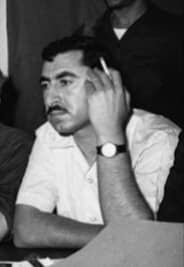
Nayef Hawatmeh
نايف حواتمة
Founder and secretary-general of the Democratic Front for the Liberation of Palestine
The Arab Nationalist Movement organiser who split from the PFLP in 1969 to found the DFLP, and who pressed the PLO towards its 1974 interim programme.
Nayef Hawatmeh was born in al-Salt, in Jordan, in November 1935, into a clan spread across Jordan, Palestine and Syria. He finished school at al-Hussein College in Amman and went to Cairo to read medicine, but abandoned his studies for a decade of political work; he later took a degree at Beirut Arab University in philosophy and sociology, submitting a thesis on the passage of the nationalist movement “from a broad nationalism to democratic leftism.”
He joined the Arab Nationalist Movement young and led it in Jordan and the West Bank after the April 1957 coup against Suleiman al-Nabulsi’s government. In February 1958 a Jordanian court sentenced him to death; he fled to Syria, and from Homs led an armed column on foot into Tripoli to join the Lebanese revolt of July 1958. After the Iraqi revolution he moved to Baghdad, where he led the ANM in Iraq and was jailed for fourteen months under Abd al-Karim Qasim, being released on 8 February 1963. He founded the newspaper al-Wihda in Baghdad with Basil al-Kubaisi; the Ba’th closed it twenty-seven days after its first issue and jailed him again, after which he was deported to Egypt. He took part in the liberation war in South Yemen and wrote The Crisis of the Revolution in South Yemen on the split between its left and right wings.
Hawatmeh was on the PFLP’s politburo when the front’s internal arguments broke open. On 22 February 1969 he led a group out of the PFLP — arguing that a petit-bourgeois formation could not simply declare itself Marxist-Leninist — severed its ties with the Arab Nationalist Movement and founded the Popular Democratic Front for the Liberation of Palestine, shortened in 1975 to the Democratic Front for the Liberation of Palestine. He was elected general secretary of its central committee at its founding congress in August 1970 and has been re-elected at every congress since, most recently the seventh, held in stages in 2018. Under his leadership the DFLP argued that the resistance’s relationship to the Palestinian masses was “impromptu and sentimental,” and that turning it into a genuine people’s war required organising and politically arming those masses. In Jordan the front pushed the slogan “all power to the resistance”; the clashes of September 1970 followed, and the Jordanian authorities put a price on Hawatmeh’s head. He moved to Beirut in July 1971.
After the October 1973 war he was central to the argument that produced the PLO’s interim programme, having called since July 1971 for a “secure, liberated support base” in the occupied territories; he was instrumental in drafting the Ten Point Programme adopted by the Palestine National Council in June 1974, and from 1975 committed the DFLP to a state on the territories occupied in 1967, with East Jerusalem as its capital and the refugees’ right of return under Resolution 194 — a position later absorbed into the PLO’s own programme. The DFLP’s stated long-term goal remained a single democratic state on all of Palestine with equality between all citizens regardless of ethnicity, religion or sex. From the beginning the front criticised the PFLP’s international hijackings as an operational style too reliant on individuals; its own fighters carried out armed operations inside the territory Israel held, launched from anchor points in Jordan, the Golan Heights and southern Lebanon, and fought in Jordan in 1970, in the Lebanese civil war, against the invasion of 1982 and in the War of the Camps. He held out in Beirut through the siege of 1982 and then moved to Damascus. He helped draft the texts ratified by the PLO’s bodies, including the Declaration of Independence of 15 November 1988, opposed the Madrid conference and rejected the Oslo Accords, calling instead for an international conference under UN auspices. At the start of the Second Intifada in late 2000 the front formed the Palestinian National Resistance Brigades as its armed wing.
Selected contributions
- Founder and secretary-general of the DFLP (1969–)
- Principal author of the PLO’s Ten Point Programme (1974)
- The Crisis of the Revolution in South Yemen (1968)
Sources
Further reading
An external biography or archive holding more on this life than the entry above.
Connected in the archive
14 connected records14 records elsewhere in the archive are linked to this one, each by a piece of evidence you can read below.
named in this record — 4 records
One record names the other. A pointer for reading, not a claim that they belong to each other.
- Oslo Accords
Evidence — Inferred from the text — read the evidence: He helped draft the texts ratified by the PLO's bodies, including the Declaration of Independence of 15 November 1988, opposed the Madrid conference and rejected the Oslo Accords, calling instead for an international conference under UN auspices.
- The Oslo Accords
Evidence — Inferred from the text — read the evidence: He helped draft the texts ratified by the PLO's bodies, including the Declaration of Independence of 15 November 1988, opposed the Madrid conference and rejected the Oslo Accords, calling instead for an international conference under UN auspices.
- The Second Intifada
Evidence — Inferred from the text — read the evidence: At the start of the Second Intifada in late 2000 the front formed the Palestinian National Resistance Brigades as its armed wing.
- UN General Assembly Resolution 194
Evidence — Inferred from the text — read the evidence: …and from 1975 committed the DFLP to a state on the territories occupied in 1967, with East Jerusalem as its capital and the refugees' right of return under Resolution 194 — a position later absorbed into the PLO's own programme.…
on a related subject — 10 records
Filed near each other — the same Mandate district, or the same uncommon subject tags.
- Abu Ali Mustafaأبو علي مصطفى
Evidence — Inferred from the text — read the evidence: Shared tag: "PFLP".
- Armed Struggle and the Search for State: The Palestinian National Movement, 1949–1993
Evidence — Inferred from the text — read the evidence: Shared tag: "PLO".
- George Habashجورج حبش
Evidence — Inferred from the text — read the evidence: Shared tag: "PFLP".
- Ghassan Kanafaniغسان كنفاني
Evidence — Inferred from the text — read the evidence: Shared tag: "PFLP".
- Issam Abdul Hadiعصام عبد الهادي
Evidence — Inferred from the text — read the evidence: Shared tag: "PLO".
- Kamal Nasserكمال ناصر
Evidence — Inferred from the text — read the evidence: Shared tag: "PLO".
- and 4 more
Cite this page
Every claim above carries its sources — citation is the point.
- Chicago
“Nayef Hawatmeh.” Figures, FALASTEEN.AI. Accessed 22 August 2026. https://falasteen.ai/figures/nayef-hawatmeh.- MLA
“Nayef Hawatmeh.” Figures, FALASTEEN.AI, 2026, https://falasteen.ai/figures/nayef-hawatmeh. Accessed 22 August 2026.- BibTeX
@misc{falasteen-nayef-hawatmeh,
  title        = {Nayef Hawatmeh},
  howpublished = {\url{https://falasteen.ai/figures/nayef-hawatmeh}},
  organization = {FALASTEEN.AI — A Living Archive for Palestine},
  year         = {2026},
  note         = {Accessed 2026-08-22}
}