Ramla district · depopulated 1948 · 2 min read
Al-Sarafand
سرافند الخراب
Al-Sarafand — Sarafand al-Kharab — was a citrus village beside the great British camp on the Ramla plain, burned by British forces in the late 1920s and rebuilt, only to be emptied in April 1948 as fighting closed in. Nes Ziona has spread over its lands, but many houses and the village school remain.
See Al-Sarafand on the Atlas31.9363°N · 34.8056°E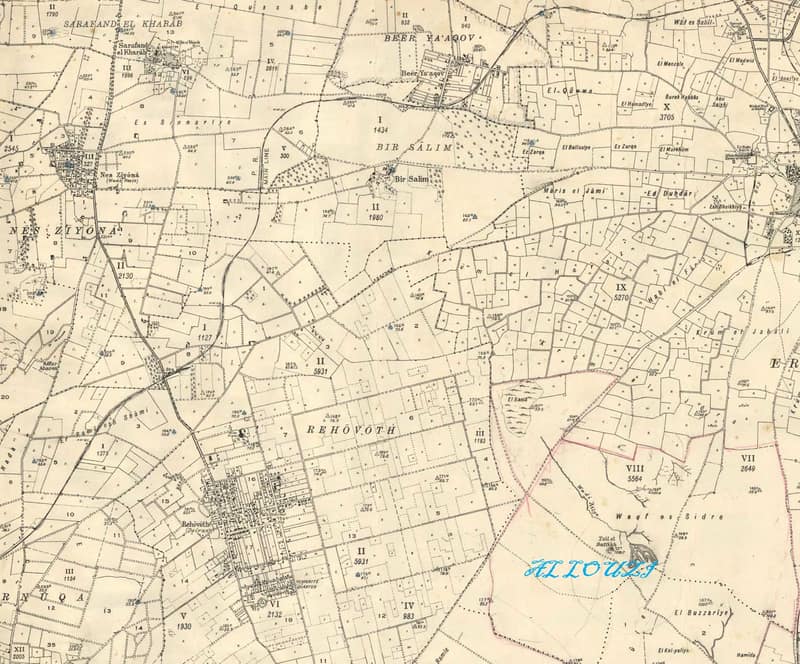
Al-Sarafand stood on a flat spot in the middle of the coastal plain, linked by a spur road to the highways between Ramla and Jaffa. It was also called Sarafand al-Sughra — the smaller Sarafand — to distinguish it from its larger sister village five kilometers to the northeast, and it had Crusader-era vaults among its houses. The name Sarafand al-Kharab, ‘Sarafand of the ruins,’ may date from the early nineteenth century: Edward Robinson, passing in 1838, reported two villages named Sarafand, one inhabited and one ruined, and the ruined one was repopulated only in the late nineteenth century. It was ruined once more in the late 1920s, when British forces burned the village in retaliation for the killing of soldiers who had entered it drunk; many of its people were displaced for a time before the village recovered and was rebuilt, its houses of mud and straw or cement rising in attached rows. In 1945 it counted 1,040 people, among them 110 Christians. Its school, built by the villagers in 1920, had 258 pupils in the mid-1940s and drew students from Wadi Hunayn, Bir Salim, and al-Nabi Rubin; a girls’ school opened in 1945. Artesian wells made its orchards rich: citrus was the principal crop, with 3,148 dunums of citrus and bananas in 1944/45.
The villagers left before the soldiers came. Benny Morris records that the people of Sarafand al-Kharab, fearing a Jewish attack, fled on 20 April 1948 — days after a New York Times report of twelve houses blown up on the outskirts of Ramla and two neighboring villages, one of which may have been this one, and in the frightened weeks after the Deir Yassin massacre of 9 April and the Giv’ati Brigade’s Operation Nachshon. The empty village may not have come under Israeli occupation until mid-May, around the time its sister village of Sarafand al-Amar and neighboring Bir Salim were taken.
The town of Nes Tziyyona, founded in 1882, has grown so that many of its buildings now stand on village land; the settlement of Yad Eli’ezer, established in the early 1950s, is also on it. Much of the village itself survived: many houses remain, no more than six of them occupied by Israeli families; the school is used by Israeli students; a pond and pump house stand undamaged in a former orchard; and the cemetery lies overgrown with cactus. The surrounding lands are cultivated.
Sources
Cited works
3- palestineremembered.com — index(opens in a new tab)https://www.palestineremembered.com/al-Ramla/Sarafand-al-Kharab/index.html
- zochrot.org — en(opens in a new tab)https://www.zochrot.org/villages/village_details/49366/en
- palquest.org — sarafand al kharab(opens in a new tab)https://www.palquest.org/en/place/17139/sarafand-al-kharab
Connected in the archive
26 connected records26 records elsewhere in the archive are linked to this one, each by a piece of evidence you can read below.
named in this record — 5 records
One record names the other. A pointer for reading, not a claim that they belong to each other.
- Deir Yassinدير ياسين
Evidence — Inferred from the text — read the evidence: Benny Morris records that the people of Sarafand al-Kharab, fearing a Jewish attack, fled on 20 April 1948 — days after a New York Times report of twelve houses blown up on the outskirts of Ramla and two neighboring villages, one of which may have been this one, and in the frightened weeks after the Deir Yassin massacre of 9 April and the Giv'ati Brigade's Operation Nachshon.
- Ramleالرملة
Evidence — Inferred from the text — read the evidence: Benny Morris records that the people of Sarafand al-Kharab, fearing a Jewish attack, fled on 20 April 1948 — days after a New York Times report of twelve houses blown up on the outskirts of Ramla and two neighboring villages, one of which may have been this one, and in the frightened weeks after the Deir Yassin massacre of 9 April and the Giv'ati Brigade's Operation Nachshon.
- Sarafand al-'Amarصَرَفَنْد العَمار
Evidence — Inferred from the text — read the evidence: The empty village may not have come under Israeli occupation until mid-May, around the time its sister village of Sarafand al-Amar and neighboring Bir Salim were taken.
- Wadi Hunaynوادِي حُنَيْن
Evidence — Inferred from the text — read the evidence: Its school, built by the villagers in 1920, had 258 pupils in the mid-1940s and drew students from Wadi Hunayn, Bir Salim, and al-Nabi Rubin; a girls' school opened in 1945.
- Bir Salimبئر سالمmapped, not yet written up
Evidence — Inferred from the text — read the evidence: Its school, built by the villagers in 1920, had 258 pupils in the mid-1940s and drew students from Wadi Hunayn, Bir Salim, and al-Nabi Rubin; a girls' school opened in 1945.
in the same district — 21 records
Filed near each other — the same Mandate district, or the same uncommon subject tags.
- Abu Shushaأبو شوشة
Evidence — From a recorded field in this archive: Both recorded in the Ramla district.
- Al-Magharالمَغار
Evidence — From a recorded field in this archive: Both recorded in the Ramla district.
- Al-Muzayri'aالمُزَيْرِعَة
Evidence — From a recorded field in this archive: Both recorded in the Ramla district.
- Al-Na'aniالنَعاني
Evidence — From a recorded field in this archive: Both recorded in the Ramla district.
- Al-Nabi Rubinالنبي رُوبِين
Evidence — From a recorded field in this archive: Both recorded in the Ramla district.
- Al-Qubabالقُباب
Evidence — From a recorded field in this archive: Both recorded in the Ramla district.
- and 15 more
Cite this page
Every claim above carries its sources — citation is the point.
- Chicago
“Al-Sarafand.” Village Memory, FALASTEEN.AI. Accessed 22 August 2026. https://falasteen.ai/memory/al-sarafand.- MLA
“Al-Sarafand.” Village Memory, FALASTEEN.AI, 2026, https://falasteen.ai/memory/al-sarafand. Accessed 22 August 2026.- BibTeX
@misc{falasteen-al-sarafand,
  title        = {Al-Sarafand},
  howpublished = {\url{https://falasteen.ai/memory/al-sarafand}},
  organization = {FALASTEEN.AI — A Living Archive for Palestine},
  year         = {2026},
  note         = {Accessed 2026-08-22}
}