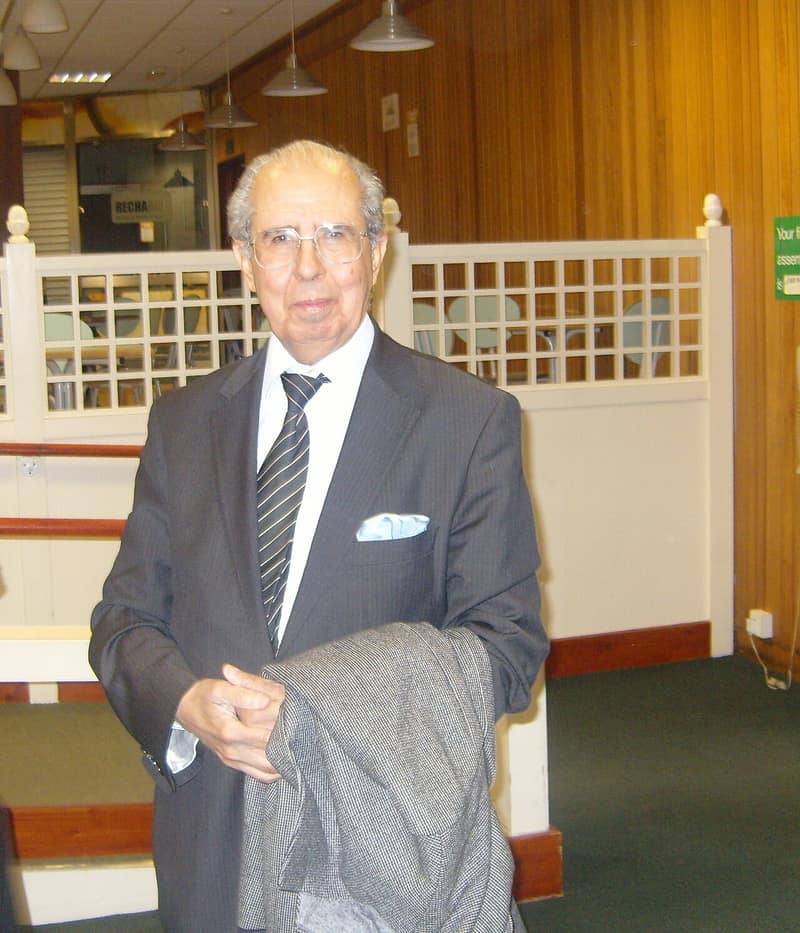
Salman Abu Sitta
سلمان أبو ستة
Engineer and cartographer of the Nakba
Civil engineer turned mapmaker, who spent decades reconstructing the villages, land holdings, and place names of pre-1948 Palestine into an atlas and a register of the depopulated.
Salman Abu Sitta was born in 1937 at Ma’in Abu Sitta, in the Beersheba district of Mandatory Palestine, and was a child when his family was driven out in 1948. He trained as an engineer — a degree from Cairo University’s Faculty of Engineering in 1958, then a doctorate in civil engineering from University College London — and practised for years before turning that training on the question of his own displacement.
The instruments of his work are maps. Abu Sitta founded the Palestine Land Society in London, a body devoted to documenting the land and people of Palestine, and out of it produced two reference works that changed how the Nakba can be argued about. The Palestinian Nakba 1948: The Register of Depopulated Localities in Palestine appeared in 1998, the fiftieth anniversary year, listing the destroyed and emptied places one by one. The Atlas of Palestine 1917–1966, published by the society in December 2010, assembles Mandate survey sheets, land registers, and village data into a cartographic record of the country as it was administered before and after its partition.
The argument the maps carry is a practical one. Against the claim that return is a fantasy because the country has been rebuilt over, Abu Sitta’s mapping sets out what was where — whose land, in what parcel, under what registered title — and asks what present use has been made of it. His public debates with Israeli figures including Uri Avnery, who called him perhaps the world’s foremost expert on the Nakba, turned on exactly that question. His memoir Mapping My Return: A Palestinian Memoir was published in 2016 by the American University in Cairo Press.
Selected works
- The Palestinian Nakba 1948: The Register of Depopulated Localities in Palestine (1998)
- Atlas of Palestine 1917–1966 (Palestine Land Society, 2010)
- Mapping My Return: A Palestinian Memoir (2016)
Sources
Further reading
An external biography or archive holding more on this life than the entry above.
Connected in the archive
11 connected records11 records elsewhere in the archive are linked to this one, each by a piece of evidence you can read below.
names this person — 2 records
One record names the other. A pointer for reading, not a claim that they belong to each other.
- Bayt Timaبَيْت طِيما
Evidence — Inferred from the text — read the evidence: The census of 1931 counted 762 people in 157 houses; the 1944/45 survey counted 1,060. Zochrot cites the Palestinian scholar Salman Abu Sitta's estimate of 1,230 people in the village in 1948.
- Salman Abu Sitta
Evidence — Inferred from the text — read the evidence: Salman Abu Sitta was ten years old in 1948, when his family was driven from Ma'in, in the Beersheba district of southern Palestine, beginning a refugee journey that took him through Gaza, Egypt, Kuwait, Iraq, Yemen, Canada and Britain.
named in this record — 1 record
One record names the other. A pointer for reading, not a claim that they belong to each other.
- Mapping My Return: A Palestinian Memoir
Evidence — Inferred from the text — read the evidence: His memoir Mapping My Return: A Palestinian Memoir was published in 2016 by the American University in Cairo Press.
on a related subject — 8 records
Filed near each other — the same Mandate district, or the same uncommon subject tags.
- Nakba Day
Evidence — From a recorded field in this archive: Shared tags: "Nakba", "right of return".
- Adel Mannaعادل مناع
Evidence — Inferred from the text — read the evidence: Shared tag: "Nakba".
- Aref al-Arefعارف العارف
Evidence — Inferred from the text — read the evidence: Shared tag: "Nakba".
- Emily Jacirإميلي جاسر
Evidence — Inferred from the text — read the evidence: Shared tag: "archive".
- Keys of Return
Evidence — Inferred from the text — read the evidence: Shared tag: "right of return".
- Nakba and Survival: The Story of Palestinians Who Remained in Haifa and the Galilee, 1948–1956
Evidence — Inferred from the text — read the evidence: Shared tag: "Nakba".
- and 2 more
Cite this page
Every claim above carries its sources — citation is the point.
- Chicago
“Salman Abu Sitta.” Figures, FALASTEEN.AI. Accessed 22 August 2026. https://falasteen.ai/figures/salman-abu-sitta.- MLA
“Salman Abu Sitta.” Figures, FALASTEEN.AI, 2026, https://falasteen.ai/figures/salman-abu-sitta. Accessed 22 August 2026.- BibTeX
@misc{falasteen-salman-abu-sitta,
  title        = {Salman Abu Sitta},
  howpublished = {\url{https://falasteen.ai/figures/salman-abu-sitta}},
  organization = {FALASTEEN.AI — A Living Archive for Palestine},
  year         = {2026},
  note         = {Accessed 2026-08-22}
}