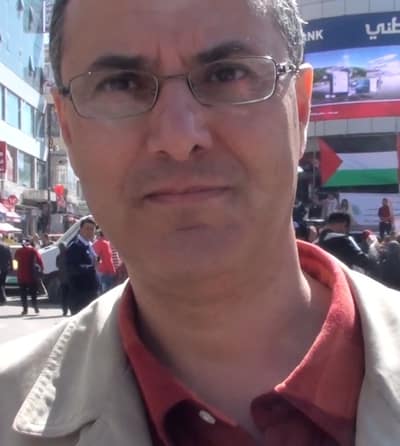
Omar Barghouti
عمر البرغوثي
Co-founder of the Boycott, Divestment and Sanctions movement
The human rights defender who co-founded the BDS movement in 2005 after a year of consultations across Palestinian society, and has lived under an Israeli travel ban and judicial harassment for leading its nonviolent campaign ever since.
“BDS was inspired by a century of Palestinian popular resistance initially against British colonialism, and then Zionist settler colonialism in Palestine,” Omar Barghouti said in July 2025, marking the movement’s twentieth anniversary. “So we’ve learned the tactics of BDS mainly from our own people’s struggle, but it’s also inspired by many liberation movements, especially the South African anti-apartheid movement, and of course justice movements like the civil rights movement in the United States.”
Barghouti is a founding committee member of the Palestinian Campaign for the Academic and Cultural Boycott of Israel (PACBI) and a co-founder of the Boycott, Divestment and Sanctions movement, launched on 9 July 2005 when Palestinian civil society groups — trade unions, coalitions of political parties, women’s unions, students, academics, professional unions and grassroots movements — signed the BDS call that he and others had drafted after nearly a year of consultations spanning the occupied territories, the Palestinians of 1948, and the refugee camps and exile communities. The call rests on three demands, which he describes as the minimum for the exercise of self-determination: an end to the military occupation, an end to the system of racial domination and apartheid, and the right of refugees to return and receive reparations. The movement is led by the BDS National Committee, the broadest coalition in Palestinian society; its stated principles oppose all forms of racism, including anti-Jewish racism, and its method is nonviolent pressure — social, economic and political — to end complicity in violations of international law. “The first very profound obligation if you want to do real solidarity,” he argues, “is to do no harm and to stop, cut back, or offset… the harm done in your name.”
The response of the Israeli state is a documented part of his record. Front Line Defenders, the international foundation for the protection of human rights defenders, lists him as a defender at risk whose case history includes a travel ban imposed in 2016 — against which he won only a temporary injunction that May — along with arrest, detention and judicial harassment, in a period it describes as one of deteriorating space for human rights work in Israel and the occupied territories: administrative detention of defenders, travel bans, and legislation restricting civil society. He has continued through it to make the movement’s argument in universities, courts and the press: that states, corporations and institutions that sustain the occupation are parties to it, and that ending that complicity is the shortest nonviolent road to Palestinian freedom.
Sources
Further reading
An external biography or archive holding more on this life than the entry above.
Connected in the archive
11 connected records11 records elsewhere in the archive are linked to this one, each by a piece of evidence you can read below.
names this person — 1 record
One record names the other. A pointer for reading, not a claim that they belong to each other.
- Palestine: A Socialist Introduction
Evidence — Inferred from the text — read the evidence: Contributors include Omar Barghouti, Nada Elia, Toufic Haddad, Remi Kanazi, Jehad Abusalim, and Khury Petersen-Smith.
on a related subject — 10 records
Filed near each other — the same Mandate district, or the same uncommon subject tags.
- The Palestinian Civil Society Call for BDS
Evidence — From a recorded field in this archive: Shared tags: "BDS", "boycott", "right of return".
- Angela Davis: Freedom Is a Constant Struggle — From Ferguson to Palestine
Evidence — Inferred from the text — read the evidence: Shared tag: "BDS".
- BADIL Resource Center for Palestinian Residency and Refugee Rights
Evidence — Inferred from the text — read the evidence: Shared tag: "right of return".
- Eyad al-Sarrajإياد السراج
Evidence — Inferred from the text — read the evidence: Shared tag: "nonviolence".
- Keys of Return
Evidence — Inferred from the text — read the evidence: Shared tag: "right of return".
- Mapping My Return: A Palestinian Memoir
Evidence — Inferred from the text — read the evidence: Shared tag: "right of return".
- and 4 more
Cite this page
Every claim above carries its sources — citation is the point.
- Chicago
“Omar Barghouti.” Figures, FALASTEEN.AI. Accessed 22 August 2026. https://falasteen.ai/figures/omar-barghouti.- MLA
“Omar Barghouti.” Figures, FALASTEEN.AI, 2026, https://falasteen.ai/figures/omar-barghouti. Accessed 22 August 2026.- BibTeX
@misc{falasteen-omar-barghouti,
  title        = {Omar Barghouti},
  howpublished = {\url{https://falasteen.ai/figures/omar-barghouti}},
  organization = {FALASTEEN.AI — A Living Archive for Palestine},
  year         = {2026},
  note         = {Accessed 2026-08-22}
}