Jenin district · depopulated 1948 · 2 min read
Zir'in
زرعين
Zir'in stood on a spur above Marj Ibn Amir, on the site of biblical Jezreel and beside the spring of Ayn Jalut where Baybars turned back the Mongols in 1260. Its 1,420 people held 23,920 dunums in 1944/45. The Fourth Battalion of the Golani Brigade took the village on 28 May 1948; the kibbutz of Yizre'el was founded on its northwestern side the same year.
See Zir'in on the Atlas32.5575°N · 35.3278°E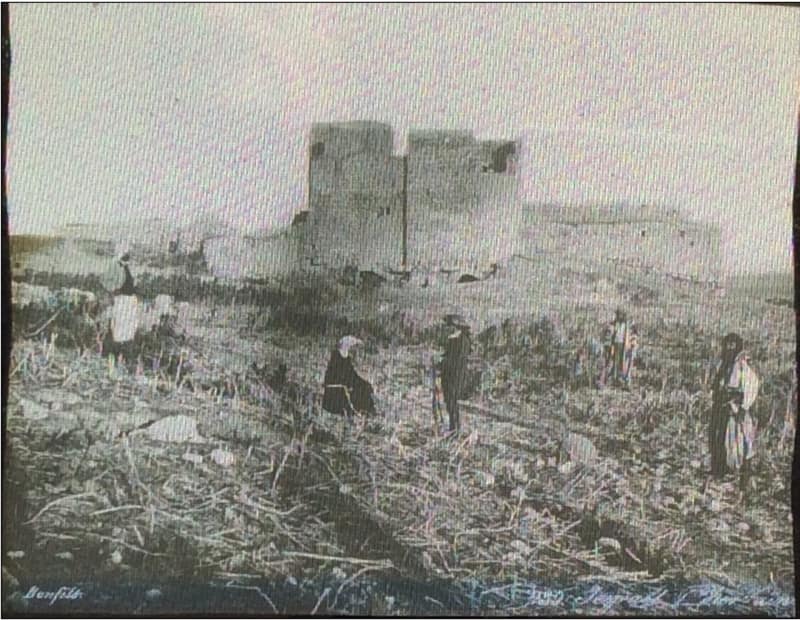
Zir’in stood on a small plateau, a spur running down from the Faqqu’a mountains, and looked out over the Marj Ibn Amir plain to the west and south while its northern and eastern slopes fell away towards Wadi al-Jalud. It was the northernmost village of the Jenin subdistrict and sat on a road linking the highways to Jenin and to Baysan. The site is identified with the Canaanite and Israelite town of Yizre’el — Jezreel — and the Arabic and Hebrew names share a root meaning to sow. The Crusaders called it Le Petit Gerin to distinguish it from Jenin, Le Grand Gerin. Midway between Zir’in and the neighbouring village of Nuris lay the spring of Ayn Jalut, where in 1260 the Mamluk commander al-Zahir Baybars defeated the Mongols.
Most of the village houses were of mud, closely built and separated by narrow alleys, with a tall, almost tower-like house belonging to the leading family standing at the centre. A mosque said to have been restored by Baybars, a small market and a school founded under the Ottomans stood in the middle of the village. All the inhabitants were Muslims; in 1944/45 they numbered 1,420 and held 23,920 dunums, of which 20,964 were sown in cereals. Zir’in was the home village of Mahmud Salim, a leader of the 1936 revolt.
In March 1948 the Arab Liberation Army reported that Jewish forces had been attempting since the seventeenth of the month to eliminate Zir’in and Nuris; the attacks were broken off around 19 March after heavy Haganah losses. On 19 April Palmach headquarters issued an order, quoted by Benny Morris, that on the capture of Zir’in most of the village houses were to be destroyed while some were to be left standing for billeting and defence. The village was taken on 28 May 1948 by the Fourth Battalion of the Golani Brigade, in the wake of the occupation of the Baysan valley and as a prelude to the attack on Jenin. Women and children had left weeks earlier, and the attackers met little resistance. Arab forces counter-attacked two days later without success, and Iraqi attempts to retake the village on 10 and 19 July also failed; the armistice line was eventually drawn to the south of the site.
The kibbutz of Yizre’el was established on the northwestern side of the village in 1948, and Avital, Yael and parts of Prazon and Meitav stand on lands that belonged to it. One dilapidated building survives, together with an old well and an Israeli memorial ringed by trees; the site is otherwise grass, thorns and cactus interspersed with heaps of stone, grazed and farmed from the surrounding settlements. Medieval vaults known locally as el-Uqud remain in the vicinity. Refugees from Zir’in and their descendants were counted at 10,116 in 1998.
Sources
Cited works
3- palquest.org — zirin(opens in a new tab)https://www.palquest.org/en/place/17189/zirin
- zochrot.org — en(opens in a new tab)https://www.zochrot.org/villages/village_details/49147/en
- en.wikipedia.org — Zir'in(opens in a new tab)https://en.wikipedia.org/wiki/Zir%27in
Connected in the archive
3 connected records3 records elsewhere in the archive are linked to this one, each by a piece of evidence you can read below.
named in this record — 2 records
One record names the other. A pointer for reading, not a claim that they belong to each other.
- Jeninجنين
Evidence — Inferred from the text — read the evidence: It was the northernmost village of the Jenin subdistrict and sat on a road linking the highways to Jenin and to Baysan.
- Nurisنورسmapped, not yet written up
Evidence — Inferred from the text — read the evidence: Midway between Zir'in and the neighbouring village of Nuris lay the spring of Ayn Jalut, where in 1260 the Mamluk commander al-Zahir Baybars defeated the Mongols.
in the same district — 1 record
Filed near each other — the same Mandate district, or the same uncommon subject tags.
- Al-Lajjunاللجّون
Evidence — From a recorded field in this archive: Both recorded in the Jenin district.
Cite this page
Every claim above carries its sources — citation is the point.
- Chicago
“Zir'in.” Village Memory, FALASTEEN.AI. Accessed 22 August 2026. https://falasteen.ai/memory/zirin.- MLA
“Zir'in.” Village Memory, FALASTEEN.AI, 2026, https://falasteen.ai/memory/zirin. Accessed 22 August 2026.- BibTeX
@misc{falasteen-zirin,
  title        = {Zir'in},
  howpublished = {\url{https://falasteen.ai/memory/zirin}},
  organization = {FALASTEEN.AI — A Living Archive for Palestine},
  year         = {2026},
  note         = {Accessed 2026-08-22}
}