Jaffa district · depopulated 1948 · 2 min read
Yazur
يازور
Yazur — the Azuru of Sennacherib's annals and the birthplace of a Fatimid vizier — was bombed and raided for months from December 1947 before falling at the end of April 1948, as Operation Hametz encircled Jaffa. Two shrines and scattered houses still stand among the apartment blocks of Azor and Holon.
See Yazur on the Atlas32.0289°N · 34.7994°E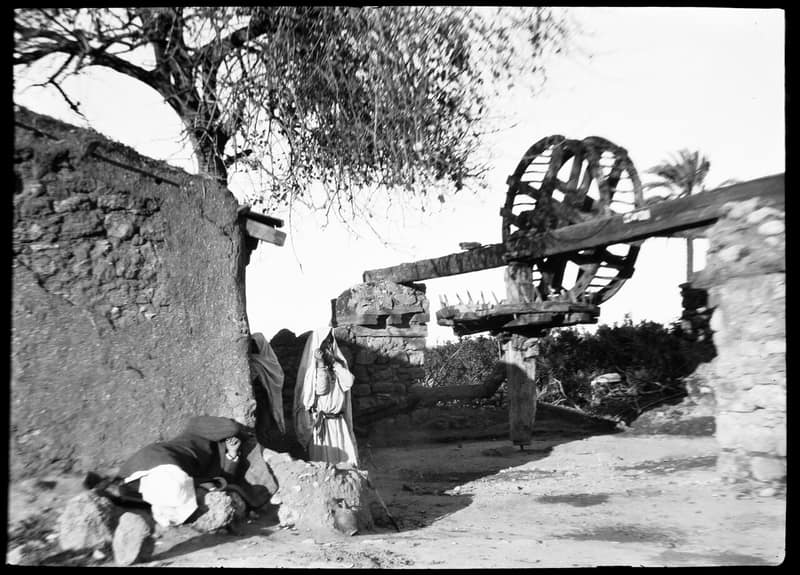
Yazur stood on flat terrain on the central coastal plain, astride the Jaffa–al-Ramla highway and the Jaffa–Lydda railway. The site is among the oldest continually named places of the plain: its Chalcolithic cave burials are famous, Sennacherib’s annals record it as Azuru, and it appears in the Septuagint as Azor. The geographer Yaqut called it a small town, the birthplace of al-Hasan ibn Ali al-Yazuri, the Fatimid minister of the eleventh century. In 1596 Yazur was a village in the nahiya of Ramla with 275 people. Sufi travelers visited the shrine of the sage Sayyiduna Haydara. The modern village was divided into four quarters, one for each clan, its houses of stone and adobe grouped around shared courtyards entered through arched gates. On a hill inside the village stood the remnants of Casel des Plains, the castle Richard the Lionheart built in 1191; the Crusader church had been rebuilt to serve as Yazur’s mosque, which with a coffeehouse and the marketplace formed the village center. Two elementary schools — for boys (1920) and girls (1933) — registered 430 boys and 160 girls in 1947. Citrus was king: 6,272 dunums of it in 1944, watered by artesian wells, and by 1947 the villagers were even raising Holstein cows. The 1945 survey counted 4,030 people, of whom twenty were Christians.
Few villages were punished so long before they fell. Palmach units began hit-and-run attacks on Yazur in January and February 1948, according to Benny Morris; other sources record raids from December 1947 — a pick-up truck bombing the coffeehouse on 11 December, and on 18 December, according to the historian Arif al-Arif, troops disguised as British soldiers who bombed the same coffeehouse and killed six villagers. Through the winter the blows continued: houses mined on 30 December, raids on 8 and 30 January, a mortar and machine-gun attack on 12 February that also struck the Jaffa suburb of Abu Kabir, and a dawn assault on 20 February with tanks and armored vehicles that destroyed an ice factory. The end came with Operation Hametz, the offensive to isolate Jaffa: more than one account dates the fall of Yazur to 30 April 1948, while Morris gives 1 May; an Arab Liberation Army unit sent to shell Tel Aviv and relieve the pressure had withdrawn two days earlier.
Miqwe Israel had stood on traditional village lands since 1870; the settlement of Azor was established on the village lands in 1948 and is now part of an industrial region linked to Tel Aviv, abutted by the suburbs of Holon. Of Yazur itself, two shrines remain standing — one of stone, its roof topped by a dozen domes clustered around a larger central dome — along with a number of intact houses, some inhabited, others converted to shops, amid the modern apartment blocks of the site.
Sources
Cited works
3- palestineremembered.com — index(opens in a new tab)https://www.palestineremembered.com/Jaffa/Yazur/index.html
- zochrot.org — en(opens in a new tab)https://www.zochrot.org/villages/village_details/49209/en
- palquest.org — yazur(opens in a new tab)https://www.palquest.org/en/place/17180/yazur
Connected in the archive
13 connected records13 records elsewhere in the archive are linked to this one, each by a piece of evidence you can read below.
named in this record — 1 record
One record names the other. A pointer for reading, not a claim that they belong to each other.
- Ramleالرملة
Evidence — Inferred from the text — read the evidence: In 1596 Yazur was a village in the nahiya of Ramla with 275 people.
in the same district — 12 records
Filed near each other — the same Mandate district, or the same uncommon subject tags.
- Abu Kishkأبو كِشْك
Evidence — From a recorded field in this archive: Both recorded in the Jaffa district.
- Al-'Abbasiyyaالعَبّاسِيَّة
Evidence — From a recorded field in this archive: Both recorded in the Jaffa district.
- al-Jammasin al-Gharbiالجَمّاسِين الغربي
Evidence — From a recorded field in this archive: Both recorded in the Jaffa district.
- al-Jammasin al-Sharqiالجَمّاسِين الشرقي
Evidence — From a recorded field in this archive: Both recorded in the Jaffa district.
- Al-Khayriyyaالخيرية
Evidence — From a recorded field in this archive: Both recorded in the Jaffa district.
- Al-Manshiyyaالمنشية
Evidence — From a recorded field in this archive: Both recorded in the Jaffa district.
- and 6 more
Cite this page
Every claim above carries its sources — citation is the point.
- Chicago
“Yazur.” Village Memory, FALASTEEN.AI. Accessed 22 August 2026. https://falasteen.ai/memory/yazur.- MLA
“Yazur.” Village Memory, FALASTEEN.AI, 2026, https://falasteen.ai/memory/yazur. Accessed 22 August 2026.- BibTeX
@misc{falasteen-yazur,
  title        = {Yazur},
  howpublished = {\url{https://falasteen.ai/memory/yazur}},
  organization = {FALASTEEN.AI — A Living Archive for Palestine},
  year         = {2026},
  note         = {Accessed 2026-08-22}
}