Beisan district · depopulated 1948 · 2 min read
Kawkab al-Hawa
كوكب الهوا
Kawkab al-Hawa was built inside the walls of the Crusader fortress of Belvoir, three hundred metres above the Jordan valley eleven kilometres north of Baysan. Its 300 people held 9,949 dunums in 1944/45. It was attacked on 16 May 1948, changed hands during the Iraqi advance, and was finally held by the Golani Brigade. The Arab village was erased; the castle was excavated and turned into a tourist site.
See Kawkab al-Hawa on the Atlas32.5951°N · 35.5200°E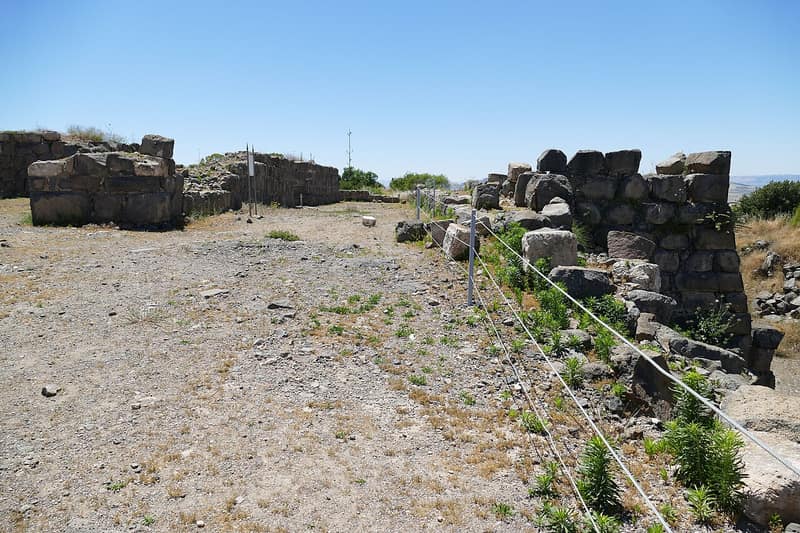
Kawkab al-Hawa — the star of the wind — sat on a hill that fell away sharply to the east, three hundred metres above sea level with land only a kilometre away lying a hundred metres below it. It commanded the Jordan river and, to the northeast, Lake Tiberias, and that position gave it its long history. A Roman signal tower may have stood on or near the site, and in the twelfth century the Crusaders raised there one of their strongest castles, Belvoir, overlooking the Jordan valley. Kawkab al-Hawa was fought over repeatedly between Salah al-Din’s armies and the Crusaders; Yaqut al-Hamawi, writing in the early thirteenth century, called it a castle on the hill near Tiberias and said it had fallen into ruin after Salah al-Din’s reign. In the Ottoman survey of 1596 it was a village of about fifty people in the nahiya of Shafa, paying tax on wheat, beans, melons and vineyards.
Because the village was built within the outline of the fortress, it grew slowly. Its inhabitants — about 110 in 1859 — lived inside the walls and cultivated some thirteen faddans outside them, and only in time did houses spread in a ring around the castle and extend north and west. Two springs, Ayn al-Hiluw and Ayn al-Jirani, lay to the south and southeast. The Muslim villagers farmed the land beyond the walls: in 1944/45, 5,839 of their 9,949 dunums were sown in cereals and 170 were irrigated or planted in orchards, and the population stood at 300.
Benny Morris dates the military assault on Kawkab al-Hawa to 16 May 1948, in the wake of the fall of Baysan. Other accounts extend the fighting. The History of the Haganah puts the occupation on 21 May and credits the Third Battalion of the Golani Brigade, describing the hilltop as ideal for artillery firing down into the valley — an advantage that became urgent when Iraqi forces entered the country on 15 May. The Palestinian historian Arif al-Arif records that Iraqi troops actually took and held the village from 15 to 17 May before withdrawing under intensified Israeli attack, and an Associated Press dispatch from Baghdad on 18 May described it as a formidable reinforced concrete position. In September 1948 a kibbutz leader in the area asked the authorities for permission to demolish the village along with three others nearby.
The village has been eliminated. There are no Israeli settlements on its lands, but the Belvoir castle within which it stood was excavated and turned into a tourist attraction, its Crusader buildings restored while the Arab structures around them were removed — a reversal the Israeli writer Meron Benvenisti singled out in his account of how the landscape was rewritten. Fig and olive trees grow over the village site; the slopes above the Baysan valley are grazed and the surrounding land farmed.
Sources
Cited works
3- palquest.org — kawkab al hawa(opens in a new tab)https://www.palquest.org/en/place/17041/kawkab-al-hawa
- zochrot.org — en(opens in a new tab)https://www.zochrot.org/villages/village_details/49217/en
- en.wikipedia.org — Kawkab al Hawa(opens in a new tab)https://en.wikipedia.org/wiki/Kawkab_al-Hawa
Connected in the archive
3 connected records3 records elsewhere in the archive are linked to this one, each by a piece of evidence you can read below.
named in this record — 1 record
One record names the other. A pointer for reading, not a claim that they belong to each other.
- Tiberiasطبريا
Evidence — Inferred from the text — read the evidence: Kawkab al-Hawa was fought over repeatedly between Salah al-Din's armies and the Crusaders; Yaqut al-Hamawi, writing in the early thirteenth century, called it a castle on the hill near Tiberias and said it had fallen into ruin after Salah al-Din's reign.
in the same district — 2 records
Filed near each other — the same Mandate district, or the same uncommon subject tags.
- Al-Ghazzawiyyaالغزاوية
Evidence — From a recorded field in this archive: Both recorded in the Beisan district.
- Sirinسيرين
Evidence — From a recorded field in this archive: Both recorded in the Beisan district.
Cite this page
Every claim above carries its sources — citation is the point.
- Chicago
“Kawkab al-Hawa.” Village Memory, FALASTEEN.AI. Accessed 22 August 2026. https://falasteen.ai/memory/kawkab-al-hawa.- MLA
“Kawkab al-Hawa.” Village Memory, FALASTEEN.AI, 2026, https://falasteen.ai/memory/kawkab-al-hawa. Accessed 22 August 2026.- BibTeX
@misc{falasteen-kawkab-al-hawa,
  title        = {Kawkab al-Hawa},
  howpublished = {\url{https://falasteen.ai/memory/kawkab-al-hawa}},
  organization = {FALASTEEN.AI — A Living Archive for Palestine},
  year         = {2026},
  note         = {Accessed 2026-08-22}
}