Gaza district · depopulated 1948 · 2 min read
Julis
جولس
Julis, set on a wadi bank beside a road junction and a British military camp on the Gaza coast highway, fell to the Giv'ati Brigade around the first truce of 1948 and then held against the Egyptian counterattack in which Gamal Abdel Nasser served as staff officer. A few cement houses remain beside the old camp.
See Julis on the Atlas31.6817°N · 34.6535°E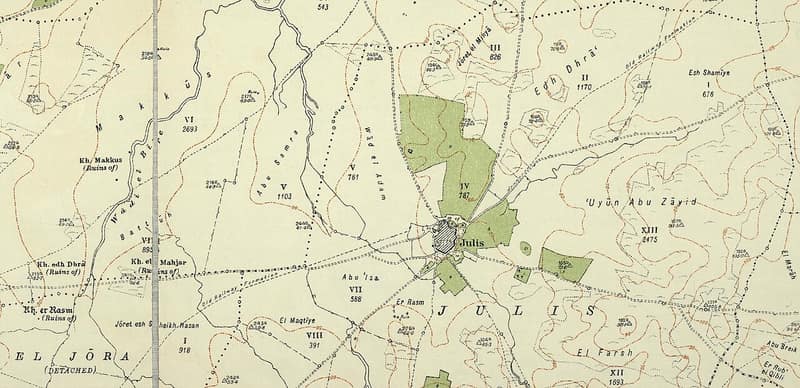
Julis stood on a slight elevation on the southern coastal plain, along the bank of a wadi, built over an archaeological site whose ancient name is unknown. In 1596 it was a village in the nahiya of Gaza with 204 people, taxed on wheat, barley, fruit, goats, beehives, and vineyards; in the late nineteenth century it was described as having adobe houses, a well to the south, and a pool with gardens to the northeast. During the Second World War the British built an inland highway through Julis, parallel to the coastal road, which met at the village the highway from al-Majdal to the Jerusalem–Jaffa road — a junction the British controlled from a military camp built beside the village. Julis was laid out in a square between the two highways; its people were Muslims, worshipping in a mosque and venerating a shrine for Shaykh Khayr, a figure local tradition held was killed fighting the Crusaders. A school opened in 1937 had eighty-six pupils in the mid-1940s. Water was abundant; grain, vegetables, and fruit filled its lands, with 10,803 dunums of cereals and 1,360 of citrus and bananas in 1944/45. The 1945 survey counted 1,030 people.
Its position made it a prize. On the night of 27–28 May 1948, the Giv’ati Brigade’s First Battalion seized the military barracks at Julis during Operation Barak but failed to take full control of the village; the village itself fell on 10–11 June, according to the History of the Haganah, as Giv’ati’s Third Battalion moved against individual villages just before the first truce. At the truce’s end in early July, Julis was one of the main positions the Egyptian army tried and failed to recapture: the Sixth Battalion — whose staff officer was Gamal Abdel Nasser — was ordered to retake it, and the attack was called off only after considerable loss of life. ‘We had no information about the enemy at Julis,’ Nasser wrote in his memoirs, arguing that even success would have left the Egyptians ‘at the mercy of the enemy’; his close colleague Isma’il Muhy al-Din was killed in the battle.
The settlement of Hodiyya was established on village lands in 1949, southwest of the site. Only a few houses remain — most of them cement, with flat roofs and rectangular openings; one is occupied by Jewish residents. Cactuses and sycamore and palm trees grow over the site, part of it planted with citrus; the British-built camp is used by the Israeli army, and the surrounding lands are cultivated.
Sources
Cited works
3- palestineremembered.com — index(opens in a new tab)https://www.palestineremembered.com/Gaza/Julis/index.html
- zochrot.org — en(opens in a new tab)https://www.zochrot.org/villages/village_details/49068/en
- palquest.org — julis(opens in a new tab)https://www.palquest.org/en/place/17029/julis
Connected in the archive
37 connected records37 records elsewhere in the archive are linked to this one, each by a piece of evidence you can read below.
gave testimony about this village — 2 records
- Dalal Nassar
Evidence — From a recorded field in this archive: village: "Julis" → Julis (Gaza)
- Mohammed Abdul Jabbar Abu Seif
Evidence — From a recorded field in this archive: village: "Julis" → Julis (Gaza)
names this place — 1 record
One record names the other. A pointer for reading, not a claim that they belong to each other.
- Ahmad al-Haj
Evidence — Inferred from the text — read the evidence: Returning from market one day in April, he was shot at by machine gunners as he passed through Julis, which Zionist forces had just taken; weeks later his village itself was attacked and burned, and his father was captured and held in prison for months.
in the same district — 34 records
Filed near each other — the same Mandate district, or the same uncommon subject tags.
- 'Iraq al-Manshiyyaعِراق المَنْشِيَّة
Evidence — From a recorded field in this archive: Both recorded in the Gaza district.
- Al-Falujaالفالوجة
Evidence — From a recorded field in this archive: Both recorded in the Gaza district.
- Al-Jiyyaالجِيَّة
Evidence — From a recorded field in this archive: Both recorded in the Gaza district.
- Al-Juraالجُورَة
Evidence — From a recorded field in this archive: Both recorded in the Gaza district.
- Al-Majdalالمجدل
Evidence — From a recorded field in this archive: Both recorded in the Gaza district.
- Al-Masmiyya al-Kabiraالمَسْمِيَّة الكَبِيرَة
Evidence — From a recorded field in this archive: Both recorded in the Gaza district.
- and 28 more
Cite this page
Every claim above carries its sources — citation is the point.
- Chicago
“Julis.” Village Memory, FALASTEEN.AI. Accessed 22 August 2026. https://falasteen.ai/memory/julis.- MLA
“Julis.” Village Memory, FALASTEEN.AI, 2026, https://falasteen.ai/memory/julis. Accessed 22 August 2026.- BibTeX
@misc{falasteen-julis,
  title        = {Julis},
  howpublished = {\url{https://falasteen.ai/memory/julis}},
  organization = {FALASTEEN.AI — A Living Archive for Palestine},
  year         = {2026},
  note         = {Accessed 2026-08-22}
}