Rafah
رفح
Rafah is ancient Raphia, the border town where armies have met since the pharaohs; 1948 filled it with refugees, 1956 left it a massacre to mourn, and the 2024 assault on the city — then sheltering over a million displaced people — was ordered halted by the International Court of Justice.
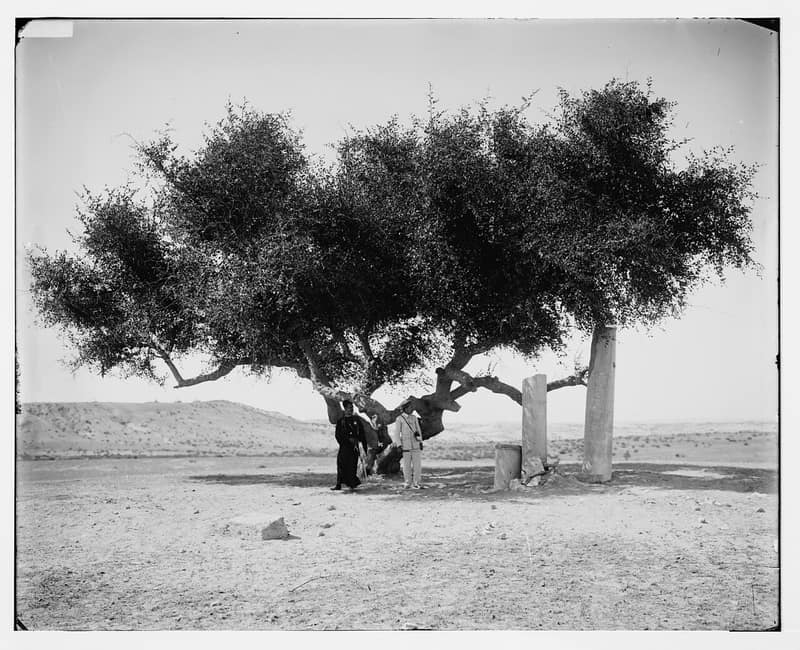
Few towns in Palestine can read their own name in records so old. Rafah is Raphia, the frontier town on the road between Egypt and Canaan: Egyptian and Assyrian inscriptions place armies here, and in 217 BCE the plain outside the town saw the Battle of Raphia between Ptolemy IV and Antiochus III, one of the largest battles of the Hellenistic age. On the Egypt road, Rafah remained what geography made it — the last town of Palestine before the Sinai, a border post under the Ottomans, and in 1906 the point where the administrative line between Egypt and Ottoman Palestine was drawn. In the First World War British and dominion forces took it in January 1917 on their way into Palestine, and under the Mandate it was a modest market town of the Gaza district.
The war of 1948 remade it. Egyptian forces held the Gaza Strip, and refugees from the towns and villages of southern Palestine poured across the frontier; a refugee camp rose beside the town in 1949 and grew, by UNRWA’s count, into one of the largest in the Strip. In the Suez Crisis of 1956 Israel occupied Gaza, and on 12 November 1956, days after the killings at Khan Younis, Israeli forces killed scores of Palestinian men in Rafah during a sweep of the town. The exact toll is contested — UNRWA’s records speak of over a hundred — and the day entered Palestinian memory as the Rafah massacre. Israel withdrew in March 1957.
Occupied again in 1967, Rafah was divided by peace: the 1979 Egyptian-Israeli treaty fixed the border through the town, and families found themselves split between Egyptian Rafah and the Gaza Strip, the frontier hardening over the years into fences, buffer zones and, along the Philadelphi corridor, a warren of smuggling tunnels. Through two intifadas the border neighborhoods were repeatedly demolished; through the closures, the Rafah crossing remained Gaza’s only gate to the world that did not pass through Israel.
In the war that began in October 2023, Rafah became the last refuge of the Gaza Strip: by early 2024 well over a million displaced Palestinians — more than half the territory’s people — were sheltering in and around the city, most of them in tents. In May 2024 Israeli forces launched their long-threatened ground offensive, seizing the Rafah crossing and the Philadelphi corridor despite international warnings; on 24 May the International Court of Justice ordered Israel to halt the offensive, an order it did not obey. The assault emptied the city and, by the assessments of the United Nations, left most of it damaged or destroyed. Raphia has stood at this crossroads for three thousand years. Its people remain — displaced in their own country, at the border that made them.
Sources
Cited works
3- palestineremembered.com — index(opens in a new tab)https://www.palestineremembered.com/GeoPoints/Rafah_1500/index.html
- unrwa.org — rafah camp(opens in a new tab)https://www.unrwa.org/where-we-work/gaza-strip/rafah-camp
- ohchr.org — israels rafah invasion must stop now say un experts(opens in a new tab)https://www.ohchr.org/en/press-releases/2024/05/israels-rafah-invasion-must-stop-now-say-un-experts
Cite this page
Every claim above carries its sources — citation is the point.
- Chicago
“Rafah.” Places, FALASTEEN.AI. Accessed 22 August 2026. https://falasteen.ai/places/rafah.- MLA
“Rafah.” Places, FALASTEEN.AI, 2026, https://falasteen.ai/places/rafah. Accessed 22 August 2026.- BibTeX
@misc{falasteen-rafah,
  title        = {Rafah},
  howpublished = {\url{https://falasteen.ai/places/rafah}},
  organization = {FALASTEEN.AI — A Living Archive for Palestine},
  year         = {2026},
  note         = {Accessed 2026-08-22}
}