Jabalia
جباليا
Jabalia, the market town on the rise northeast of Gaza City, became after 1948 the site of the largest refugee camp in the Strip; the first intifada began in its alleys in December 1987, and the war since 2023 has returned to it again and again.
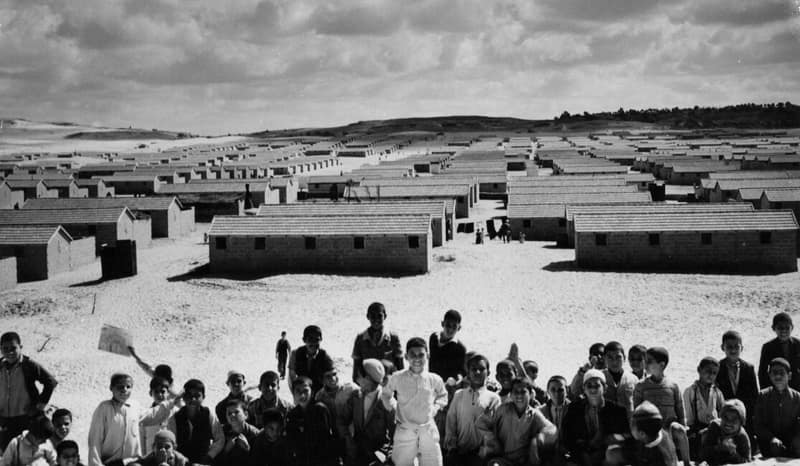
The town takes its name from the ground it stands on — jabal, the mountain, though the rise northeast of Gaza City is a modest one, a sandstone ridge above the coastal plain. Under the Ottomans and the Mandate, Jabalia was a village of the Gaza district, its people farming citrus and cereals on the plain between Gaza City and the northern border; by the 1940s it was still a place of a few thousand souls, known chiefly for its weekly market.
The war of 1948 remade it beyond recognition. Refugees from the villages of the Gaza district and the southern coastal plain — from Majdal, Isdud, Hamama and dozens of smaller places — were gathered onto the ridge, and the tent lines that rose there in 1948 hardened over the years into the largest refugee camp in the Gaza Strip: by UNRWA’s count, well over one hundred thousand registered refugees in about a square kilometre and a half, among the most crowded places on earth. Town and camp grew together until no line divided them, and Jabalia — original villagers and refugees alike — became a city of the Strip’s northern edge.
In December 1987 Jabalia gave its name to a turning of history. After an Israeli army vehicle killed four Palestinian workers from the camp at the Erez crossing, demonstrations broke out in Jabalia’s alleys and spread within days across Gaza and the West Bank: the first intifada had begun, and the camp remained one of its fiercest centers through six years of uprising, raids and curfews.
In the war that began in October 2023, Jabalia was among the first places struck and among the first invaded; its camp was bombed repeatedly, with single strikes killing scores at a time. Israeli forces returned to it in May 2024 and again in October 2024 in a siege of the whole north that the United Nations said had cut the area off almost completely; satellite assessments found most of the camp’s buildings damaged or destroyed. Three times in living memory Jabalia has been made a byword — for refuge, for uprising, for ruin. Its people bury their dead and remain.
Sources
Cited works
2- palestineremembered.com — index(opens in a new tab)https://www.palestineremembered.com/GeoPoints/Jabaliya_1203/index.html
- unrwa.org — jabalia camp(opens in a new tab)https://www.unrwa.org/where-we-work/gaza-strip/jabalia-camp
Cite this page
Every claim above carries its sources — citation is the point.
- Chicago
“Jabalia.” Places, FALASTEEN.AI. Accessed 22 August 2026. https://falasteen.ai/places/jabalia.- MLA
“Jabalia.” Places, FALASTEEN.AI, 2026, https://falasteen.ai/places/jabalia. Accessed 22 August 2026.- BibTeX
@misc{falasteen-jabalia,
  title        = {Jabalia},
  howpublished = {\url{https://falasteen.ai/places/jabalia}},
  organization = {FALASTEEN.AI — A Living Archive for Palestine},
  year         = {2026},
  note         = {Accessed 2026-08-22}
}